Lesson 1
What Does Quantitative Research Actually Do?
Begin with a vague market intuition and see how quantitative research clarifies a question and inspects evidence consistently and reproducibly.
Hoppy had given up applying to join the “quant camp.”
He knew that quantitative research could study value, growth, trends, reversals, and many other routes. But that immediately raised a new question: Once quant walks through one of those doors, what does it actually do?
Hoppy decided to stop wondering.
He opened Codex and pasted in the sentence he had written at the end of the previous lesson:
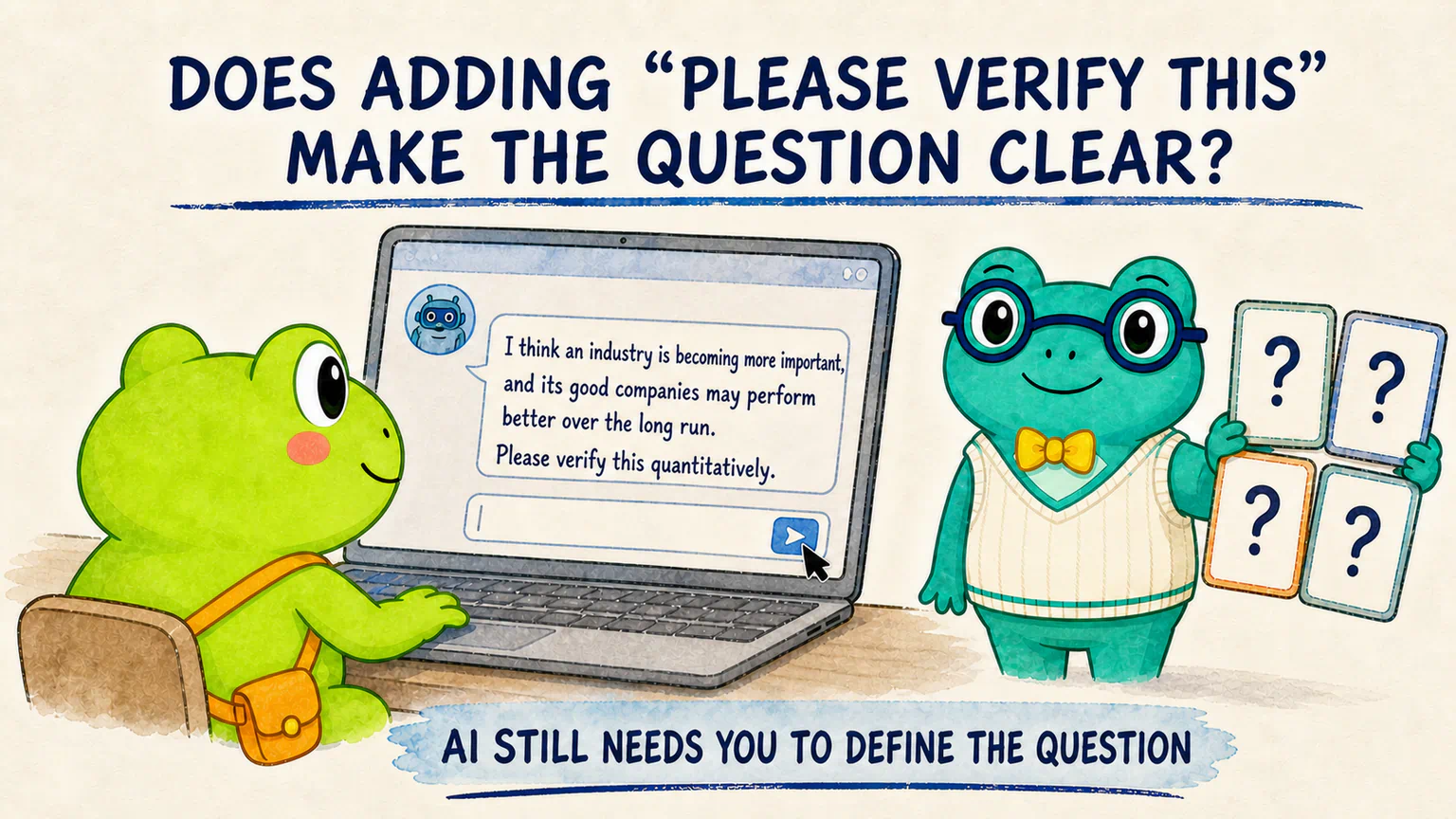
I think an industry is becoming more important, and its good companies may perform better over the long run. Please verify this quantitatively.
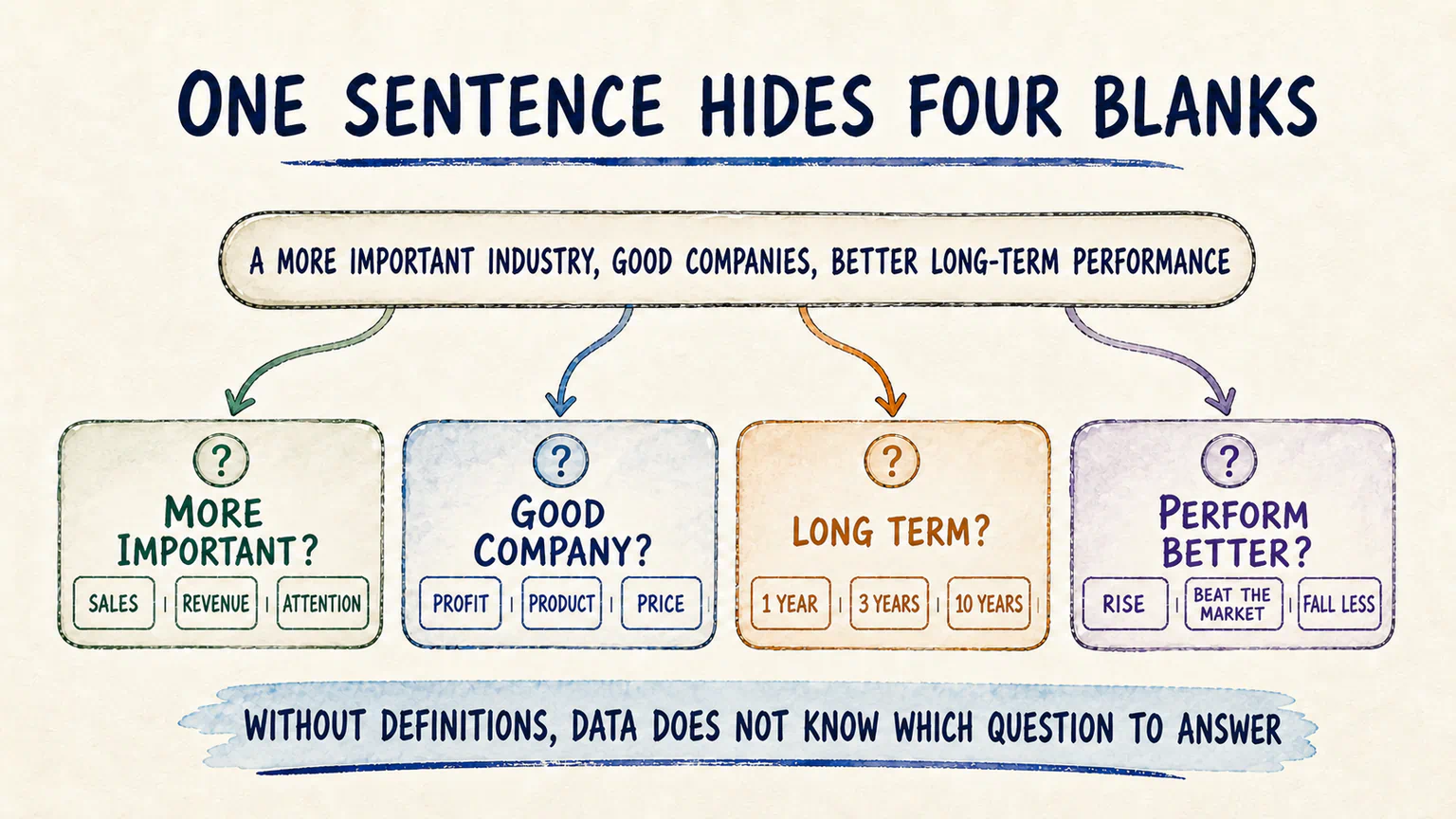
His cursor was already hovering over Send when Dr. Hop asked four questions:
Hoppy stared at his sentence.
It had seemed like a reasonably complete idea. Now he could see four phrases, each of which could lead to several different studies.
Codex could certainly choose definitions for him.
The problem was that the “good company” chosen by the AI might no longer be the company Hoppy had meant.
“I Think” Is Not Wrong. It Is Just Not Finished.
Market intuition is not the enemy of quantitative research.
Many studies begin with an unfinished sentence:
- I think this industry will become more important;
- I think the price fell too quickly and may recover;
- I think stocks with lucky-sounding names attract more interest;
- I think a sudden burst of trading activity may be followed by another change.
These ideas share one strength: they point toward something worth asking.
They also share one problem: the data does not yet know which version of the question to answer.
Hoppy’s idea still needs several blanks filled in:
Who: Which industries and companies?
What information: How will “important” and “good” be recorded?
What condition: When does the event count as having happened?
How long: One year, three years, or another window?
How to judge: Compared with what, and what result would count as better?
These questions are not meant to punish an ordinary idea.
They prevent a researcher from quietly changing the question after seeing the answer.
If the three-year result looks poor, Hoppy could claim that “long run” meant ten years. If the stocks lag the market, he could say that “better” merely meant the companies survived. When every phrase can change afterward, the original idea never has to face the evidence.
Quantitative Research First Makes the Question Inspectable
We can now give the working definition used in this course:
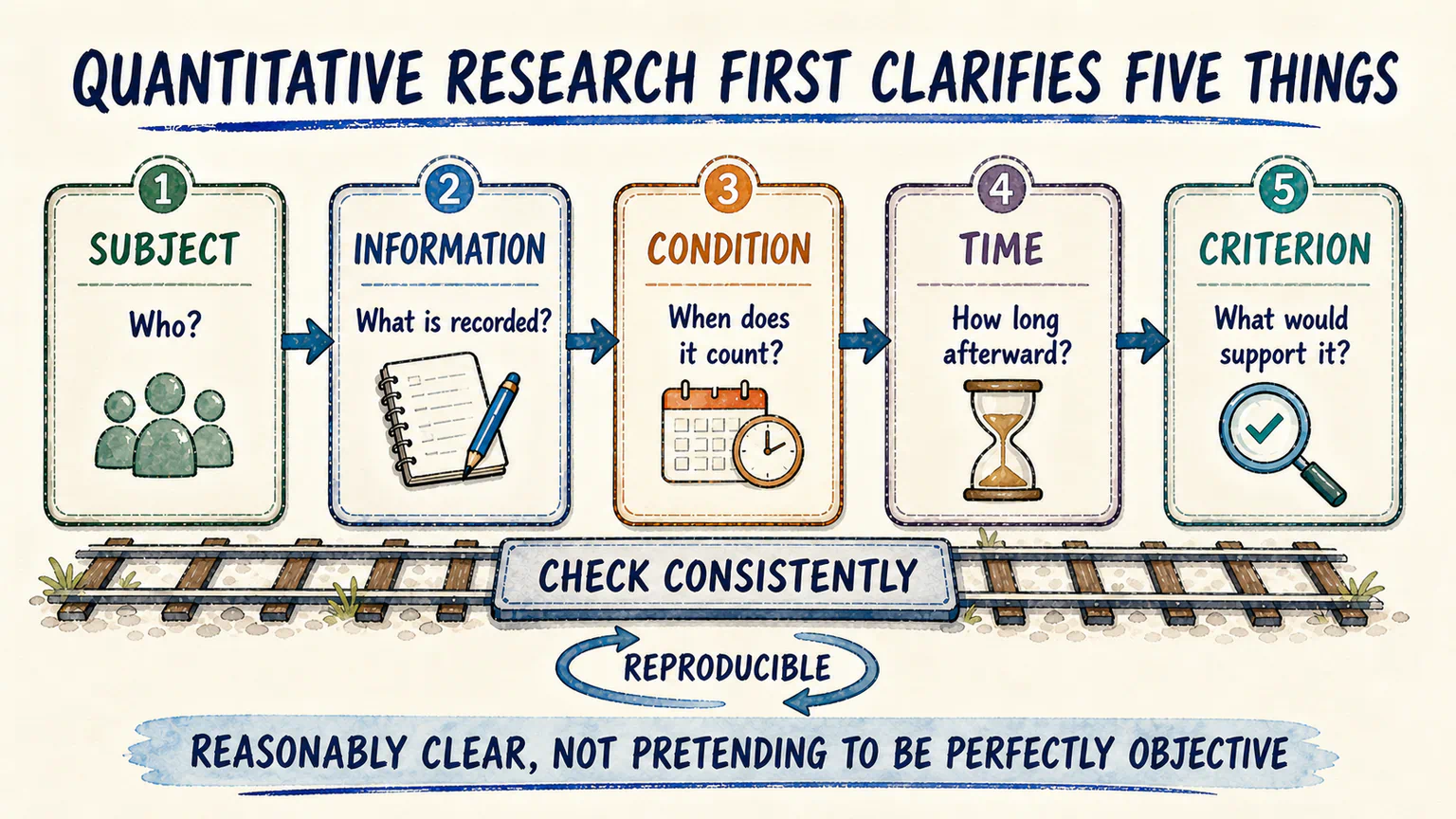
Quantitative research expresses a market idea using reasonably clear subjects, information, conditions, time horizons, and decision criteria, then inspects the evidence in a consistent and reproducible way.
You do not need to memorize that sentence. Let us unpack it.
Reasonably clear does not pretend that the researcher has found one perfectly objective definition.
It asks us to admit our choices. If we use growth in industry sales as our current meaning of “becoming more important,” we write that down. We can later argue about whether it is a good choice, but we cannot pretend that importance naturally means sales growth.
Consistent means that one round of research should use the rules agreed on in advance.
If a definition produces an unwelcome answer, we should not quietly replace it and report only the prettiest version. Definitions can change, but the change should be recorded and treated as a new check.
Reproducible means that using the same data, steps, code, methods, and analysis conditions should produce the same computational result again.
If the same run reports an 8% increase today and 18% tomorrow even though nothing changed, we have not established what the program did—let alone whether its conclusion deserves trust.
But reproducibility has an important limit:
A program can reproduce the same wrong definition perfectly, again and again.
Reproducibility helps us inspect the process. It does not guarantee that we asked a sensible question.
The Data Is Not Here to Agree with Hoppy
Hoppy’s original instruction was: “Please verify this quantitatively.”
That can easily sound like: please find a way to prove me right.
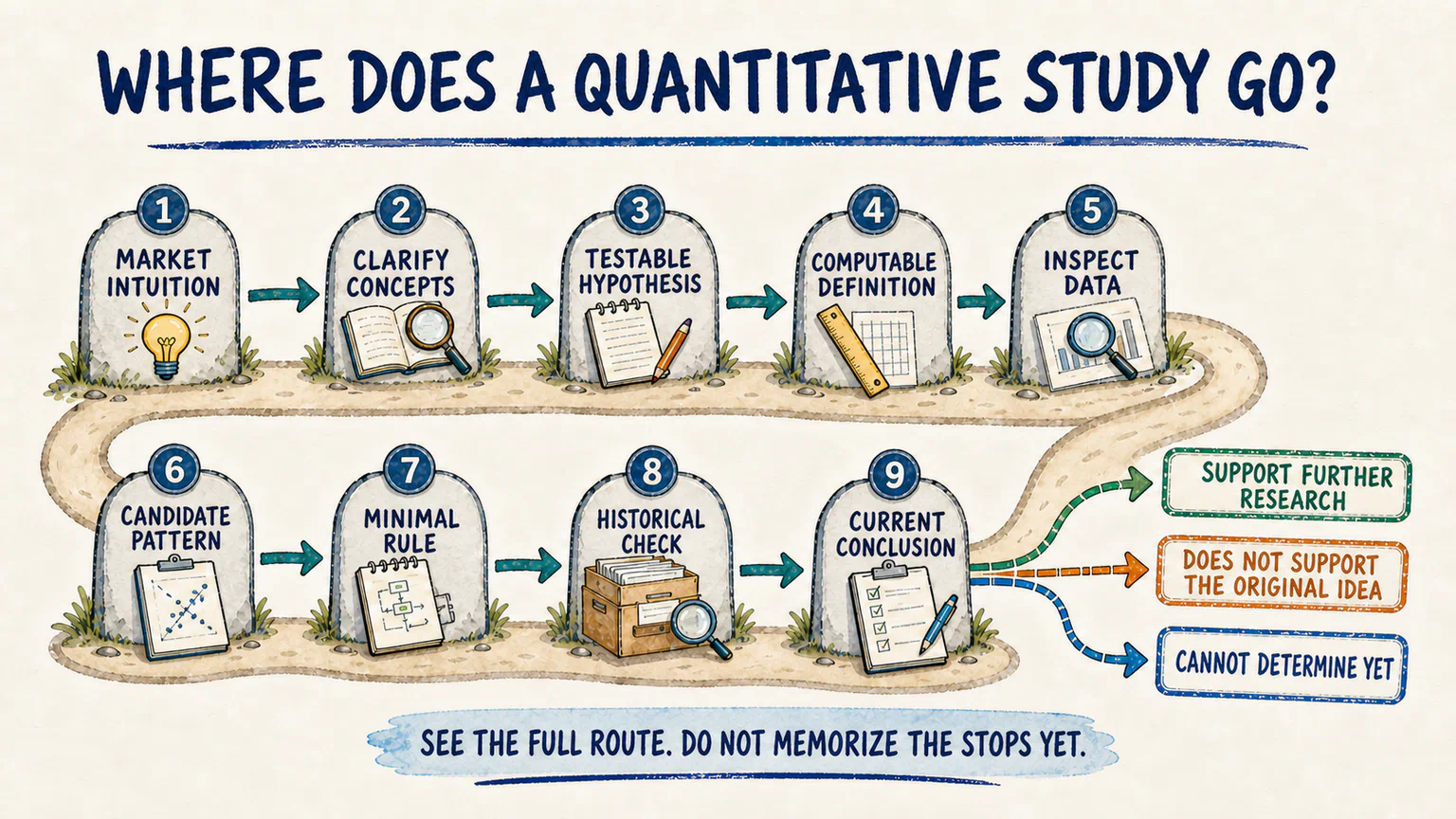
But quantitative research should not give the original idea only an Agree button. The evidence can lead to at least three legitimate places:
Current evidence supports further research
Current evidence does not support the original idea
The definition or data is insufficient, so we cannot determine yet
The third outcome is not an excuse to avoid an answer.
If we have no reasonable way to record “industry importance,” or only a very short period of data, forcing a yes or no would pretend that we know more than we do.
The second outcome is not a failed study, either.
If the data does not support the intuition, we have removed one path that currently lacks support. That is already more useful than risking money on an idea that was never checked.
Quantitative research does not search for proof for “I think.” It first makes “I think” clearer, then gives the evidence a fair chance to support it, oppose it, or tell us that we cannot determine yet.
Where Does a Study Go From Here?
This whole unit will gradually lay out the parts of quantitative research.
For now, take one look at the full route:
Market intuition
→ Clarify vague concepts
→ Write a hypothesis that evidence can oppose
→ Build computable definitions
→ Obtain and inspect data
→ Decide whether a pattern deserves more research
→ Write minimal rules
→ Inspect those rules in historical data
→ Reach a conclusion that matches the strength of the evidence
You do not need to memorize the station names or know how to carry out each step yet.
Only notice two things.
First, the program is not the starting point. Before code appears, the researcher already has to decide what question is being asked.
Second, a backtest is not a profit certificate at the end of the line. After a historical check, we may still discover unstable evidence, excessive costs, or an explanation that does not hold together.
Later lessons will visit every station. For now, remember that the whole route cannot be compressed into one “please verify this” button.
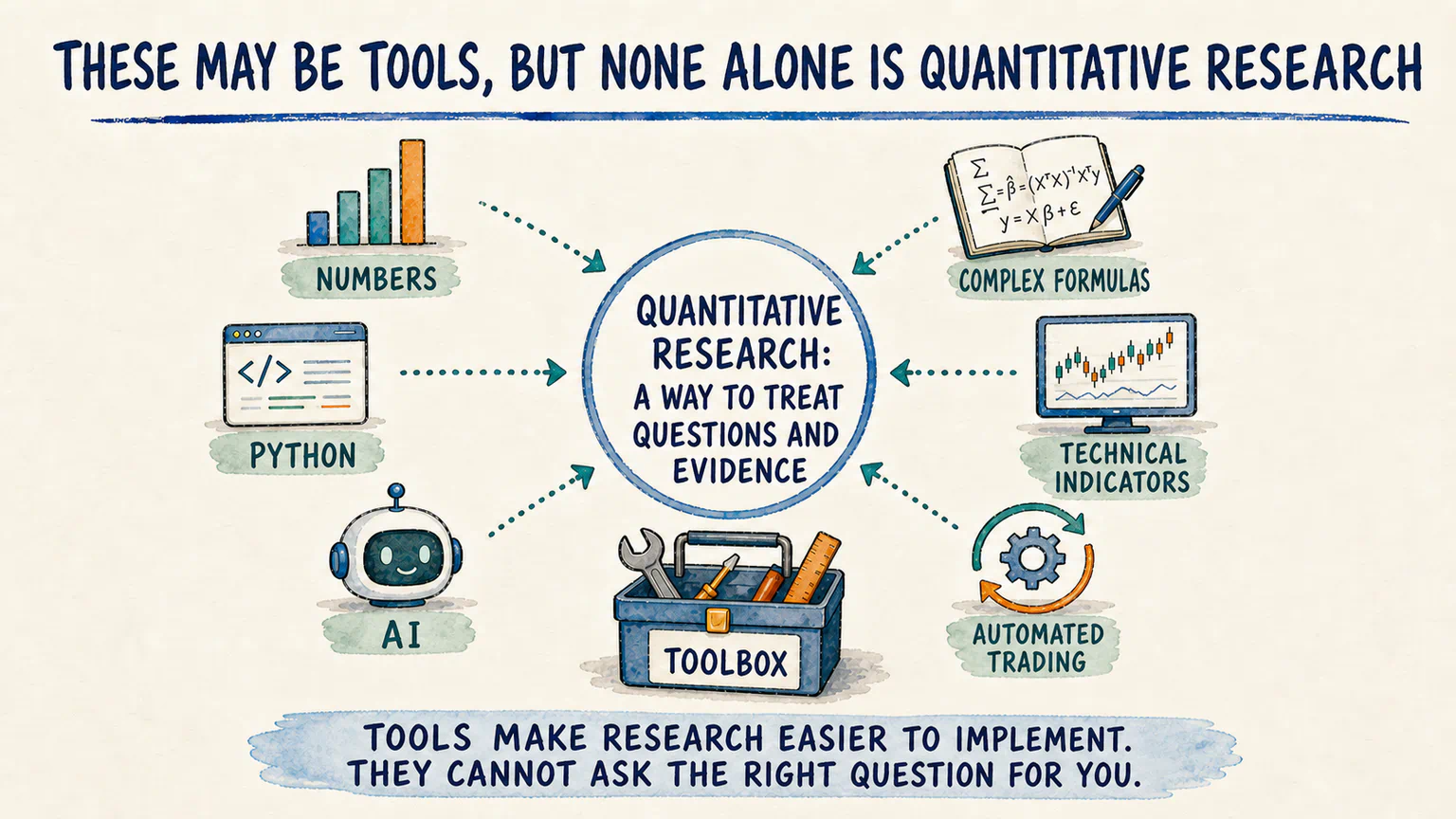
Lots of Numbers Does Not Necessarily Mean Quantitative Research
The word “quantitative” can summon a familiar picture: several monitors, dense numbers, rapidly moving charts, and someone typing code.
Those things may appear in quantitative research. None of them equals the research by itself.
Lots of numbers does not mean the question is clear.
A table can contain hundreds of columns. If the researcher does not know what they represent, more numbers merely create more places to get lost.
A complicated formula does not make an answer reliable.
Complex mathematics can describe complex relationships. It can also hide a poor assumption more effectively.
A technical indicator does not prove the future.
Moving averages, MACD, and RSI organize historical records according to formulas. What they measure—and whether that measurement relates to a future outcome—are separate questions.
Python and AI doing their jobs does not establish the study.
They can turn definitions into programs, process data, and investigate errors. If the original question is vague, they may simply execute one interpretation faster.
A rule being automated does not make it worth executing.
Automated trading addresses how to execute. It does not explain why the rule might have an advantage.
Quantitative research is not a group photo of these tools.
It is a way of treating questions and evidence. Tools make that process easier to implement; they do not decide whether the question is sensible or the evidence deserves trust.
Later experiments in this course use China’s A-share market and structured daily data as a shared case. The research principles in this lesson are not limited to China: changing markets changes data and trading rules, but it does not remove the need for clear definitions and inspectable evidence.
Next: Not Everything Important Fits in a Table
Hoppy did not send his original request.
He opened a small table and began listing the information his research might need:
Date: recordable
Closing price: recordable
Trading volume: recordable
Industry becoming more important: ?
Good company: ?
The first three entries fit naturally into cells. The final two got stuck.
“Industry importance” and “company quality” may be extremely important. They simply do not arrive with ready-made numbers in the way a closing price does.
Does that mean information that cannot be measured directly is worthless? Should we find something else to stand in for it? What happens when that substitute is poor?
That is the question for the next lesson.
References
Sources checked on August 12, 2026
- National Academies, “Reproducibility and Replicability in Science”, used to check the boundary of computational reproducibility: consistent results from the same input data, computational steps, methods, code, and analysis conditions. This lesson does not confuse reproducibility with obtaining similar findings from a new study and new data;
- CFA Institute, “Standard V(A): Diligence and Reasonable Basis”, used to preserve the need to understand and inspect data sources, model parameters, assumptions, limitations, and the output of quantitative tools.
The course definition of ‘quantitative research’ is a working definition designed for the lessons ahead, not a claim that the entire finance industry uses one mandatory definition. Hoppy’s industry idea, chat window, and information table are fictional teaching devices and do not refer to a real industry, company, stock, or investment recommendation.
Lesson discussion
Share a question, insight, or different view—and see how other learners are thinking.