Lesson 9
AI Can Write the Code. What Is Still Your Job?
Separate task completion, a successful program run, and a reviewed study, then clarify what AI lowers and what the researcher still owns.
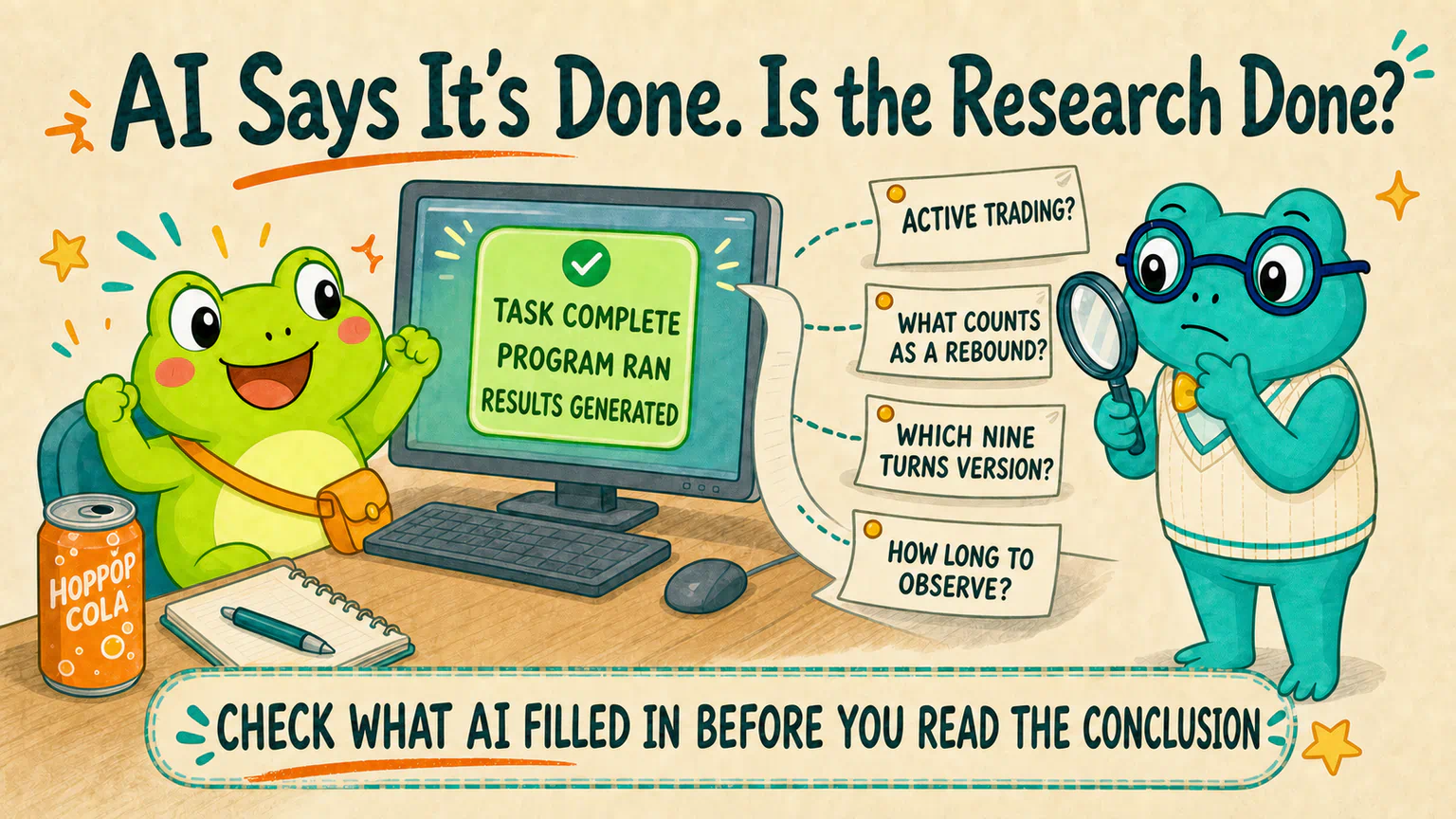
Hoppy handed a research task to an AI assistant:
Check whether stocks with more active trading are more likely to rebound after a falling Nine-Beat Count completes.
Before long, three green lines appeared on the screen:
Task completed
Program ran successfully
Results generated
Hoppy was pleased.
The project existed. The code was written. Nothing had crashed. At this pace, all he had to do was open the results and see which stock to buy.
Dr. Hop did not look at the results.
He asked, “Does ‘active trading’ mean high trading volume or high turnover?”
Hoppy shook his head.
“Does ‘more likely to rebound’ mean rising tomorrow or beating an index over the next twenty trading days?”
Hoppy shook his head again.
“Which version of the Nine-Beat Count did the program use? If the signal is known only after the close, which day begins the return calculation?”
Hoppy looked back at the green “Task completed” message.
It suddenly looked a little less green.
The AI may indeed have finished its task.
But was that task the same study Hoppy thought he had requested?
“Done” Has Three Different Layers
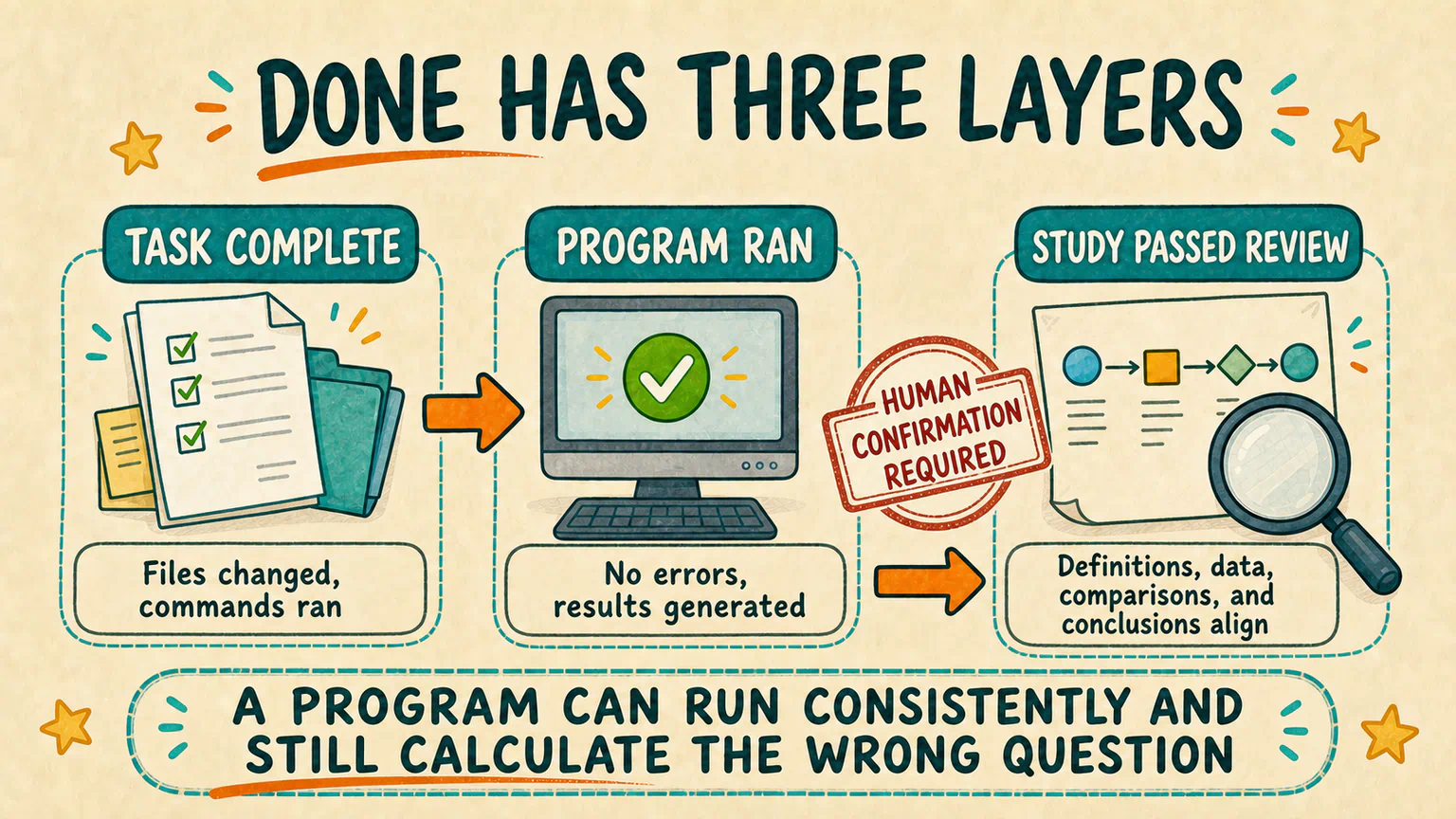
It is easy to blend the following three events into one.
Layer one: the task is complete
The AI read files, changed code, ran commands, and produced a report.
Those actions really happened.
Layer two: the program ran successfully
The program produced no error. Tests passed. The result file opened normally.
This tells us that the program can execute some set of rules.
Layer three: the study passed review
The program's definitions match the original question. The data was available at the relevant time. The comparison is sensible. The calculation did not peek into the future. The conclusion does not claim more than the evidence supports.
Only at this layer are we ready to discuss what the evidence currently says.
The first two layers matter, but they do not automatically deliver the third.
A program can calculate the wrong question with perfect consistency.
Suppose you ask whether trading was active. The program quietly defines that as “today's volume is above its twenty-day average.” That definition is not automatically wrong, but it needs your approval.
You ask whether the stock rebounds later. The program chooses the next five trading days. Five days is not automatically wrong either. Ten or twenty days would simply answer a different question.
The program can apply those choices quickly and neatly.
If nobody checks them, however, the entire study may march efficiently toward a question you never meant to ask.
A Complete Quant Study Used to Be a Lot to Carry
Before AI coding assistants, one person trying to complete an independent quant study often had to handle many jobs at once:
- state the market question clearly;
- find suitable data;
- understand fields and market rules;
- set up a Python environment;
- write programs, make charts, and calculate results;
- handle missing values, suspensions, and unusual records;
- investigate errors;
- preserve parameters and outputs so the study could be run again;
- decide what the evidence actually supported.
That does not mean only institutions could do quant research.
Many individual researchers have completed such work on their own. The difference is that they usually had to cross several barriers spanning finance, data, programming, and statistics. A team could divide those jobs among different people.
For a beginner, the first error message could become a bigger obstacle than the market question.
You started the evening wondering whether prices tend to rebound after a Nine-Beat Count. By midnight, you were still learning why one package was missing from your environment.
When the program finally started, you had nearly forgotten why you opened the computer.
AI Lowers the Implementation Barrier
That route has changed substantially.
Within the access you grant it, Codex can read a project, edit files, run commands and tests, investigate errors, repeat an experiment, and help organize the results.
This allows someone who does not yet know much Python syntax to begin with a real market question, then work with AI to turn confirmed definitions into a program.
AI can assist with many jobs that once consumed a great deal of time:
- create a research project;
- turn confirmed rules into code;
- organize and inspect data;
- calculate indicators and group results;
- run programs and tests;
- investigate error messages;
- make a change and rerun the study;
- keep charts, parameters, and results in understandable places;
- explain which files changed.
If Codex is not available, WorkBuddy or another AI tool that can work with local tasks can provide an alternative route.
The interfaces and workflows may differ. The course should not lock the research door simply because one tool is unavailable.
The important change is this: you no longer have to master every implementation skill before you are allowed to begin a study.
That is one reason this course can now invite beginners into the full process.
But the barrier being lowered is the implementation barrier, not the judgment barrier.
Human–AI Collaboration Is Not a List of Things Each Side Is Forbidden to Touch
“The human owns the question. AI writes the code.”
That sounds tidy, but it is still too simple.
AI can help rewrite your question, find missing decisions, offer several definitions, and even point out an unfair comparison.
You can read code, change a parameter, or write a small program yourself.
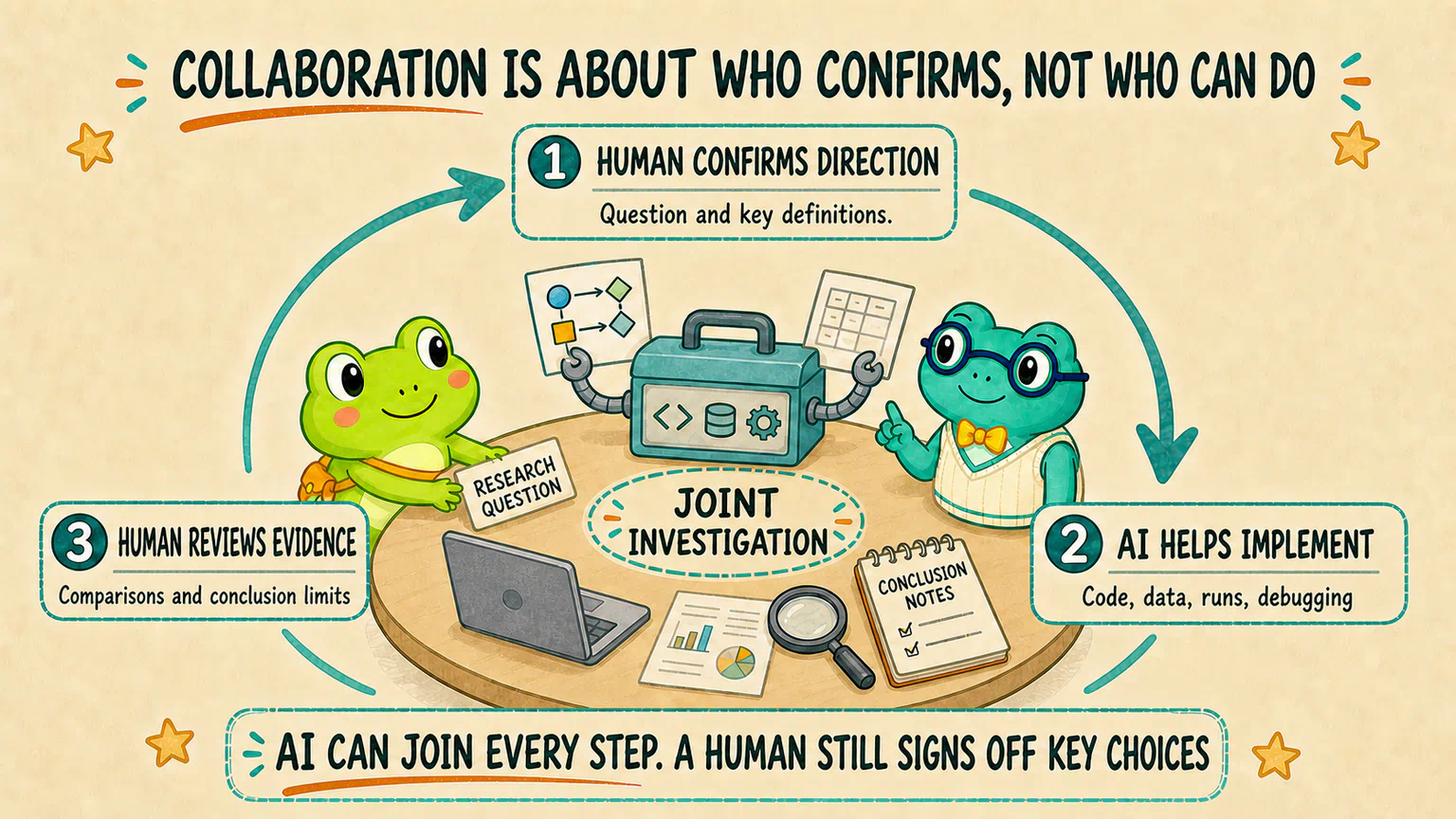
The real line is not about who is allowed to touch each job. It is about who gives the final confirmation.
A study can move through the following loop.
The human puts the direction on the table
You do not need to know every detail at the beginning. You should at least say what you want to investigate and which parts remain undecided.
For example:
I want to study whether trading conditions are related to later performance after a falling Nine-Beat Count. We still need to confirm the exact count rule, the definition of trading conditions, and the observation window.
This is much better than “Find me a profitable Nine-Beat Count strategy.” It does not quietly hand every research decision to the AI.
AI lays out the missing decisions
The AI can ask:
- Which stocks are in the study?
- Which version of the signal should be used?
- What counts as active trading?
- When does the observation begin?
- How long does it continue?
- What is the comparison benchmark?
- What result would count against the original idea?
It can also offer several possible definitions and explain how each one changes the question.
The human confirms the key choices
You do not have to invent every answer alone.
But if the AI offers “volume above its twenty-day average” and “turnover near the high end of its past year” as two versions of active trading, you need to confirm which one better matches your question.
If you cannot decide yet, a perfectly respectable choice is to keep both versions and study them separately—not blend them into one vague word called “active.”
AI implements, runs, and investigates
Once the definitions are confirmed, AI can write code, inspect data, run the program, investigate errors, and organize outputs.
It is not merely a typist waiting for line-by-line orders. It can investigate proactively and suggest repairs.
The human reviews the evidence and owns the conclusion
At the end, you need to confirm which data the program actually used, what comparison it actually performed, how strong a claim the result supports, and which limitations remain unresolved.
AI can assist with this review and may find problems faster than you do.
But the study does not receive an automatic sign-off simply because the AI says, “Looks good.”
The Blanks AI Fills for You May Be the Most Important Parts of the Study
When a request is incomplete, an AI faces a practical choice: ask another question or make an inference and continue.
Sometimes it asks. Sometimes it fills the gap using a common convention.
That inference may be reasonable. It may also differ from what you meant.
The following blanks are especially dangerous to leave invisible in quant research:
- whether a “large company” means large market capitalization, high revenue, or many assets;
- whether “active trading” means volume, value traded, relative volume, or turnover;
- the exact time at which a signal becomes knowable;
- the day and price from which later performance begins;
- whether “better performance” means an absolute gain or outperformance against an index;
- which stocks, years, and special market states belong in the sample;
- whether a condition invented after seeing the results is being presented as part of the original plan.
Every one of these choices can change the result.
Working with AI therefore does not mean asking fewer questions.
It gives us a chance to spend more energy on the questions that actually deserve it.
Six Questions for Reviewing AI-Assisted Research
You do not need to begin by reviewing every line of Python.
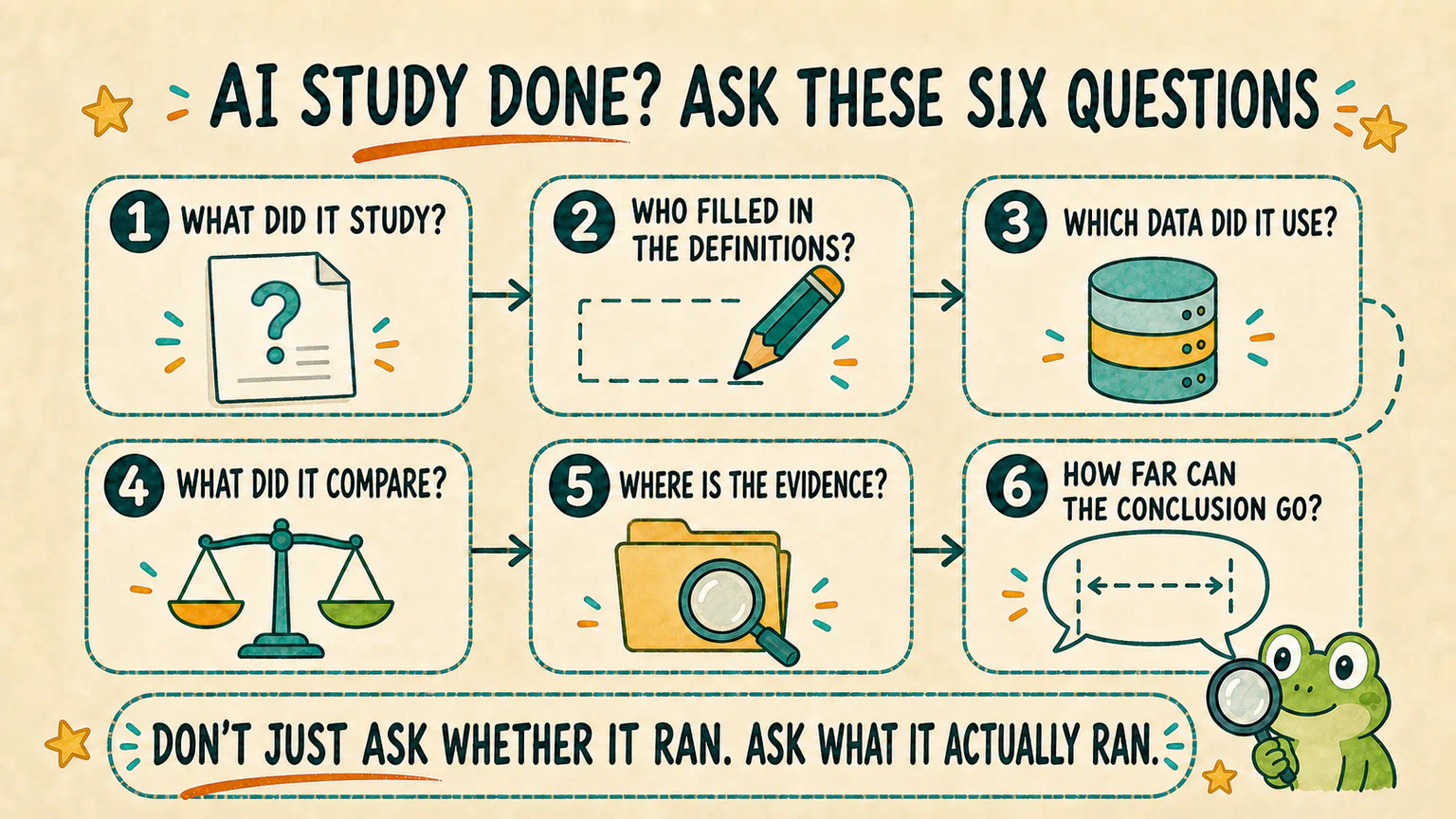
First, ask the AI to answer six questions in plain language. That alone often reveals whether the study has quietly changed the subject.
- What complete question did the program actually study? 2. Which key definitions did I explicitly confirm, and which ones did you infer or choose by default? 3. Which data, fields, stock universe, and dates did you use? Was each item available at the decision time? 4. What did the program actually compare, when did the observation begin, and how long did it last? 5. Which real files, run logs, tables, or charts support your answer? 6. What is the strongest claim the current evidence supports, and what does it clearly not support?
These questions are not a trap designed to catch the AI making mistakes.
They also catch vague human instructions, missing data, and parts of the study that nobody has properly decided.
If the AI says that active trading used a default definition, you know that choice still needs confirmation.
If it can only say that results were generated but cannot name the comparison or observation window, the work remains at the first two layers of done.
If it offers a beautiful conclusion but cannot point to the corresponding output or run record, the conclusion is not yet standing on evidence.
A Conversation You Can Save for Later
The prompt below does not assume that the AI knows HoppyQuant or any lesson numbers.
Replace the brackets with your own research question. If the AI has not read your project or data, it should say so first rather than pretending it has.
Optional conversation
I am investigating this market question: [write your question here].
Do not decide whether I should trade, and do not merely tell me whether the program ran successfully. Use only the description I provide and the files, data, and run evidence you can actually access to help me review the study.
First, restate in plain language the question the program actually studied. Then list:
- the definitions I explicitly confirmed;
- the definitions you inferred, selected by default, or remain uncertain about;
- the actual data, fields, sample, and date range;
- the comparison groups, starting point, and observation window;
- the real files and run evidence supporting the current assessment;
- what the current conclusion can and cannot say.
If anything is missing, write “Researcher confirmation required” and ask me a follow-up question. Do not silently turn a missing choice into a settled answer.
Once we enter a real project, this conversation will keep evolving.
The AI will be able to read files, inspect run results, and cite specific evidence. You will gradually learn where the code, data, configuration, and outputs live.
For now, remember the direction of the review: do not ask only, “Did it run?” Ask, “What exactly did it run?”
Is Python Still Worth Learning?
Yes.
The learning order has changed, however.
Beginners once felt they had to memorize a large amount of syntax before they deserved to ask their first quant question.
Now you can begin with a question, let AI help you cross many syntax and environment barriers, and gradually learn Python inside a real project.
Every time you understand a variable name, notice that a calculation uses the wrong field, know where to find a configuration, or rewrite a vague request more precisely, your collaboration with AI becomes more reliable.
Python is no longer a ticket that says, “No entry until you know this.”
It is a research language you can learn over time. The more you understand, the more clearly you can explain what you want and check what actually happened.
Why Can the Human Researcher Not Clock Out?
Because a market question does not define itself.
Data does not volunteer a list of everything it leaves out.
A fair comparison does not appear automatically because a program ran quickly.
AI can handle a large share of implementation and become a remarkably capable investigation partner. For the first time, many people can reclaim their attention from brackets, indentation, and environment errors and spend it on questions and evidence.
Someone still has to ask:
Is this the question we meant to investigate?
Are these definitions reasonable?
Can this data answer the question?
Is this comparison fair?
Is the evidence actually strong enough?
That person does not remain in the study because they type faster than the AI.
They remain because they must understand the work, confirm it, and take responsibility for the conclusion.
AI can take many steps for you, but it cannot decide for you whether the journey has gone off course.
The best collaboration is not “Complete the research for me.” It is “Complete it with me, and lay every key choice and piece of evidence on the table.”
Next: Enter the Local AI Quant Lab
Hoppy returned to the task. He did not open the return chart.
Instead, he sent a new message:
Do not give me the conclusion yet. List the Nine-Beat Count rule version, active-trading definition, observation period, and comparison benchmark you used. Mark anything I did not explicitly confirm.
This time, the AI did not rush to provide an answer.
It began by laying out every part of the study that still needed a decision.
Our theory map is now complete.
Next, we will bring it onto our own computer: explore a local research project, separate code, data, configuration, and output, and work with AI to run our first study that can be checked and repeated.
References
Sources checked on August 14, 2026
- OpenAI: Introducing Codex, used to check that Codex can read and edit project files, run commands and tests, and provide terminal logs and test outputs for review. The same source explicitly states that agent-generated code still requires human review and validation.
- OpenAI: Running Codex safely at OpenAI, used to check that coding agents can access projects and run commands on a user's behalf, which makes execution boundaries, permissions, approvals, and audit records important in real use.
- WorkBuddy official overview, used to check WorkBuddy's positioning as a natural-language assistant for multi-step work, local files, and data tasks. The course presents it as an alternative when Codex is unavailable; it does not claim that different tools have identical features or interfaces.
- CFA Institute: What employers want: A new skills blueprint, used to check that programming and Python remain valuable in investment work while financial analysis, critical thinking, and judgment about automated outputs remain important as well.
HopPop Cola, the Nine-Beat Count task, the green completion message, and all research events in this lesson are fictional teaching examples. Nine-Beat Count, or 九拍计数, is the course's own name for the fixed teaching rule used in this example. This course uses China's A-share market as its main data case. Market rules differ across countries and exchanges, but those differences do not change the research-responsibility principles taught here. Nothing in this lesson describes a real stock, real software interface, research result, or investment recommendation.
Lesson discussion
Share a question, insight, or different view—and see how other learners are thinking.