Lesson 6
Why Can the Price Move Before the Company Does?
Put views, money, limits, deadlines, and emotions back into trading to see why market traces do not reveal one cause.
At two in the afternoon, HopPop Cola's share price suddenly dropped.
Hoppy's first thought was: Did something happen to the company?
He rushed to check its announcements. Nothing new.
Then he checked the industry news. Still nothing.
No policy had changed. Raw-material prices had not suddenly jumped. HopPop Cola was still selling the same cola it had sold yesterday.
Yet sell orders were already reaching the market.
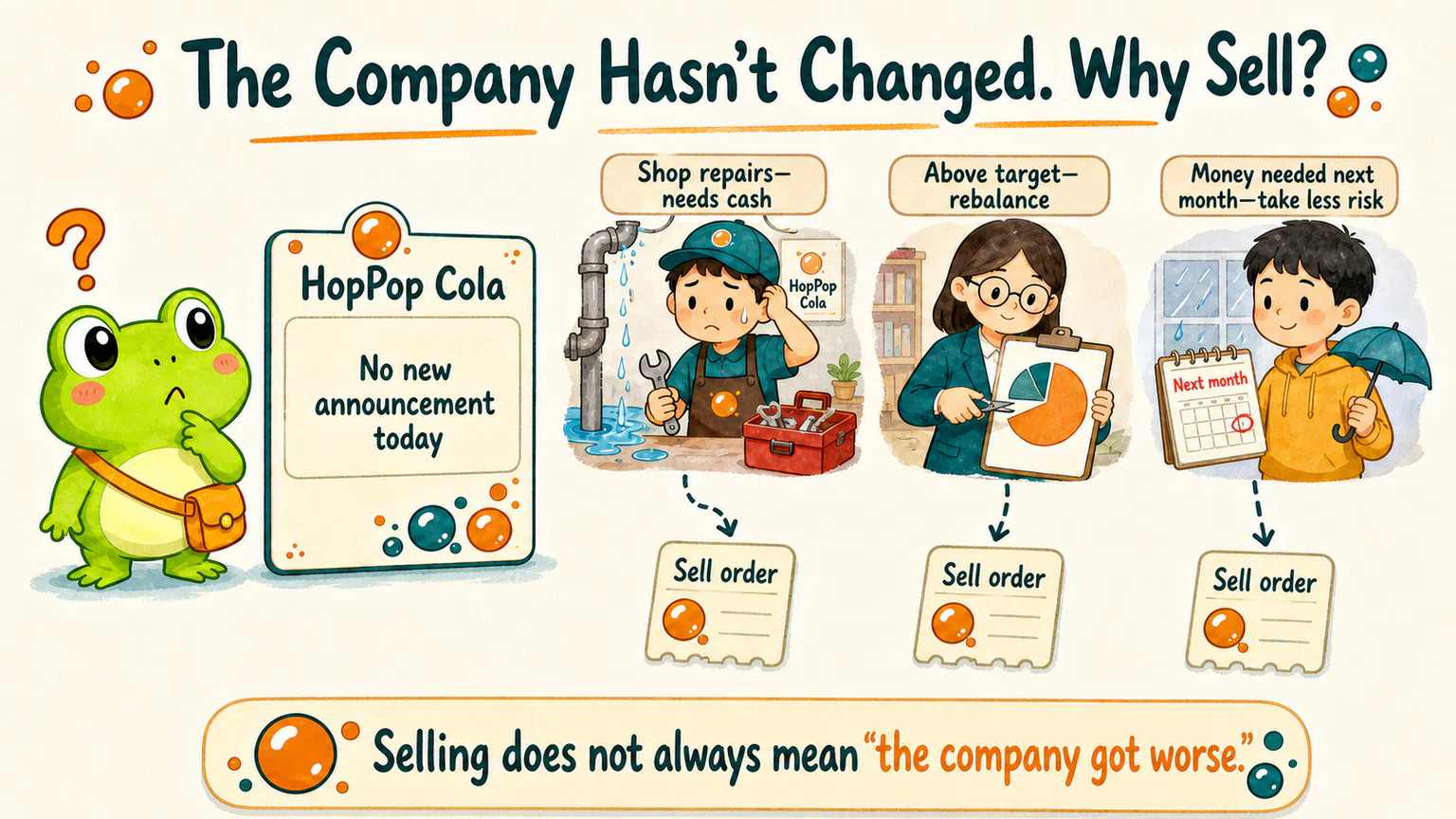
If we could briefly step backstage in this fictional market, we would meet three sellers:
- Mr. Zhou's drink shop had a burst pipe, and he needed cash for repairs;
- a fund reviewed its portfolio at month-end, found that beverage companies had grown beyond their planned share, and sold some;
- Xiaolin saw market swings getting larger and worried about money needed next month, so he decided to hold fewer shares for now.
None of them had received new bad news about HopPop Cola.
Hoppy stopped.
Exactly.
A trade can affect the price, but it is not necessarily a fresh research report about the company.
The company, price move, participants, and motives in this story are all fictional. We are using them to examine trading motives, not to analyze a real stock.
This course uses China's A-share market as its main source of examples. Trading rules, disclosures, settlement, and data labels differ across markets. Those differences matter in real research, but they do not change the basic ideas in this lesson: people trade under real-world constraints, every completed trade has two sides, and a market trace is not the same thing as its cause.
People Do Not Bring Only an Opinion to the Market
So far, we have kept asking one important question: What do people think will happen to the company?
That question matters, but it gives us only half the picture.
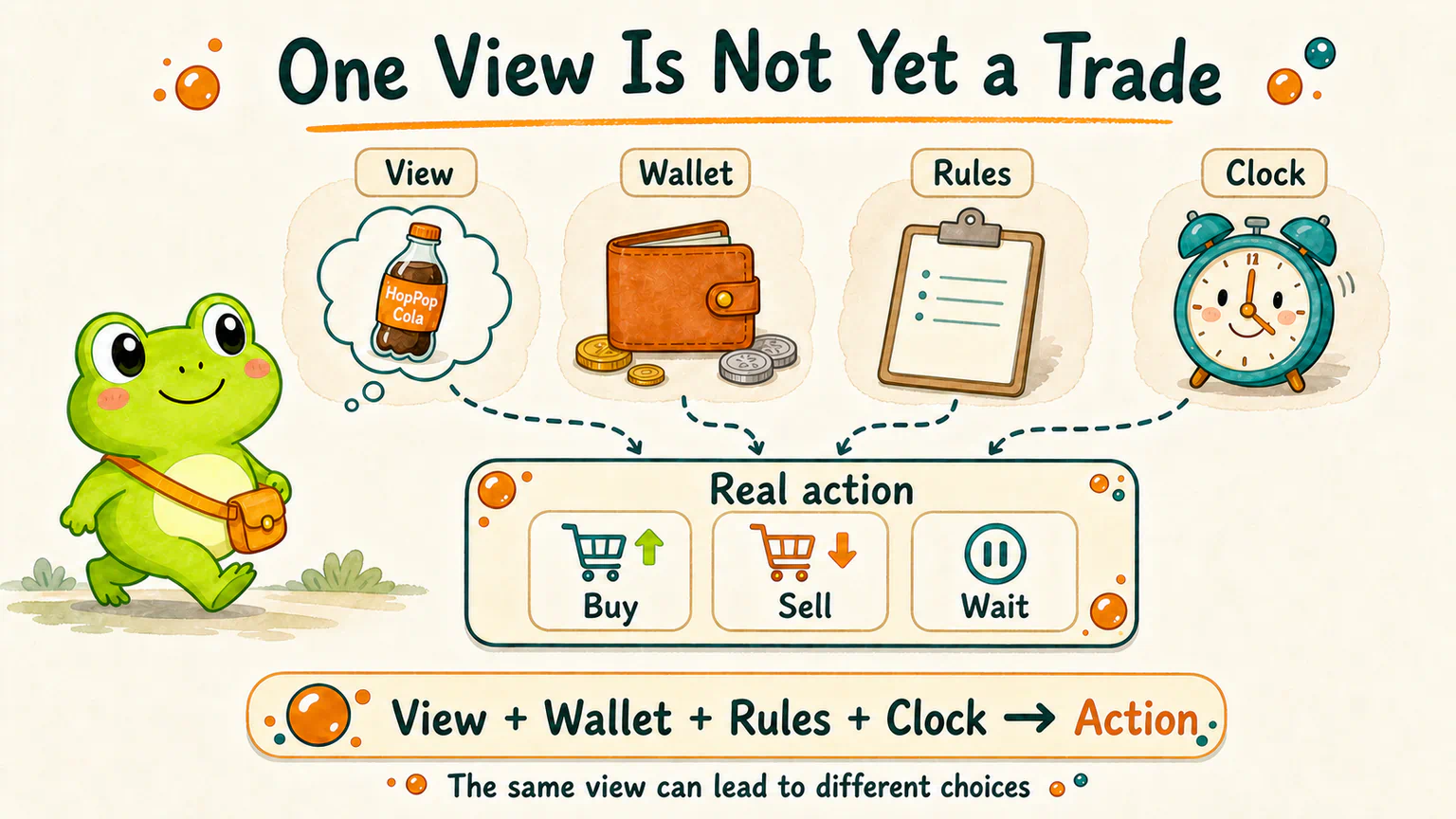
Market participants also arrive with a few other things:
View: What do I think will happen to this company?
Wallet: How much money do I have, and when will I need it?
Rules: How much may I hold, and how much risk may I take?
Clock: How long can I wait, and when must I decide?
What reaches the market is not an opinion floating by itself. It is the action produced when these things meet.
view + wallet + rules + clock
→ buy, sell, or do nothing for now
Suppose two people both believe HopPop Cola's long-term business has not become worse.
Mr. Zhou must pay for repairs tomorrow, so he sells. Another investor does not need the money and is willing to wait, so she does not sell.
Same positive view, different actions.
The reverse can happen too.
Someone may be slightly worried about the company but decide to watch because the position is tiny. Someone else may have no new opinion at all but trim the position because it has moved beyond a preset limit.
When we see a trade, the first thing we can safely confirm is simply this: an action happened.
Whether it came from new information, a cash need, a portfolio rule, or several things at once requires more evidence.
People do not enter the market with opinions alone. They also bring wallets, limits, deadlines, and emotions. Price is what remains after those actions meet—not a subtitle for one particular thought.
Rebalancing Is Not the Same as Changing Your Mind
Why did the fund in our story sell?
Suppose it had set a simple target: beverage companies should not become too large a part of the whole portfolio.
If beverage shares rose for a while, their portfolio weight could grow even if the fund did not deliberately buy another share.
To return to its planned mix, the fund could sell part of the overweight holding or direct new money toward an underweight area.
That is rebalancing. In plain English: the portfolio has tilted, so you move it back toward the arrangement you chose.
It does not automatically mean the fund has suddenly turned against HopPop Cola. It does not mean the fund knows a secret. It may simply be following a plan set earlier.
Individuals face similar changes.
A home purchase, tuition bill, or emergency fund can change how much money a person can leave in stocks. The person's opinion of the company may stay exactly the same while the action changes.
The company did not change. The person's situation did.
That can be enough to create a trade.
Risk Appetite: Same Cloud, Different Umbrellas
Now look at Xiaolin.
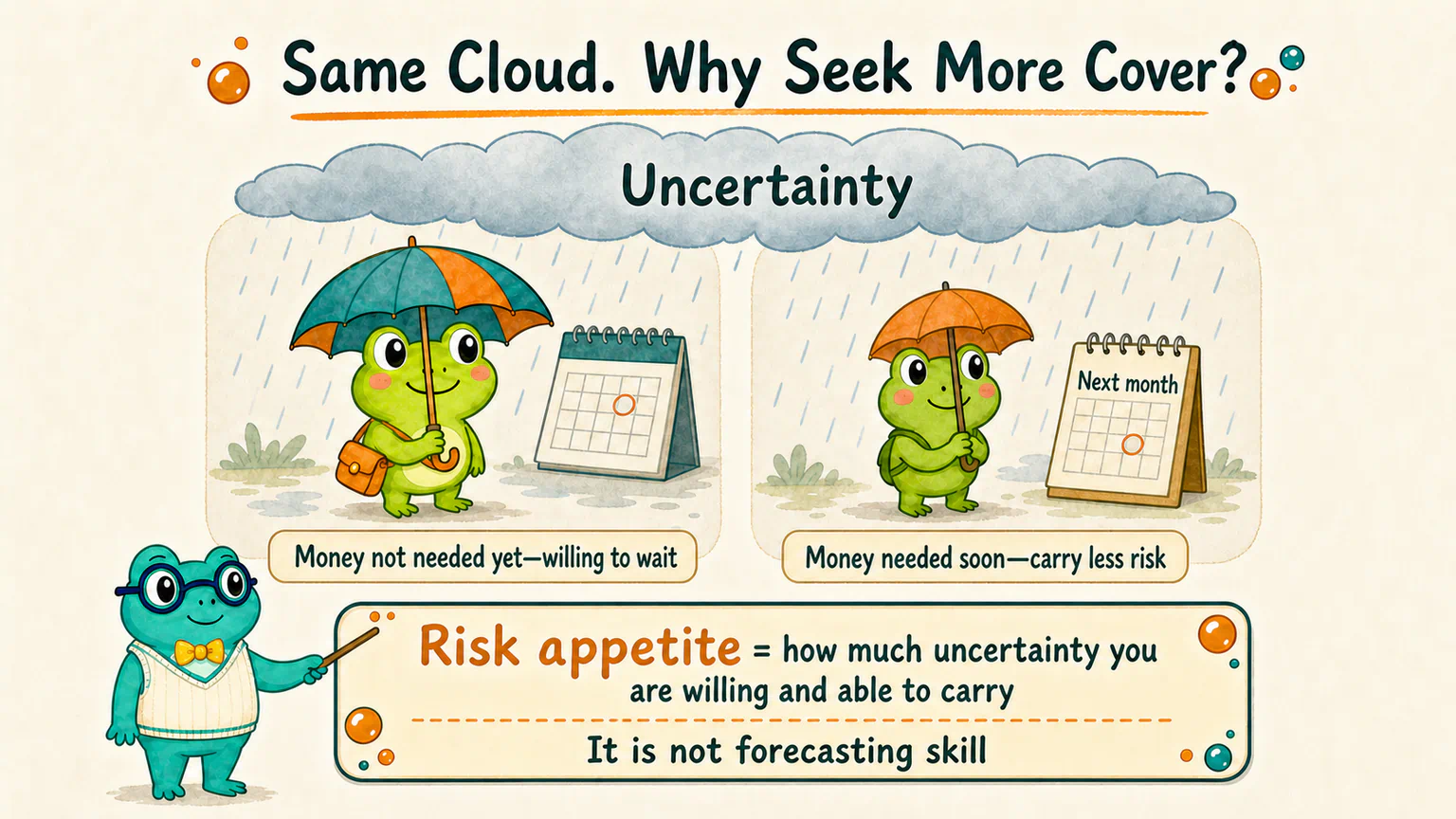
He found no new problem at HopPop Cola. Market swings had simply grown, while he might need the money next month.
Before, he thought, “A few bumps are fine. I can wait.”
Today, he thinks, “If the price happens to be down next month, I cannot wait it out.”
The company is still the same company. Uncertainty has simply become more expensive in his own life.
That is one plain-language way to understand risk appetite—how much uncertainty someone is willing and able to carry.
Both “willing” and “able” matter.
Someone may feel brave but still be unable to handle large swings because the money is needed soon. Someone else may have plenty of time and cash but simply sleep badly through rough markets.
Higher risk appetite does not mean better forecasts. Lower risk appetite does not prove that a company is in trouble.
It tells us how willing participants are to keep money in uncertain places.
Emotion Enters the Market, but It Has No Magic Button
When many people feel relaxed and optimistic, they may be more willing to wait or accept uncertainty.
When worry spreads quickly, some people may reduce their holdings first and look for an explanation later. Others see the selling and become more nervous. Their actions then draw even more attention to the price move.
This is one way emotion can enter the market:
optimism or worry changes
→ willingness to carry uncertainty changes
→ some people change their actions
→ trades leave traces in price, volume, and volatility
But do not read this as “emotion explains everything.”
Emotion is not a giant invisible hand floating above an exchange. It is not a button that makes every stock rise or fall together.
In the same market, one person can be nervous, another calm, another short of cash, and another following a rebalancing rule written months ago. Price emerges from many different situations meeting one another.
If we say, “The price fell because sentiment was bad,” but cannot explain what changed, whose action might have changed, or what other explanations remain, we have merely replaced “I don't know” with a phrase that sounds like an answer.
If Money “Flowed Out,” Where Did It Go?
Hoppy stared at a line in a market-data app:
Money flowed out today.
He was confused again.
That is a very useful question.
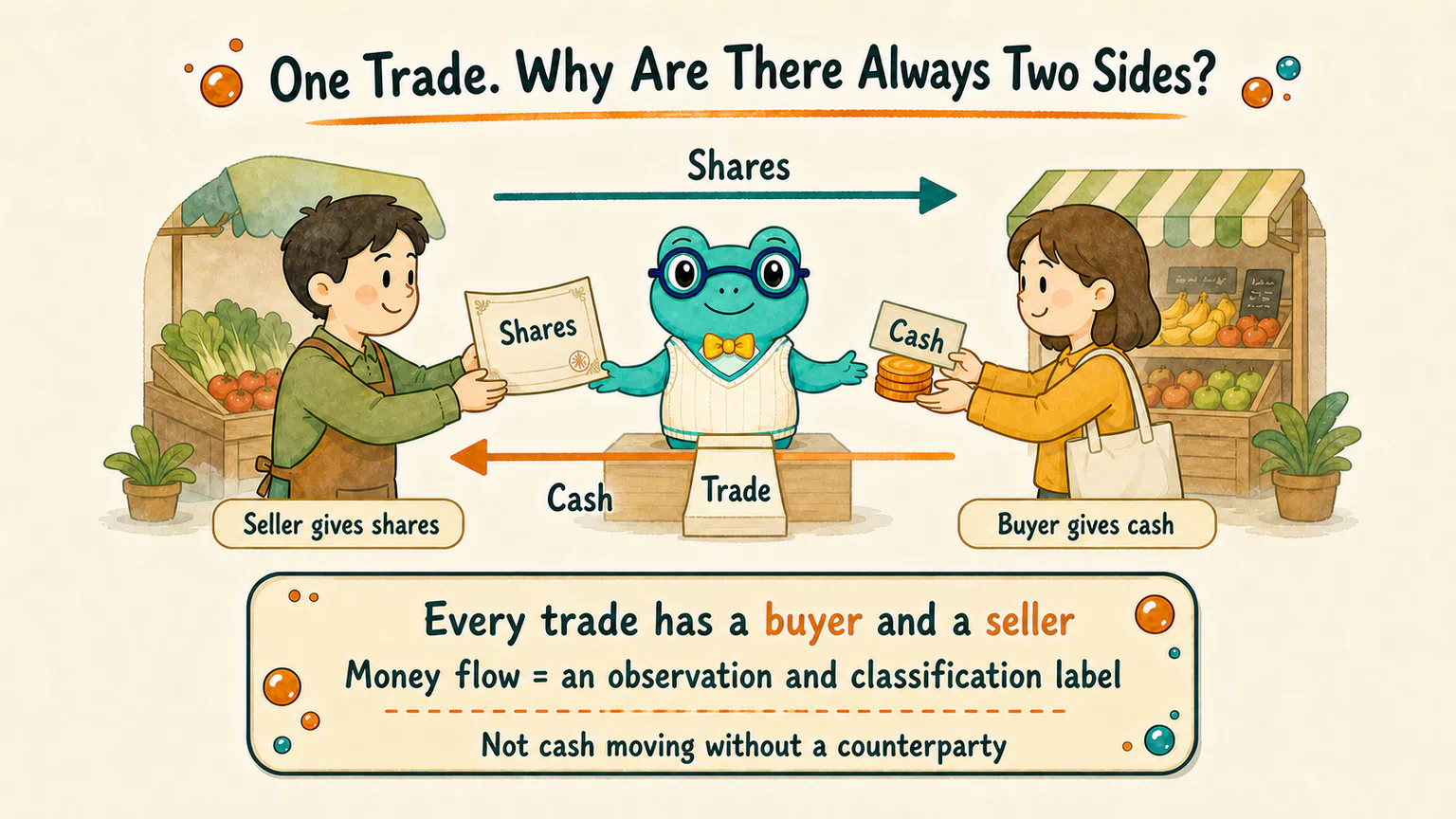
Draw one ordinary completed trade, and it looks like this:
seller gives shares ←→ buyer gives cash
A completed trade means a buyer and a seller exchanged assets at an agreed price.
Without a seller, the buyer cannot buy. Without a buyer, the seller cannot sell.
So everyday labels such as “money inflow” and “money outflow” usually do not mean that cash ran in one direction while the other side vanished. A data service often uses prices, orders, or another rule to classify some trades toward one side and then reports an observation label.
The exact method can differ across markets, data providers, and classification rules.
A money-flow label can be one way to observe the market, but it is not an ID card for the cause of a trade.
The label alone cannot tell us:
- who traded;
- why they traded;
- whether they had new information;
- whether they will continue tomorrow;
- which way the price must move next.
Translating “money outflow” directly into “smart money is escaping” skips far too many steps.
Trading Can Push Price for a While, but It Cannot Explain Everything
Suppose many participants try to reduce risk at the same time. Selling can cluster, and price swings may grow.
That can amplify a small worry. It can also temporarily cover up genuinely good company news.
In the other direction, when people are more willing to take risk, optimistic trading may pull price ahead of business results.
But there is no automatic rubber band that must snap back quickly.
We cannot promise that a price which seems detached from business reality will soon return. The company's operations, market expectations, and participants' situations keep changing. Even the size of the supposed gap is not something we can know at a glance.
Nor should we fill every unexplained move with, “A big player must be controlling it.”
Real markets contain participants of very different sizes, including institutions that rebalance and manage risk. Size alone does not provide a universal remote control for every price move.
A useful research question reduces the unknown. It does not put a mysterious hat on it.
The Price Moved. What Do We Actually Know?
Return to our opening story.
Because we wrote this fictional scene, we know that Mr. Zhou needed shop repairs, the fund rebalanced, and Xiaolin reduced short-term risk.
In a real market, Hoppy would usually see only this:
price fell
volume changed
volatility may have increased
These are traces left by trading.
Traces are useful. They tell us that market actions happened, and that their size or timing may differ from normal.
But a photograph of a footprint usually cannot tell us whether the walker was going to work, buying groceries, or escaping the rain.
In the same way, a chart of price and volume usually cannot prove by itself that traders were rebalancing, raising cash, panicking, or revising their view of the company.
When a price moves without obvious company news, ask:
- Did the company, industry, economy, or policy truly have no new change?
- Am I looking at a confirmed event, or only price, volume, and volatility?
- Could cash needs, rebalancing, risk limits, or deadlines also produce action?
- Am I using money or sentiment as an explanation that needs no evidence?
- What other causes could leave the same traces?
- What additional evidence would help rule some of them out?
These questions still will not predict tomorrow's price.
They help us protect a crucial boundary: seeing the result does not mean we have found the cause.
Hoppy sorted the things on his screen into three piles:
- one news story about the company;
- one price chart;
- one set of volume figures.
Does the news show the event itself, or only a window through which the event reached us? Do price and volume prove the cause, or merely record the result of trading?
Next, we will separate those three things and see what each can tell us—and what it cannot answer for us.
References
Sources checked on August 11, 2026
- Investor.gov: Beginners’ Guide to Asset Allocation, Diversification, and Rebalancing, used to check how investors may sell overweight assets or buy underweight assets when a portfolio drifts from its target allocation;
- FINRA: Know Your Risk Tolerance, used to check that risk tolerance includes both willingness and ability to take risk and depends on goals, needs, and time horizon;
- FINRA: Volatility, used to check how short-term liquidity needs can produce different responses to volatility and how emotions can affect actions in turbulent markets;
- Shanghai Stock Exchange Investor Education: Entrustment and Order Submission, used to check the basic path by which A-share investors submit buy and sell instructions through a securities firm;
- Shanghai Stock Exchange: Trading Rules, 2026 Revision, used to check buy and sell order submission and transaction records under current A-share trading rules;
- U.S. Securities and Exchange Commission: Staff Legal Bulletin No. 12R, used to check that execution statistics may classify trades according to defined rules.
The company, price move, and participant motives in this lesson are fictional. “View, wallet, rules, and clock” is only a learning model. This lesson does not analyze real money-flow data, teach order-book tactics, or provide investment advice.
Lesson discussion
Share a question, insight, or different view—and see how other learners are thinking.