Lesson 3
Why Can One Company Sneeze and the Whole Industry Catch a Cold?
Use shared customers, inputs, channels, technologies, and rules to see why peers share conditions but not identical outcomes.
Following the trail from the tiny ledger, Hoppy found a report about rising packaging costs at HopPop Cola.
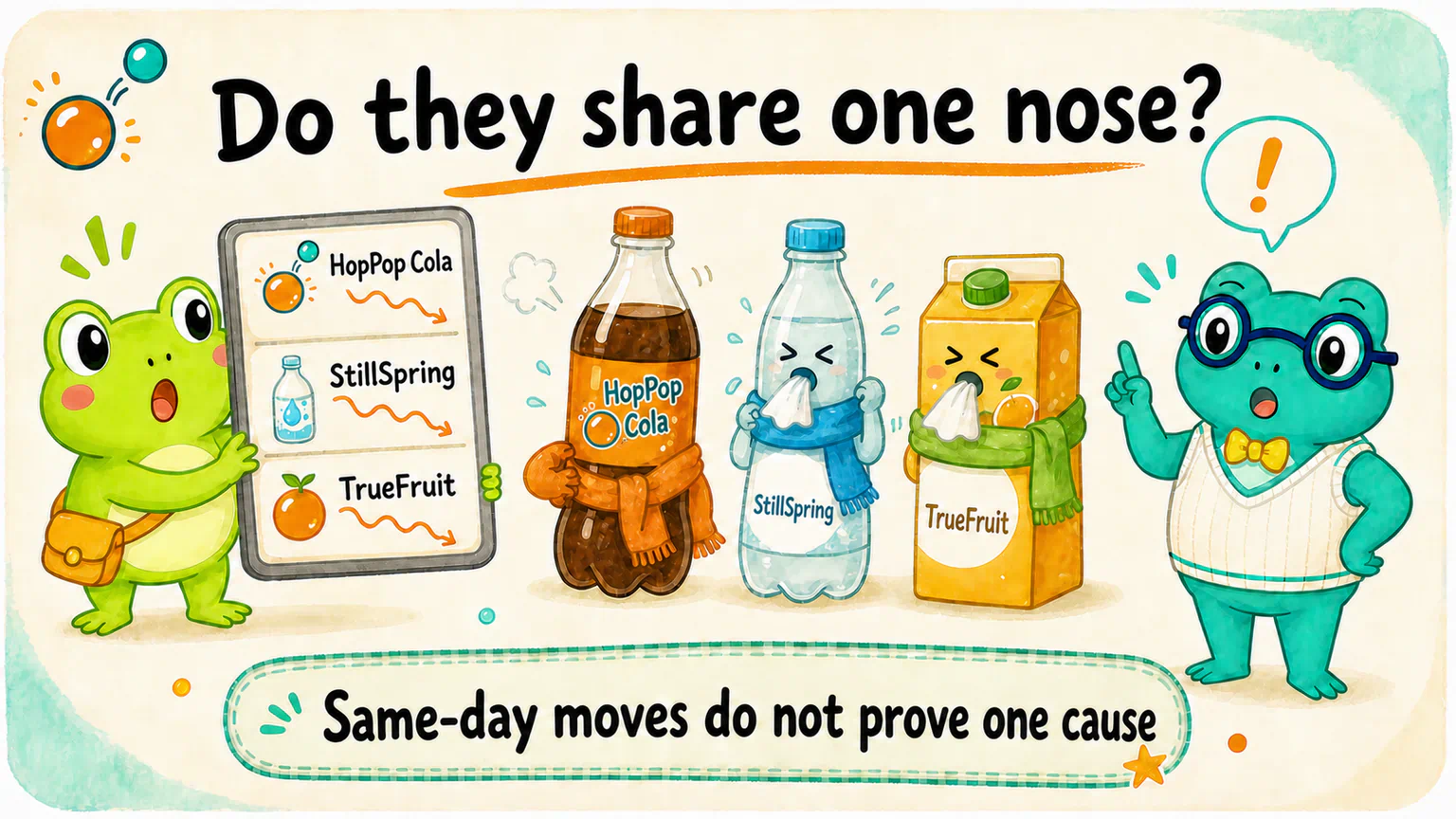
He opened his market app. HopPop was down that day. Then he scrolled and saw that StillSpring Sparkling Water and TrueFruit Juice were down too.
“HopPop sneezed. Why did the other two companies call in sick?”
Dr. Hop did not immediately diagnose the entire beverage industry with a cold.
“Wait. Three companies coughing on the same day does not prove they caught the same thing.”
They might truly share a problem. Customers may be buying fewer drinks, supermarkets may be pushing down wholesale prices, or a common type of packaging may have become more expensive.
The stocks may also have fallen together by coincidence. HopPop might be worried about packaging, StillSpring might have a failed expansion, and TrueFruit might have no new business event at all—someone simply sold its shares that day.
So we are not here to memorize “companies in the same industry move together.”
We are asking something more useful: Why can a group of companies share the same conditions and still end up with very different results?
An industry helps us find companies with similar businesses
HopPop Cola, StillSpring Sparkling Water, and TrueFruit Juice do not sell exactly the same thing.
They do compete for people who want a drink. Their products may appear in similar supermarkets, convenience stores, and delivery apps. That gives people a reason to place them together and ask what is happening in the beverage business.
That is the most intuitive use of an industry:
It groups companies whose main businesses are similar and that often face similar questions.
Nature did not draw one permanent boundary for us.
A company that sells drinks, snacks, and health products may be classified according to its largest business. A different classification system may put it somewhere else. An industry can be divided into smaller industries or placed inside a larger sector.
We do not need a complete classification table yet.
For now, an industry is a way to organize a question. It reminds us that when we study one company, we should also look at nearby companies doing similar business.
This course uses China’s A-share market as its main case background. The ideas in this lesson—peers, shared business conditions, supply chains, and baskets of stocks—also apply in other major markets. Industry classifications, disclosure rules, index constituents, and weighting methods can differ by market and data provider, so a real study must check its own definitions.
Why do peers often encounter similar changes?
Companies in similar businesses often share part of their operating environment.
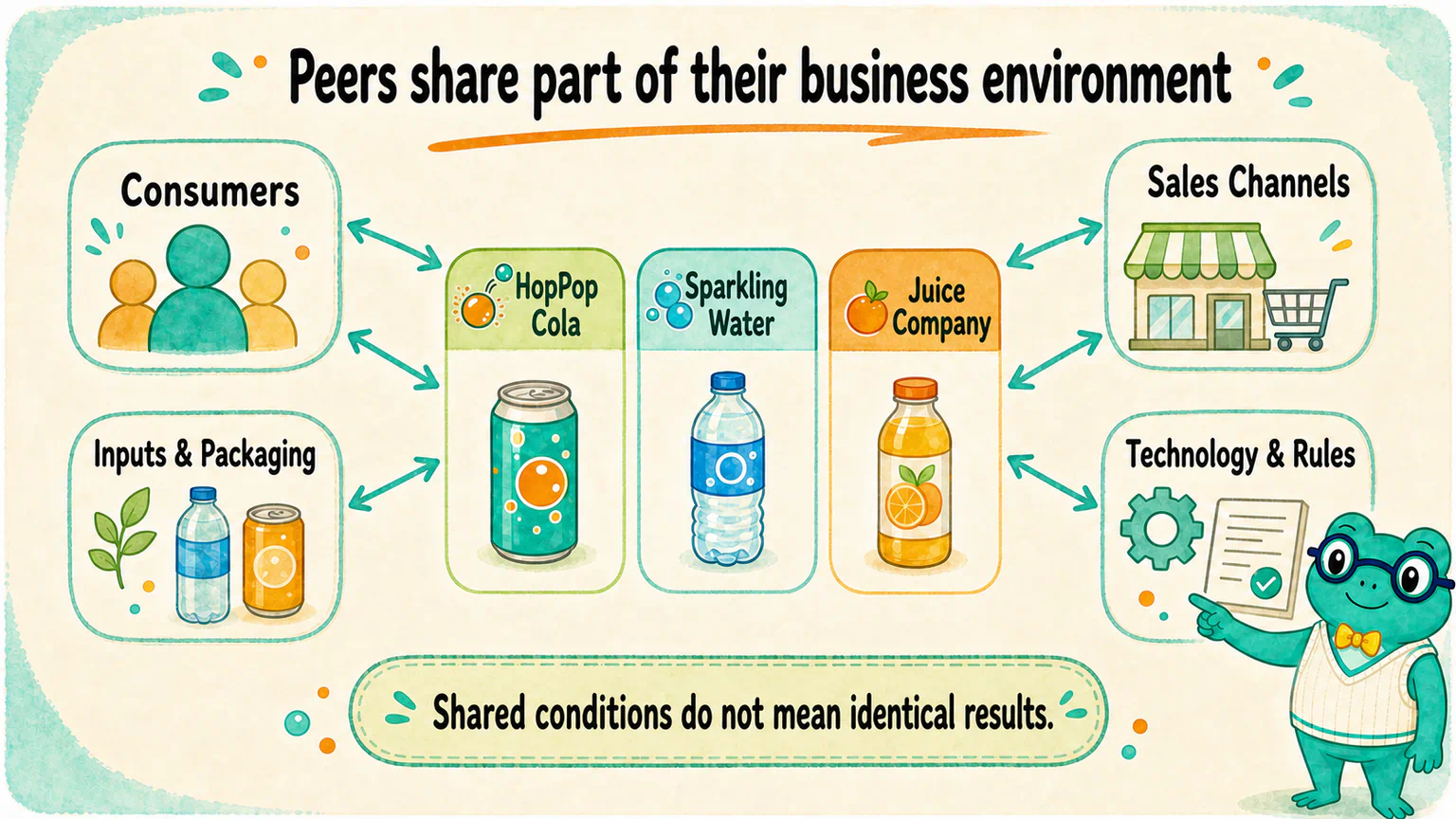
They may serve similar customers
During a very hot summer, more people may want cold drinks. Several beverage companies could gain an opportunity.
If consumers suddenly care more about sugar, traditional sugary drinks may face pressure together. A change in customer taste is not a private message addressed only to HopPop.
They may use similar inputs and services
Beverage companies may all need sugar, sweeteners, bottles, cans, cartons, transportation, and refrigerated displays.
If a common packaging material becomes more expensive, it does not need to knock on every company’s door. It can raise costs across many businesses at once.
They may compete for similar sales channels
A supermarket shelf has limited space. A convenience-store refrigerator cannot expand forever.
If one company discounts its drink to win shelf space, competitors may cut prices, spend more on promotion, or leave that particular fight. One company’s action can become a new condition for the others.
They may face similar technology and business rules
A new preservation technology may let a category of products travel farther. A new packaging requirement may force several companies to modify production lines.
But “facing the same change” tells us only that it arrived in the same neighborhood. It does not tell us what happened to each company afterward.
The same wind can hit very different boats
Suppose demand for sugar-free drinks suddenly expands.
That sounds like an opportunity for the beverage industry. The opportunity will not be deposited equally into every company’s account.
HopPop already has an established sugar-free drink and spare production capacity. It may be able to fill more orders quickly.
StillSpring wants to join in, but it needs a new formula, modified equipment, and fresh negotiations with retailers. Demand has arrived; its costs may arrive first.
TrueFruit’s customers mainly buy it for the juice flavor. The sugar-free trend may have little effect on them. TrueFruit could even lose some sales if consumers move part of their drink budget toward sparkling water.
One demand change can lead to different outcomes because each company brings different things to the moment:
- products that may or may not fit the new demand;
- enough capacity—or not enough—to fill orders;
- different brands and sales channels;
- different additional costs;
- management teams that respond at different speeds;
- financial positions that provide different amounts of room to adjust.
Shared pressure works the same way.
When packaging costs rise, a company with a long-term supply contract may feel less near-term pressure. A company with pricing power may pass part of the cost to customers. A business with an already thin profit margin may struggle more. An upstream packaging producer might even receive more revenue.
“The industry benefits” and “the industry is under pressure” are openings to a story, not endings.
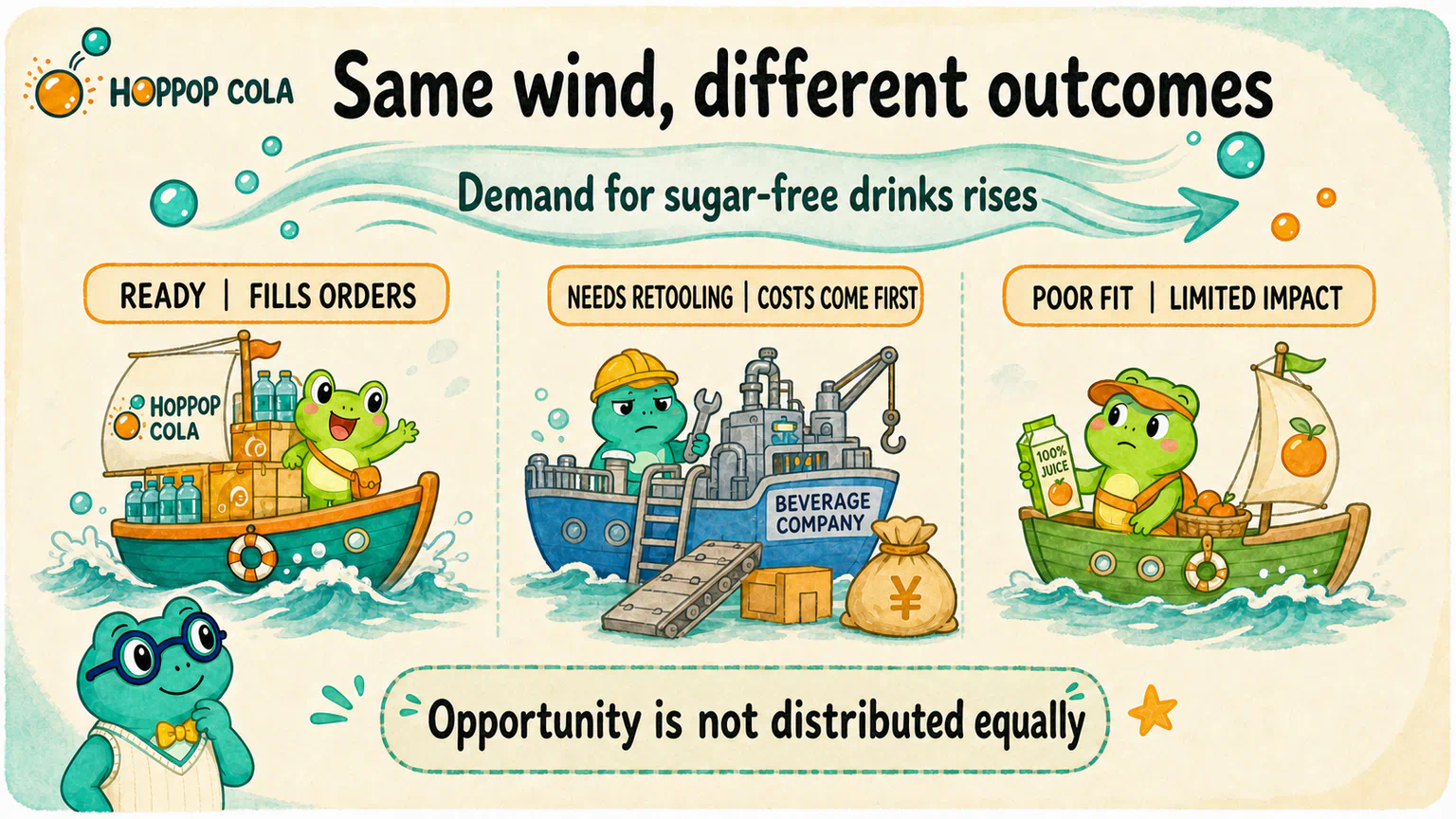
Peers can share customers, inputs, channels, technologies, and rules, so they may receive opportunities or pressure at the same time. Their products, costs, capacity, finances, and ability to respond determine why the same change does not land equally on every company.
How suppliers, peers, channels, and customers connect
We now have more than several companies standing side by side.
A bottle of soda sits inside a longer relationship:
Sugar, packaging, and equipment suppliers
→ beverage producers
→ supermarkets, convenience stores, and delivery platforms
→ the people who buy the drinks
The side supplying materials and equipment is often called upstream.
Sales channels, businesses using the product, and final customers can sit downstream.
Companies competing for customers in a similar part of the business are peers or competitors.
People often call the full set of connected stages a supply chain or, in a broader business context, an industry value chain.
An industry and a supply chain are not the same thing.
An industry mostly groups horizontal neighbors doing similar work. A supply chain helps us follow the vertical relationship from inputs through production and distribution to customers.
There is no need to memorize that as an exam answer. It simply reminds us not to stare only at beverage makers after packaging prices rise. Packaging suppliers, retailers, and consumers may receive very different effects.
One change might travel like this:
Packaging supply tightens
→ packaging prices rise
→ costs increase for some beverage companies
→ some raise prices, some earn less, and some reduce production
→ retailers and customers face new prices and choices
That is still a set of possible paths.
Long-term contracts, inventory, substitute materials, and competitive responses can change the route. A supply chain is not a row of dominoes that always falls in order.
Is this the company’s problem or an industry problem?
When something changes at one company, find a comparison: Are peers reporting something similar?
Suppose one batch of HopPop drinks has a quality problem and no competitor reports a similar incident. That looks more like a company-specific event.
Suppose sugar and packaging costs rise while several companies discuss the same pressure. That looks more like a shared industry change.
Suppose industry sales grow, but HopPop’s revenue falls. Shared demand may not be the main explanation. We may need to return to HopPop’s products, channels, or management.
There is no permanent line separating the two.
A company event can spread into an industry concern if one accident makes customers question similar products. An industry change also becomes a different company result after passing through each company’s business structure.
Comparing peers does not announce the cause for us. It helps us ask a sharper question:
Did this happen only to the company, or are many similar businesses facing it too?
An industry index is an observation basket
We cannot inspect every stock in an industry every day.
So people select a group of related stocks and use a stated method to build an industry index. The index helps them observe the performance of that basket of stocks.
That is convenient. It does not turn the index into a synchronized thermometer for every company in the industry.
First, the basket may not include every company.
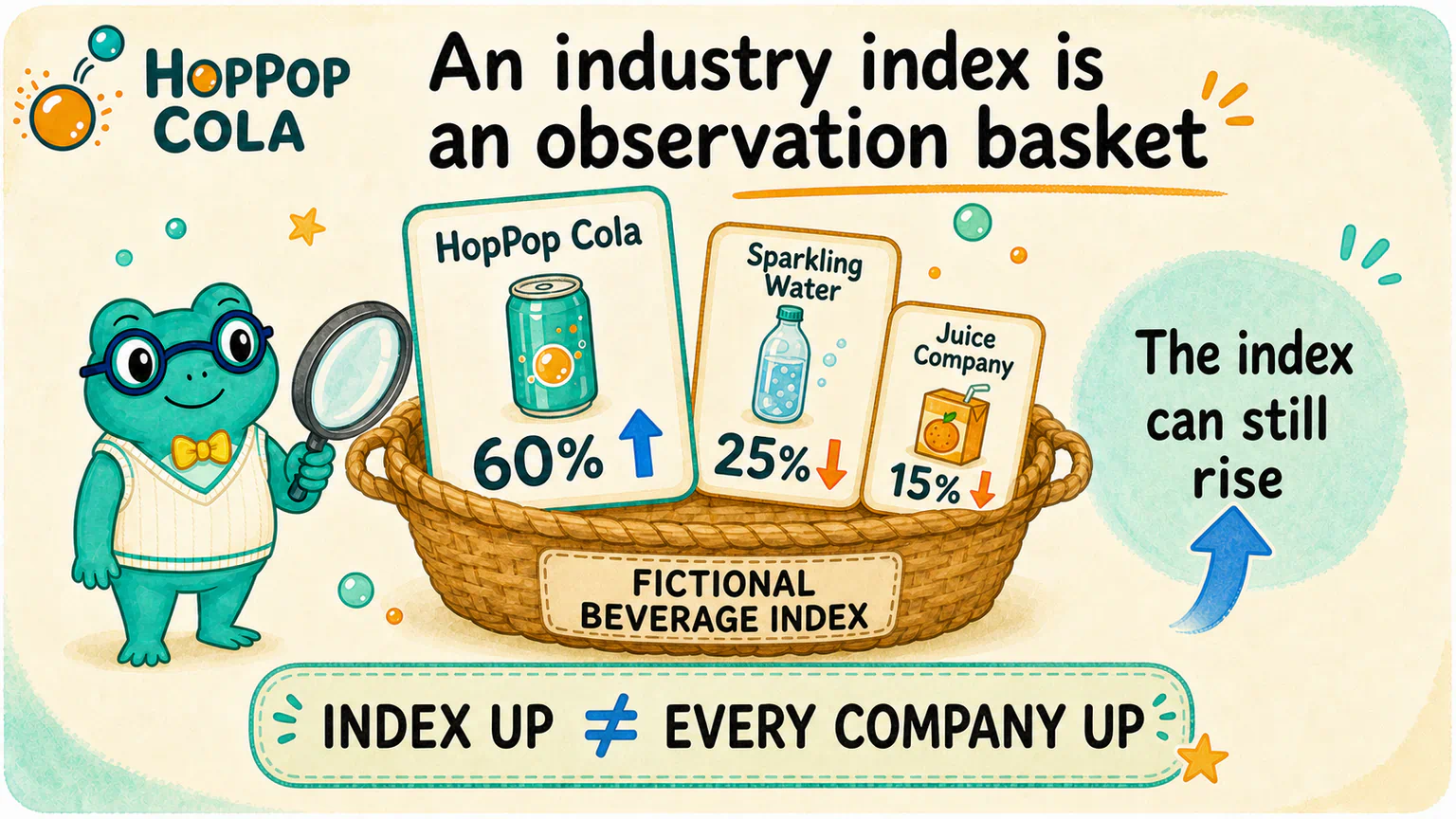
Second, every stock may not have the same influence. Imagine a fictional beverage index in which:
- HopPop Cola has a 60% weight;
- StillSpring Sparkling Water has a 25% weight;
- TrueFruit Juice has a 15% weight.
If HopPop rises enough while the other two fall slightly, the index can still rise.
“The industry index rose” therefore does not mean “every company in the industry rose.” It certainly does not mean every company rose for the same reason. What an index reflects depends on which stocks it includes, their weights, how the index is calculated, and when its constituents are reviewed.
An industry index can be a research entry point.
It can help us notice whether a group of stocks is moving together, and later it can provide quantitative data for an industry hypothesis. It is not a perfect substitute for the real industry, and it is not a finished explanation of cause.
Revisit the “shared cold”
Return to the opening scene.
HopPop Cola, StillSpring Sparkling Water, and TrueFruit Juice all fell on the same day. What does that tell us?
It gives us a reason to examine peers and the industry environment.
One day alone still cannot prove that the three companies caught the same “illness.” We need to ask:
- Did this change happen only to one company, or did several peers report it?
- Do they share the customers, inputs, channels, technology, or rules that changed?
- Is the direction really the same, and which company is affected more?
- Which companies are in the industry index, and what weight does each receive?
- Are we looking at a business change, or merely stock prices that happened to move on the same day?
These questions do not make industry research instantly easy. They do block two common mistakes:
Moving together = definitely the same cause
A better industry = every company becomes better
Hoppy wrote the three company names on a sheet of paper. Beside them, he added sugar, packaging, supermarkets, and customers.
Then he stopped.
“What if it isn’t just drinks? What if people are buying less of everything?”
“Then we need to pull the camera back again,” Dr. Hop said.
Weaker consumer spending, higher borrowing costs, and changes in the renminbi exchange rate can cross the boundary of the beverage industry and enter many completely different businesses. Next, we will ask why those distant-sounding economic changes can still reach company orders, costs, and the stock market.
Sources for this lesson
Sources checked on August 11, 2026
- FINRA: Stock Investing and Due Diligence, used to check why company research also considers competitors, peers, and the condition of the wider industry;
- FINRA: Evaluating Stocks, used to check the relationships among product demand, supply-chain challenges, company risks, industry position, and the broader economy;
- FINRA: A Guide to Equity Market Sectors, used to check how industry classification supports comparison and can be divided into multiple levels;
- Investor.gov: Index Funds, used to check that a market index measures a basket of securities and that different methods can assign different weights to constituents.
The companies, stock moves, packaging costs, sugar-free demand, and industry index in this lesson are fictional. This lesson does not predict or recommend a real industry or stock and is not investment advice.
Lesson discussion
Share a question, insight, or different view—and see how other learners are thinking.