Lesson 5
Why Can the Same Policy Make One Company Cheer and Another Worry?
Use access, costs, demand, and competition to separate a policy goal, a company result, and a stock reaction.
The document on Hoppy’s desk was not very long.
One sentence had two lines under it:
Six months from now, bottled drinks must meet new recyclable-material and recycling-label requirements.
This is a fictional teaching document. No such policy exists.
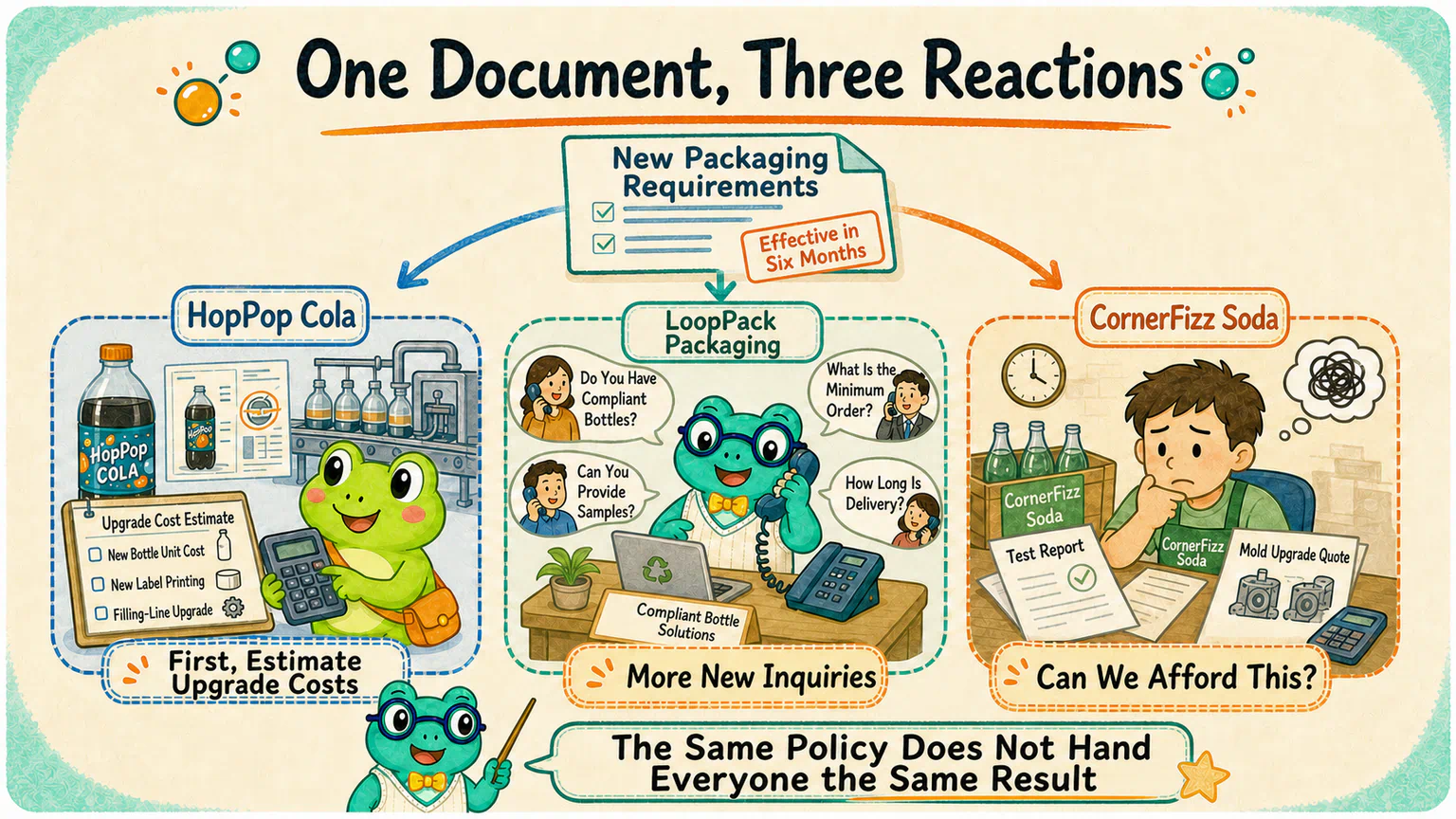
Yet as soon as the document reached three companies, the reactions could not have been more different.
The production manager at HopPop Cola began adding up the costs. Would the bottle need a redesign? Would the filling line need an upgrade? How long could the old packaging still be used?
The phones at LoopPack Packaging started ringing. Several drink companies asked the same question: “Can you deliver compliant bottles in time?”
The owner of CornerFizz Soda was the quietest. His company might sell less in a year than a large producer sells in a few days, but testing, new molds, and new labels would not disappear just because the business was small.
Hoppy looked at the same document and scratched his head.
“Why does this look like an order form for one company and a bill for another?”
Dr. Hop replied, “Because a policy does not begin by putting a ‘good news’ or ‘bad news’ sticker on a stock. It begins by changing the conditions under which somebody does business.”
Before Asking Who Benefits, Ask What the Document Actually Changes
Financial headlines love to squeeze a long document into a few words:
Encourage. Support. Regulate. Strengthen. Restrict.
Those words suggest a general direction. They often do not tell us what a company will actually face.
“Support better drink packaging” sounds positive.
But does it support materials research, factory upgrades, or consumer recycling? Who qualifies? Does a company spend first and apply for help later? When does it begin?
Different answers create different paths into a business.
So when a policy headline appears, put “Which stock benefits?” aside for a moment. Find five things first:
- Who issued the information?
- Is it a discussion, a draft, or a formally published document?
- Who does it cover, and who is outside its scope?
- Which condition does it actually change?
- When does the change begin, and what supporting arrangements are still needed?
A headline is the sign above the door. The document’s subjects, actions, conditions, and dates tell us what is actually inside.
This course uses China’s A-share market as its main case background. Policy-document forms, legal status, implementation processes, disclosure rules, and market structures differ across countries and markets. Keep the Chinese case rather than replacing it with an American one—but check the original rules of the jurisdiction you are actually researching.
Policy Often Enters a Company Through Four Doors
Policy can do many things. We are not going to build an encyclopedia here.
For now, remember four easy doors: the ticket, the bill, the order, and the playing field.
Door One: Who Can Enter, and Who Must Meet New Conditions?
Some kinds of business require a license, qualification, inspection, or technical standard.
When rules change, new companies may find it easier to enter—or may have more conditions to meet first. Existing companies may need to upgrade before they can keep operating.
This door changes market access and operating boundaries.
For HopPop Cola, the packaging standard is not an opinion. It is a concrete answer to the question, “What will count as compliant six months from now?”
Door Two: Who Pays More, and Who May Pay Less?
Taxes, subsidies, financing conditions, inspections, environmental requirements, and technical standards can all change a company’s bill.
But “there is a subsidy” does not mean free money has fallen from the sky.
A company may need to complete an upgrade first, meet eligibility conditions, and pay part of the cost itself. The support may not cover the full expense.
To decide whether a company ultimately pays more or less, we still need to compare new expenses, savings, eligibility rules, and duration.
Door Three: Who Might Receive More Orders?
Public procurement, public projects, consumer support, or newly required services can change demand for certain products.
If the fictional packaging requirements take effect, drink companies will need compliant bottles, labels, tests, and upgrade services.
LoopPack Packaging may therefore receive more inquiries.
But an inquiry is not revenue, and revenue is not profit. The company still needs capacity, quality, delivery ability, and a workable price before it can capture the opportunity.
Door Four: Who Is Competing on the Same Playing Field?
Rules can also change the conditions of competition.
Companies that could not enter before may gain access. Companies that relied on a special advantage may need to compete again. A prepared business may move faster, while a slow upgrade may cost another business some orders.
That does not mean the policy has personally selected a winner.
It has changed some thresholds, costs, and sources of demand. Companies still have to operate under the new conditions.
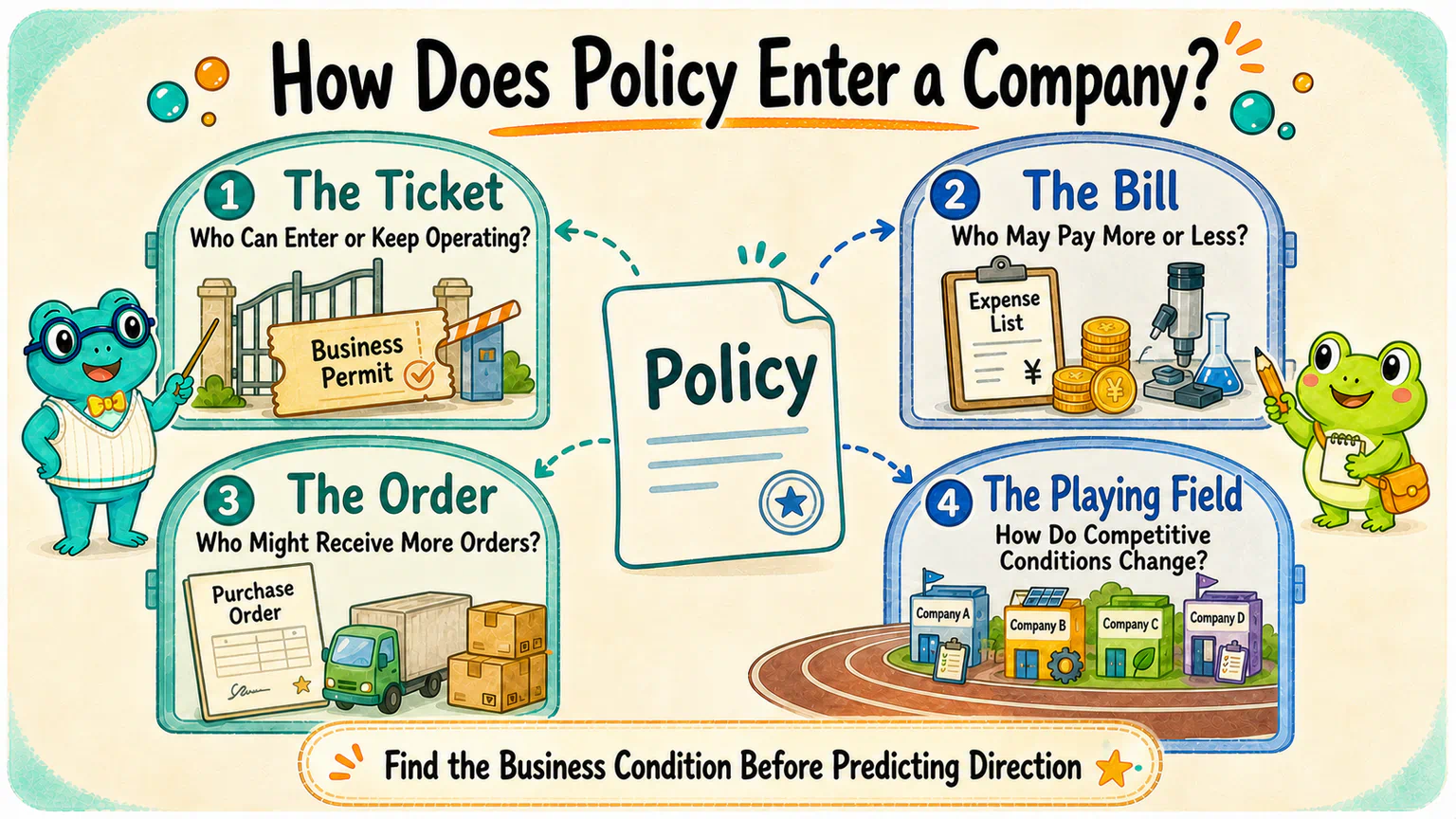
These four doors are not a complete classification of policy.
They are simply a way to translate a large word into business questions we can continue investigating.
The Same Document Does Not Hand Every Company the Same Result
Return to the three companies.
HopPop Cola needs to change packaging and complete testing, which may raise costs in the short run. If it has more cash and started experimenting earlier, it may also finish the upgrade before less-prepared competitors.
LoopPack Packaging may see more demand. But if many suppliers expand at the same time, price competition may become tougher. If LoopPack cannot deliver, ringing phones will remain just ringing phones.
CornerFizz Soda sells at a smaller scale, so testing and mold costs may add more to the cost of each bottle. Leaving the market is not its only possible response. It might change suppliers, share a production line, or adjust its products.
The same change can therefore create at least three situations:
Possible new demand
Possible new cost
Not enough information yet
One company may even stand on both sides at once.
HopPop Cola may pay for an upgrade today and gain orders later if some competitors leave. LoopPack may increase revenue while taking on larger equipment and cash demands to expand.
“Beneficiary” and “cost bearer” are not permanent identities.
We still need to ask how large the effect is, how quickly it appears, how long it lasts, and whether the company can turn the opportunity into a real result.
A Policy Goal, a Company Result, and a Stock Reaction Are Three Different Things
The fictional document may aim to make packaging easier to recycle.
That is the problem the policy hopes to address.
Whether a company gains orders, pays more, loses customers, or improves its competitive position is the business result the company actually experiences.
How market participants interpret those changes, whether they revise their view of the company’s future, and whether they actually trade may eventually create a stock-price reaction.
There is a path between the three:
What the policy hopes to change
→ What changes in the company’s operating conditions
→ Whether the company can adapt or capture the opportunity
→ How the market revises expectations about the future
→ Trades may leave a reaction in the price
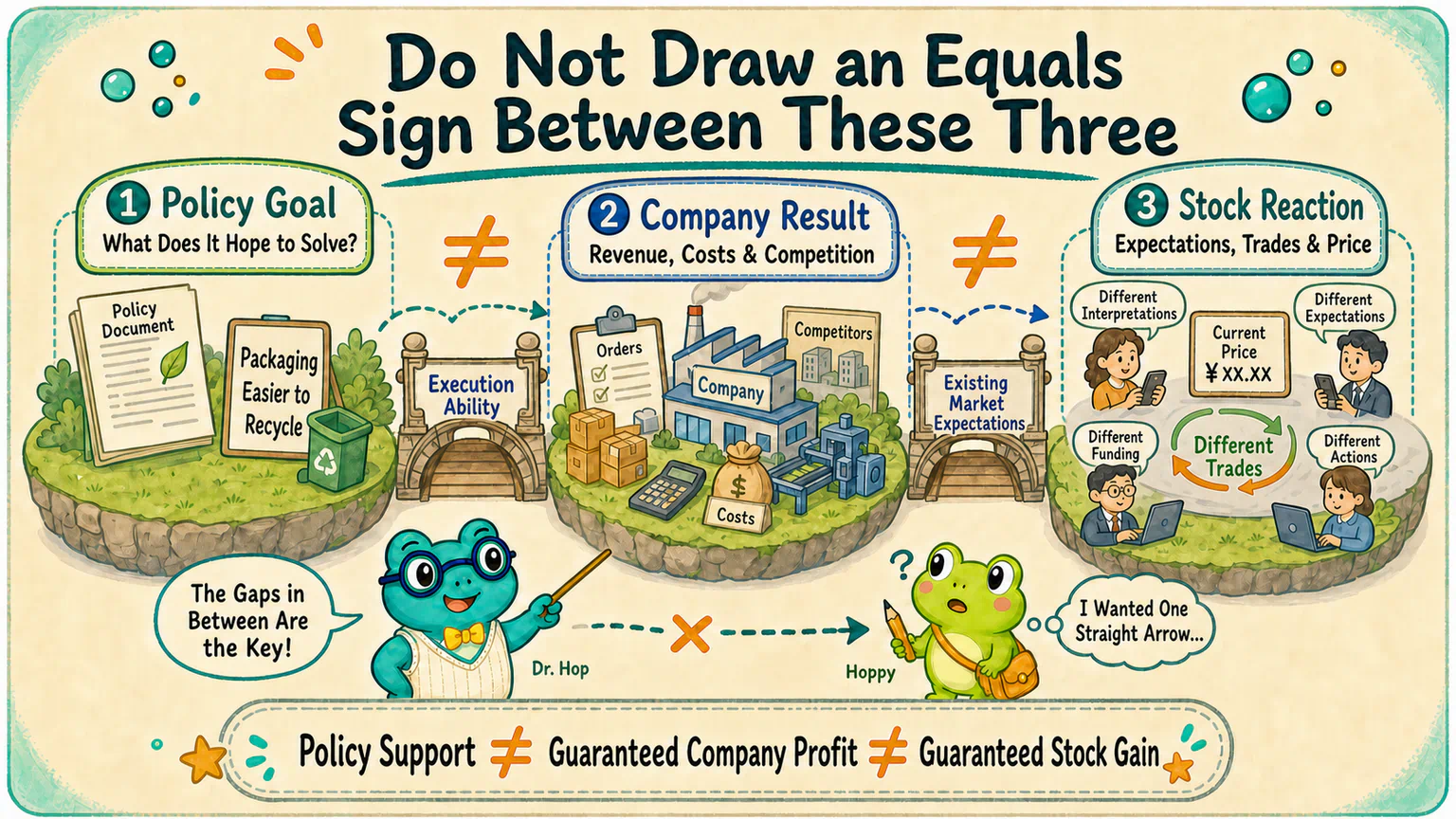
“The industry has policy support” is only the beginning of the story.
If customers do not buy, capacity is missing, the company does not qualify, or competition is already overheated, a supportive direction may not become profit for that company.
Even if the company really does receive new orders, the market may have expected them already—or expected much more.
Policy first changes rules, costs, demand, or competitive conditions. Whether a company turns that change into revenue and profit still depends on eligibility, preparation, execution, and competition. A stock reaction adds another question: what did the market expect, and did those new judgments become trades?
Publication Does Not Mean the Entire Effect Has Already Happened
Hoppy circled the words “six months from now.”
Those words matter.
If the rule takes effect in six months, companies may begin changing equipment, finding suppliers, and rewriting contracts today. Some business effects may appear early. Others may not be visible until after implementation.
Market time can begin even earlier.
Before a formal document appears, people may have heard discussions or read a draft. Some expect the idea to become official. Others expect it to change. Trading can begin while people are still guessing.
A common sequence might look like this:
Discussion or market speculation appears
→ A formal document is published
→ The rule takes effect on its stated date
→ Companies complete changes and begin operating under it
→ Effects on orders, costs, and competition gradually appear
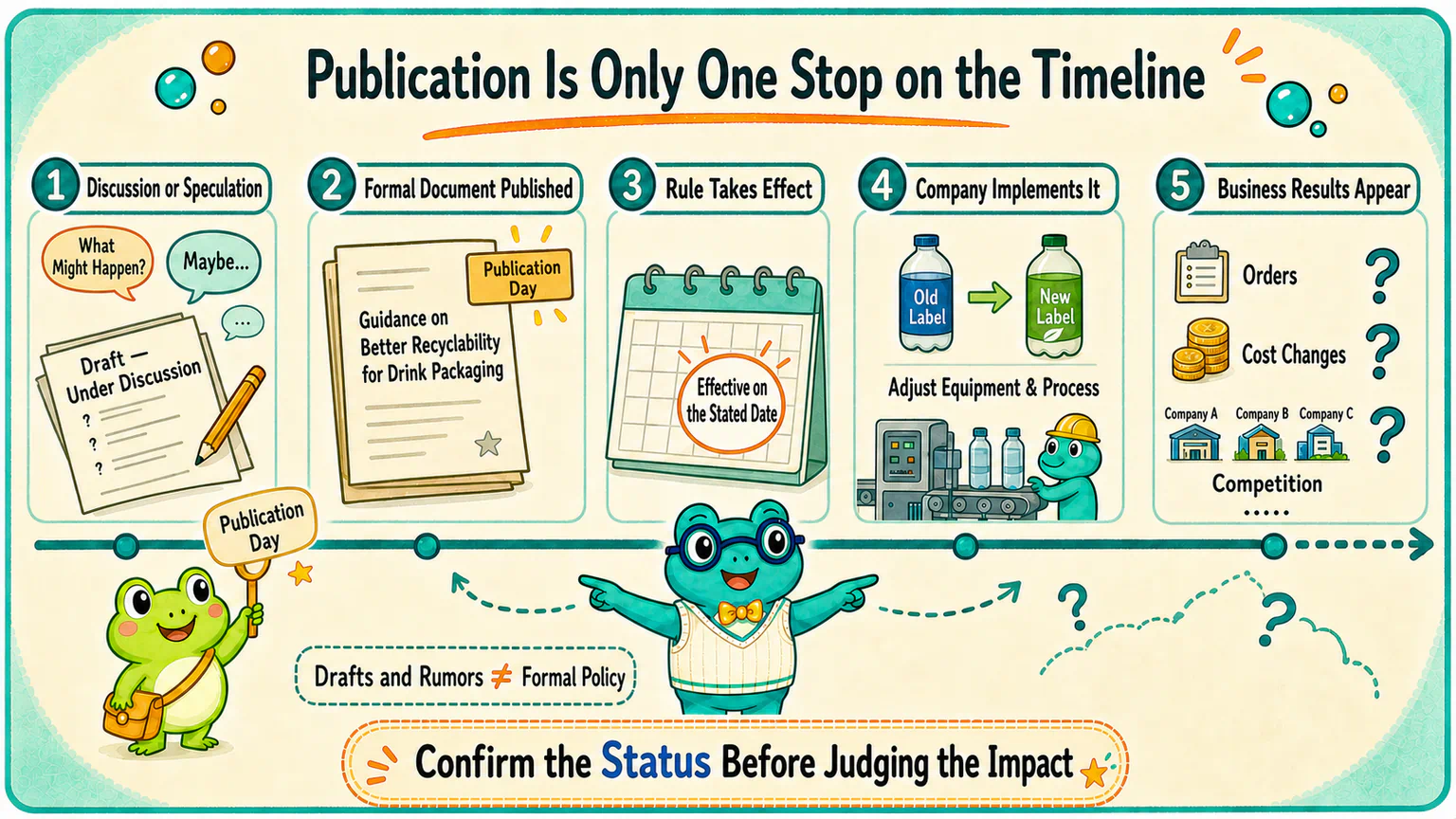
This is not a fixed process that every policy must follow.
Some documents apply quickly. Others wait for an effective date or supporting arrangements. Drafts may change, and a market rumor is not an official policy.
Because policy time has several stages, a market reaction on publication day cannot be explained by asking only whether the policy is “good” or “bad.”
Ask what changed relative to earlier expectations. Was the effective date sooner or later? Were the conditions looser or stricter than people expected?
Markets often react to the difference between new information and old expectations.
When You Read “Policy Tailwind,” Finish the Sentence
“This policy is good for the industry” leaves too much unsaid.
Rewrite it as an unfinished research question:
Because this policy changes __, it may first affect __, then reach this company through __. But whether the company can capture it, when it appears, and what the market expected still need to be checked.
Then ask:
- What kind of document is this, and what is its current status?
- Who is covered, and who is outside its scope?
- Does it change the ticket, the bill, the order, or the playing field?
- Who might gain an opportunity, who might bear a cost, and who is still unclear?
- When do publication, effectiveness, and actual implementation occur?
- Which qualifications, capacity, funding, and execution ability does the company need?
- What did the market already expect?
These questions do not predict a stock price for us.
They turn an impulsive headline into an impact path that can be investigated.
Hoppy looked at the three companies again.
He could now say that the fictional document might increase upgrade costs for HopPop Cola and CornerFizz Soda, while increasing possible demand for LoopPack Packaging.
He still could not say who would definitely make money, who would definitely leave the market, or which stock “should” rise.
Too many questions remained: What would testing actually cost? Could suppliers deliver on time? How would small companies adapt? How much had the market guessed already?
The next day, there was no new policy document and no new company announcement.
The price moved anyway.
Hoppy stared at the policy path he had drawn and noticed something missing.
He had been drawing what happened to companies and the outside world. He had not yet drawn the buyers’ and sellers’ cash needs, position limits, or nervousness.
Next, we will look at why funding decisions and emotions inside the market can move prices even when the company and the outside news have not changed.
References
Sources checked on August 11, 2026
- State Administration for Market Regulation: Measures for Implementing the Fair Competition Review Regulation, used to verify that policy measures involving business activity may concern market entry and exit, industry development, public procurement, qualification standards, regulatory enforcement, operating costs, and competition.
- The State Council of China: Decision to Amend the Regulation on Procedures for the Formulation of Rules, used to verify the distinction between a rule’s publication date and effective date, as well as the general interval and exceptions.
- The State Council of China: Policy Explanation of the Fair Competition Review Regulation, used to verify that policy measures can affect competitive conditions through market access, tax preferences, fiscal rewards, subsidies, and access to production factors.
- FINRA: Stocks, used to verify that legislation, regulation, standards, and specific taxes can change business or industry risk, while stock performance still depends on investors’ expectations and demand.
The companies, packaging document, and company reactions in this lesson are fictional. This lesson does not interpret or predict current policy, identify policy beneficiaries, teach policy-theme trading, or provide legal or investment advice.
Lesson discussion
Share a question, insight, or different view—and see how other learners are thinking.