Lesson 2
Why Should the Market Care When a Company’s Business Changes?
Separate units, prices, revenue, costs, profit, cash, and business risk to see why company changes may affect expectations.
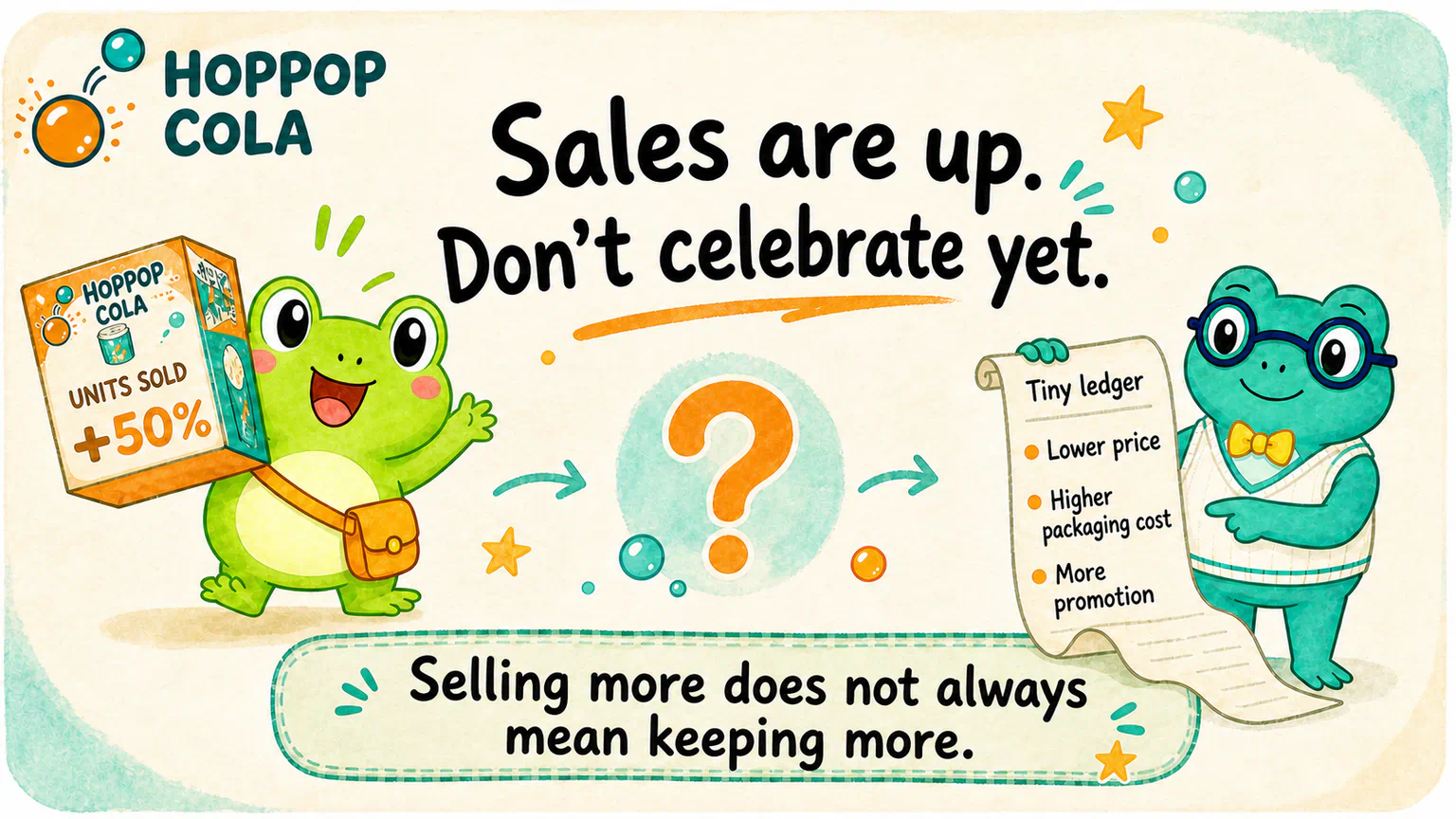
Sales of HopPop Cola’s new sugar-free drink were up 50% from the previous month.
Hoppy saw the news and immediately started typing in the group chat:
“The new drink isn’t fading! If sales are up 50%, profit should be up about 50% too, right?”
Before he could send the message, Dr. Hop handed him a tiny ledger.
Last month, HopPop sold 100 cases at RMB 50 each. That produced RMB 5,000 in sales revenue. After subtracting a few direct expenses, the simplified amount left over was RMB 1,200.
This month, HopPop really did sell 150 cases—50% more. But it cut the price to RMB 40 for a promotion. Packaging became more expensive, and the campaign cost extra money. Sales revenue reached RMB 6,000, yet only RMB 300 remained in this deliberately simplified ledger.
Hoppy deleted his message one character at a time.
“It sold more. Revenue went up too. How did it end up keeping less?”
That is the first chain of equal signs we need to break:
More units sold ≠ revenue rising by the same percentage
                ≠ profit rising by the same percentage
Selling more answers only the first question
To earn revenue, a company usually has to sell a product or service.
For this simplified HopPop example, we can begin with one plain relationship:
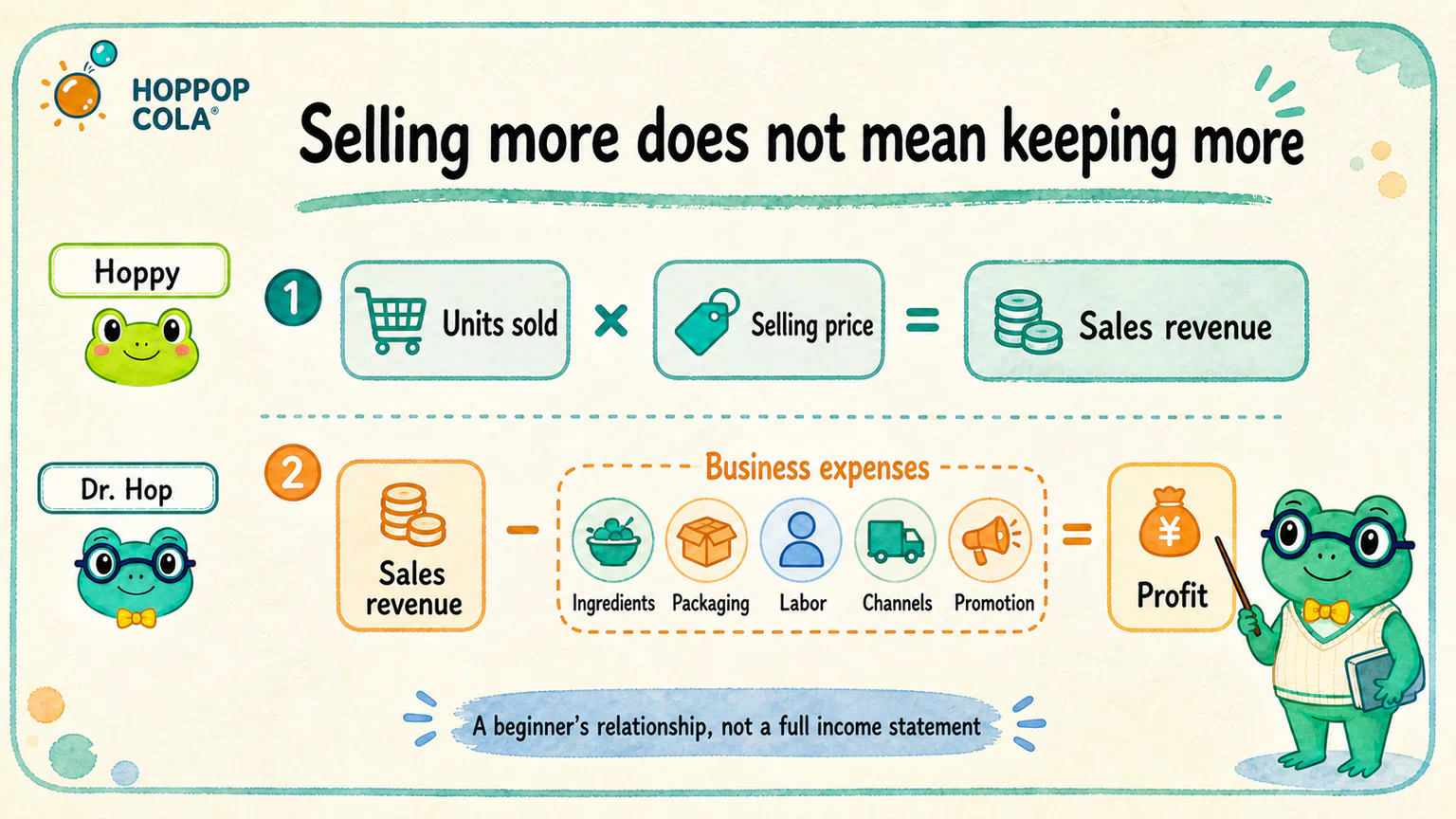
Units sold × Selling price = Sales revenue
The number of cases rose from 100 to 150, an increase of 50%.
The price fell from RMB 50 to RMB 40, so revenue rose from RMB 5,000 to RMB 6,000—an increase of only 20%.
That is not automatically good news or bad news. It simply tells us that units sold and sales revenue are not the same thing.
A real company may also sell many products. An older drink can lose sales while a new one gains them. The mix between expensive and inexpensive products can change. Real financial reporting also has fuller rules for when revenue is recognized, but we are not turning this into an accounting course.
For now, build one habit: when you read “sales volume surged,” do not fill in all the remaining equal signs.
Ask one more question first: Did the selling price change?
Money comes in, and money keeps going out
Sales revenue is not what the company ultimately keeps.
To put one case of cola on a store shelf, HopPop may need ingredients, packaging, factory workers, shipping, and retail channels. It might also pay for advertising, promotions, new-flavor research, or a larger production line.
We can capture the basic idea with another rough relationship:
Sales revenue
− the many costs and expenses of running the business
= profit left after those expenses
This is a teaching shortcut, not a complete income statement.
Real financial reports contain many more items and accounting rules, and “profit” itself has several formal measures. You do not need those names yet. We only need to see one easily missed fact: expenses can rise faster than revenue.
Higher sales of a new drink may mean customers truly like it. They may also come from a steep discount, a large advertising campaign, or a company spending nearly every extra yuan of revenue to buy attention.
So Hoppy’s ledger does not prove that HopPop’s business became worse. It only shows that units sold alone are not enough to tell us whether the company earned more or less.
HopPop is a fictional company, and the numbers use renminbi because this course uses China’s A-share market as its main case background. The basic business relationships in this chapter travel well across markets. Reporting formats, accounting standards, disclosure rules, and the data available to investors can differ, so research on a real company still has to follow the rules of its own market.
How can a profitable business still feel short of cash?
The story is not over.
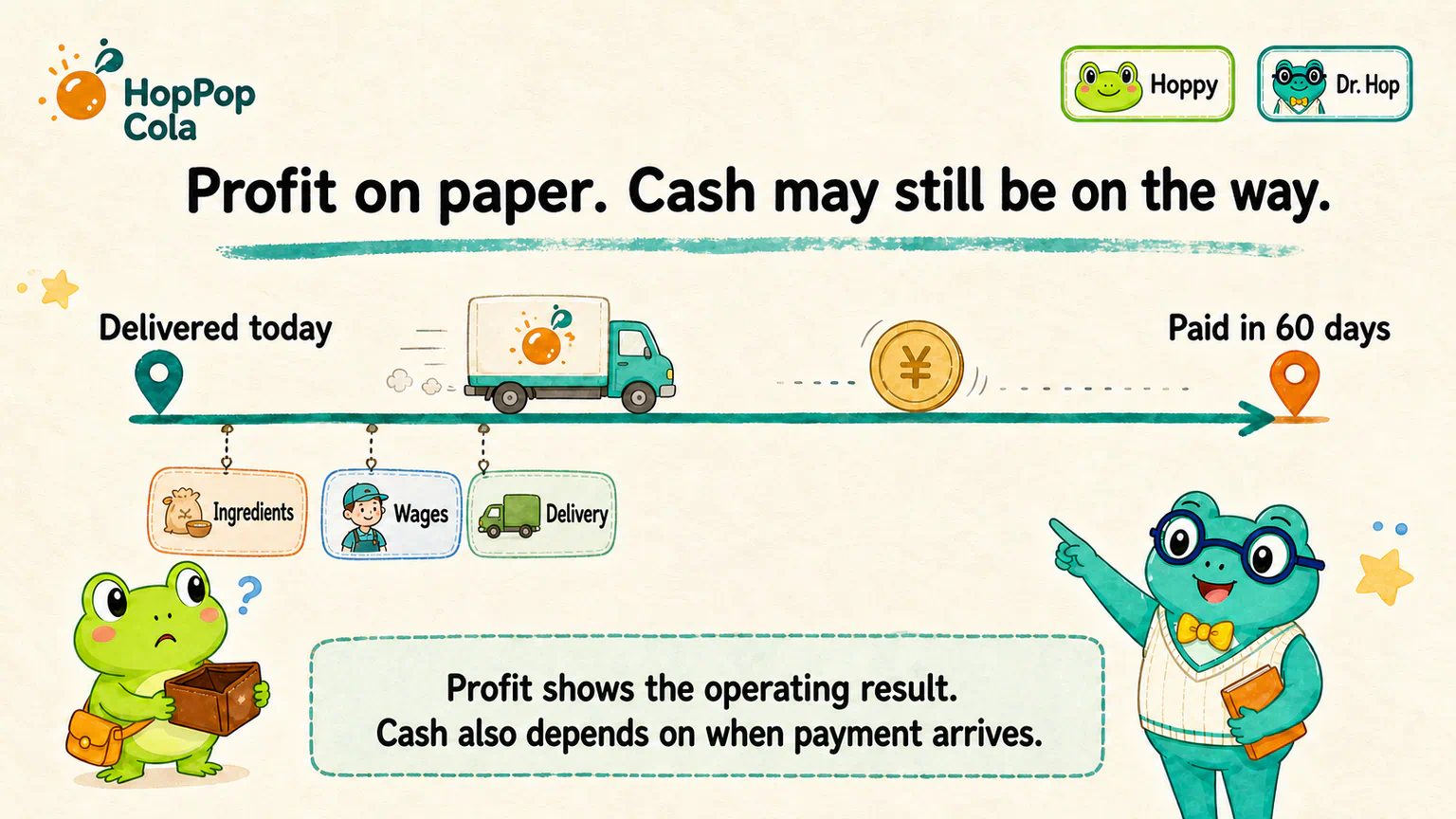
Suppose HopPop delivers those 150 cases to a supermarket chain. Under the contract, the supermarket will pay 60 days later.
The sale may already be included in the company’s reported operating result, but the money is still on the way. Meanwhile, the ingredient supplier wants payment this week. Employees must be paid at the end of the month, and the delivery company will not wait two months either.
That creates a situation that sounds odd but is perfectly possible:
The business may show a profit on paper while the company still feels short of cash.
The reverse can happen too. A company can borrow money and see the cash in its bank account increase. That borrowed cash is not profit earned by selling cola, and it has to be repaid.
This is why looking at a company cannot stop at profit.
Profit asks something like: Under the relevant reporting rules, did the business earn or lose money during this period?
Cash adds another question: When did money actually arrive, and when did money have to leave?
A cash shortage does not mean a company is about to collapse. Borrowing does not automatically make a company dangerous either. Healthy businesses can use debt and can have gaps between collecting from customers and paying suppliers.
The useful questions are more specific: Does the company have enough cash for the bills in front of it? Can it handle debt when payment comes due? If sales disappoint, can it keep operating?
Those questions go beyond “How much did it earn?” They are also about pressure on the business and its ability to absorb a surprise.
One good month is not a lifetime subscription
Now suppose HopPop did not rely on a discount and its profit truly increased.
We still cannot rush to write a happy ending.
The market can keep asking:
- Do customers genuinely like this flavor, or did they only try it once?
- Did demand last, or was this a one-time promotion?
- Can the company keep producing reliably, or is the factory already stretched?
- Will competitors release similar drinks?
- Is the packaging increase temporary or likely to persist?
- Could a management change, product-quality incident, or failed expansion create a new risk?
A current business change can matter to the market for more than the number reported this month.
People use that change to revise their picture of the future: Can the company keep selling? For how long can it keep earning? What will continued growth cost? Can the business withstand a setback?
That is why a product launch, store expansion, management change, and serious operating incident may look unrelated but still enter expectations through a few common doors:
Could future revenue change?
Could future costs change?
Could operating risk change?
Could the room for future growth change?
If the business improved, should the stock go up?
At this point, another tempting equation appears:
A better business = a rising stock
That equation still moves too quickly.
The market does not only ask whether the result improved. It compares the result with what people expected before it arrived.
If many participants had expected HopPop’s sales to double, a 50% increase could disappoint even though sales clearly rose.
If people had feared that no one would buy the drink at all, the same 50% increase could be much better than expected.
Participants may also act on orders, channel checks, or other information before the formal result is announced. By announcement day, part of the change may already have been traded.
Company facts matter. They still do not bypass expectations and trading to press an automatic “stock up” button.
When you read company news, do not connect units sold, revenue, profit, cash, and stock price with one long row of equal signs. They answer different questions. Even after the business genuinely improves, we still need to ask whether the change can last, what the market expected, and whether those expectations have already entered trading.
What do people mean by “fundamentals”?
In financial conversations, this whole territory is often called company fundamentals.
The phrase sounds grand. For now, translate it into ordinary language:
How does this company make money, how is the business doing now, and can it keep going?
Units sold, prices, revenue, costs, profit, cash, debt, products, management, and operating risks can all provide pieces of the answer.
Fundamentals are not one number. They are not a report card that automatically tells you what to buy or sell. They are a set of business facts that need to be checked against one another.
Read only one number, and you can easily miss half the story.
A plain-language checklist for company news
We do not know how to read a full financial report yet. We do not need to.
When you see news such as “sales surged,” “profit hit a record,” “the company is expanding,” or “a serious incident occurred,” begin with a few ordinary questions:
- What did the company sell, how much did it sell, and did the price change?
- How much did revenue change, and what extra costs or expenses appeared?
- Are profit and cash describing the same event and the same timing?
- Could this change continue, or did it happen only once?
- Was the result better, worse, or roughly equal to what the market expected?
- Do I have a business fact, or someone else’s “good news” or “bad news” label?
These six questions will not tell us whether a stock should rise or fall.
They do something more practical: they stop an exciting headline from turning directly into a rushed investment conclusion.
Hoppy looked at HopPop’s tiny ledger again.
This time, he did not stare only at “sales up 50%.”
He circled a few more questions. Why did packaging become more expensive? Who forced the discount? Why did customers suddenly want sugar-free drinks? Were other cola companies running promotions too?
As the questions grew, they walked out of HopPop’s office.
Suppliers, supermarkets, competitors, and customers were all waiting outside.
A company never does business in a sealed room. Next, we will look at the business world around it—and ask why many stocks in one industry sometimes seem to catch the same cold, yet can also end up with very different results.
Sources for this lesson
Sources checked on August 11, 2026
- FINRA: Evaluating Stocks, used to check the roles of a company’s business model, product demand, profitability, debt, industry position, and business risks;
- FINRA: Using Financial Statements to Evaluate Investment Opportunities, used to check the different roles of revenue and expenses on an income statement and cash inflows and outflows on a cash-flow statement;
- FINRA: Financial Performance Metrics Every Investor Should Know, used to check that net income subtracts multiple kinds of expenses from revenue and that any one profit measure tells only part of the company’s story;
- Investor.gov: How to Read a 10-K/10-Q, used to check that public reports may discuss operating results, liquidity, capital resources, known trends, uncertainty, and business risks.
HopPop Cola, its sales growth, prices, expenses, payment terms, and operating events are fictional. The tiny ledger is not a financial statement, and this lesson is not investment advice.
Lesson discussion
Share a question, insight, or different view—and see how other learners are thinking.