Lesson 4
Why Can a Changing Economy Affect So Many Stocks at Once?
Start with demand, prices, interest rates, and exchange rates to trace how economic changes reach companies and markets.
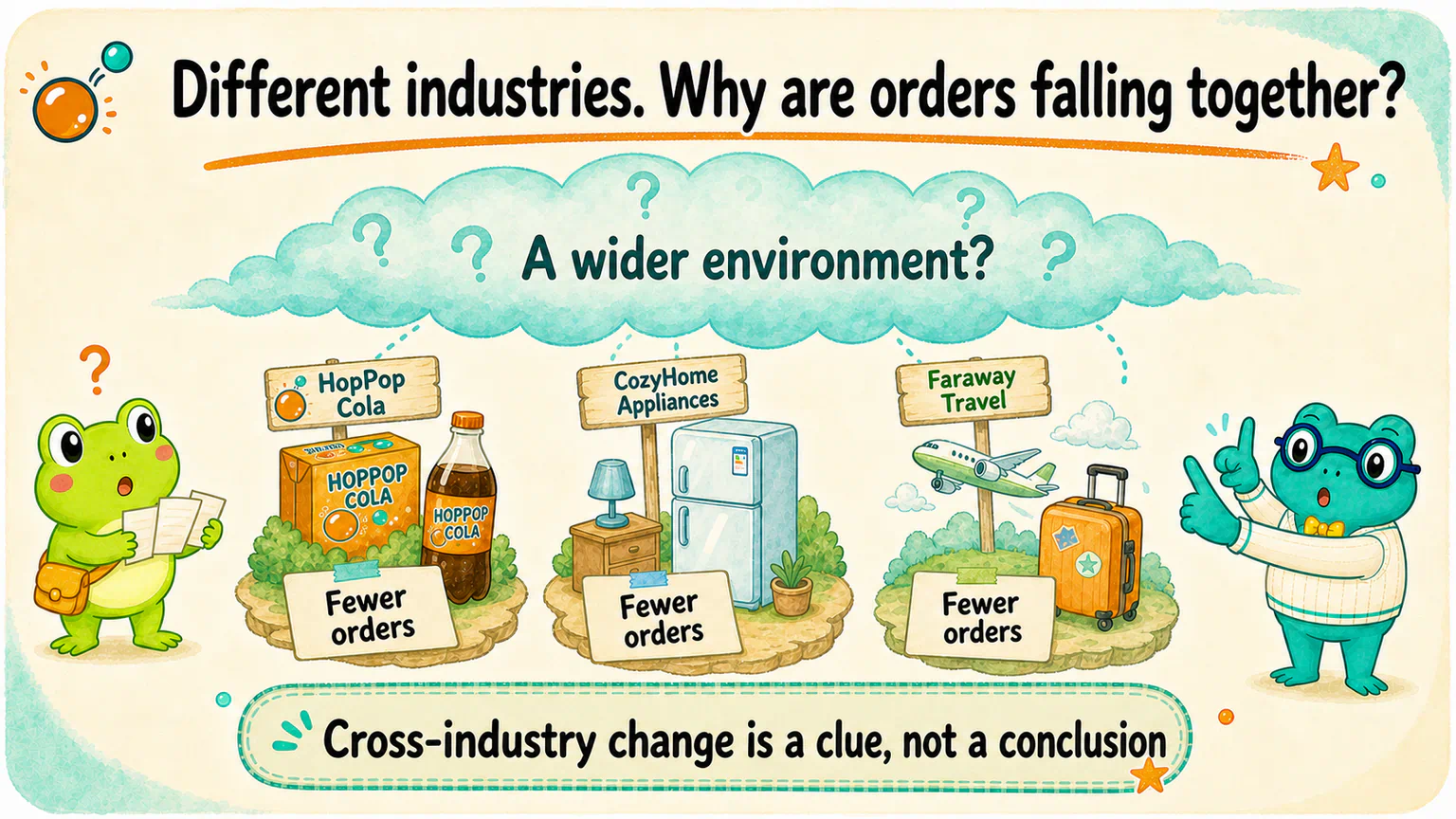
At the end of the month, Hoppy found three company updates on his desk.
HopPop Cola said its distributors were restocking more cautiously.
CozyHome Appliances said some customers had decided to keep their old refrigerators for another year.
Faraway Travel said long-distance bookings had also slowed down.
Hoppy drew three circles around the companies.
One sold drinks, one sold appliances, and one sold trips. They did not use the same ingredients. They did not even compete for the same shelf space.
“These three companies could not share a warehouse if they tried. So why are their orders falling at the same time?”
Dr. Hop did not immediately announce that the economy was getting worse.
“Let’s not diagnose an entire economy from three company updates. They are only a clue that we may need to pull the camera farther back.”
If many households decide to buy a little less—or wait a little longer—the change will not stay inside one industry.
If many businesses delay expansion and cut purchases at the same time, equipment makers, material suppliers, logistics companies, and hiring plans may all feel it.
That is why something as large-sounding as the economy can still arrive at one company’s front door.
“The Economy” Is Not a Cloud of Numbers in the Distance
When we study one company, we ask how it sells products, pays its costs, and earns a profit.
When we pull back to an industry, we look at a group of similar companies facing related customers, materials, sales channels, and competitors.
Pull back again, and we start watching what many households, businesses, and governments are doing at the same time:
- How much are people willing and able to spend?
- Are businesses willing to invest and hire?
- How are the prices of goods and services changing?
- How expensive is it to borrow money?
- How much of another currency can the local currency buy?
These broad changes make up what we will call the economic environment.
It is not a remote control floating above the stock market.
It is more like millions of decisions about income, spending, borrowing, and investing changing together, then reaching companies and markets through orders, costs, cash, and trades.
We will focus on four common entry points: demand, prices, interest rates, and exchange rates.
This course uses China’s A-share market as its main case background. These broad cause-and-effect paths appear in markets around the world, but interest-rate systems, currencies, data calendars, policy frameworks, and trading rules differ. When you conduct real research, use the definitions and rules of the market you are studying.
When Demand Changes, Companies May Feel It Through Orders
We do not need to begin by memorizing a formal definition of economic growth.
Imagine something more ordinary.
Households feel secure enough to spend more. Businesses receive more orders and decide to buy equipment or expand factories. Governments also purchase goods and services.
One person’s spending becomes somebody else’s income or order.
Households, businesses, or governments spend more
→ More goods and services are purchased
→ Some companies receive more orders
→ Those companies may increase production, purchasing, and hiring
When many kinds of production and trade expand together, people say the economy is growing.
The reverse can happen too. If many households worry about the future while businesses postpone expansion, demand may weaken across several industries. A drink company, an appliance maker, and a travel business may all feel the change even though they sell completely different things.
But “the economy is growing” still does not mean “every company is growing.”
Where does the new demand land? Can the company handle the orders? Is competition already fierce? Did the market expect the growth months ago? Different answers can lead to different company and stock outcomes.
When Prices Rise, Selling Prices and Costs Can Move Together
One shipment of sugar becoming more expensive does not prove that an entire economy has inflation.
Inflation is a broad rise in the overall price level of a basket of goods and services over time. It is about a wider pattern, not one item becoming expensive on its own.
When that pattern reaches a company, it can touch several parts of the business at once.
HopPop Cola might be able to charge an extra half a yuan per bottle. That sounds good for revenue.
But sugar, cans, transport, and wages may also cost more. Once customers are paying more for food, rent, and travel, they may decide to buy fewer bottles of cola.
Price changes can therefore affect:
How much a company can charge
How much it costs the company to produce
How much customers can still buy with their money
Some companies can raise prices without losing many customers. Others lose buyers as soon as they try. Some have already locked in material prices, while others feel the new costs immediately. An industry may even be one of the sources of the price increase.
So rising inflation is not one market-wide bad-news notice. Falling inflation is not an automatic “stocks go up” button either.
When Interest Rates Change, Borrowing and Alternatives Change Too
For now, think of an interest rate as the price paid to use money.
Households pay interest when they borrow for a home or a car. Companies also count interest costs when borrowing to build factories or buy equipment.
When borrowing becomes more expensive, some households may delay large purchases and some businesses may pause expansion. The change can continue through spending and orders.
Borrowing costs change
→ Households and businesses reconsider spending
→ Consumption, investment, and company orders may change
Interest rates can also change the comparisons investors make.
If the returns available on deposits or bonds change, some people will reconsider how much money—and how much uncertainty—they are willing to put into stocks.
But this does not mean:
Rate cut = stocks must rise
Rate increase = stocks must fall
Lower rates may reduce borrowing pressure, but they may also arrive because the economy is already weak. Businesses may still refuse to borrow. Households may still refuse to spend. The market may have expected the move already—or expected a much larger one.
When interest-rate news appears, the arrow is not enough. Ask who is borrowing, why the rate changed, when the effect could travel through the economy, and what the market expected beforehand.
Exchange Rates Can Send Importers and Exporters in Different Directions
An exchange rate tells us how much of one currency can be exchanged for another.
This topic becomes confusing quickly because news stories use words such as “stronger,” “weaker,” “appreciation,” and “depreciation” without always saying what the currency is being compared with.
Let’s use one fictional scenario: the renminbi, or RMB, weakens against a particular foreign currency.
If HopPop Cola needs that foreign currency to buy imported equipment, the same machine may now cost more in RMB.
If FarSail Equipment sells products overseas, the same amount of foreign-currency revenue may convert into more RMB.
If CozyHome Appliances mainly buys and sells inside China, the direct effect may be smaller. It could still be affected indirectly through competitors, materials, or customer spending.
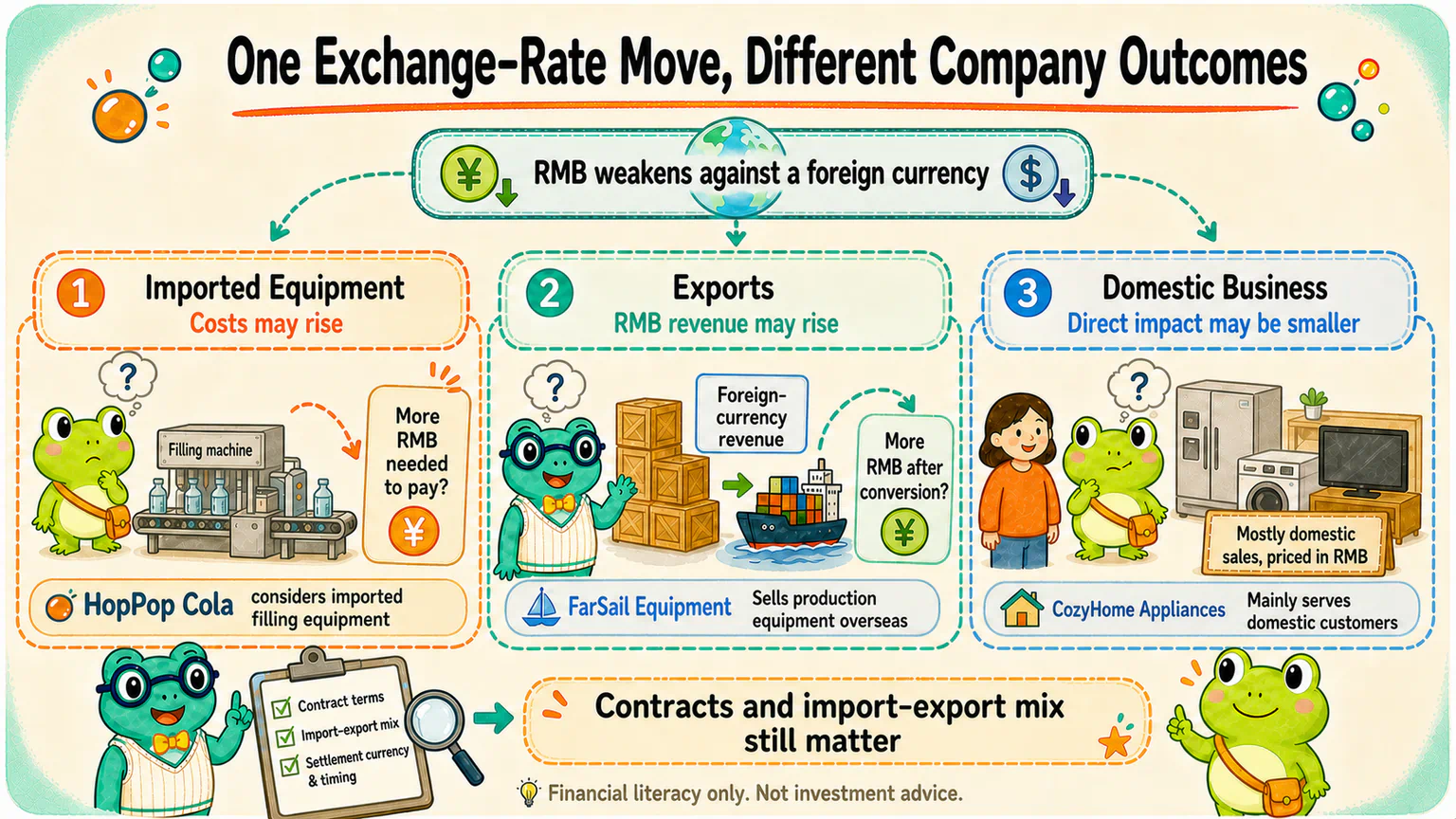
None of these paths is guaranteed.
A company may have hedged the exchange rate in advance. It may import parts and export finished products at the same time. It may use long-term contracts. Overseas demand, pricing, and competition still decide whether customers keep buying.
“A weaker RMB helps exporters” can be a starting hypothesis to check. It cannot be the conclusion.
Four Changes, Four Starting Points
Now place the four entry points side by side:
Demand changes → Orders and revenue
Price changes → Selling prices, costs, and purchasing power
Interest-rate changes → Borrowing costs, spending, and asset comparisons
Exchange-rate changes → Import costs, export revenue, and cross-border competition
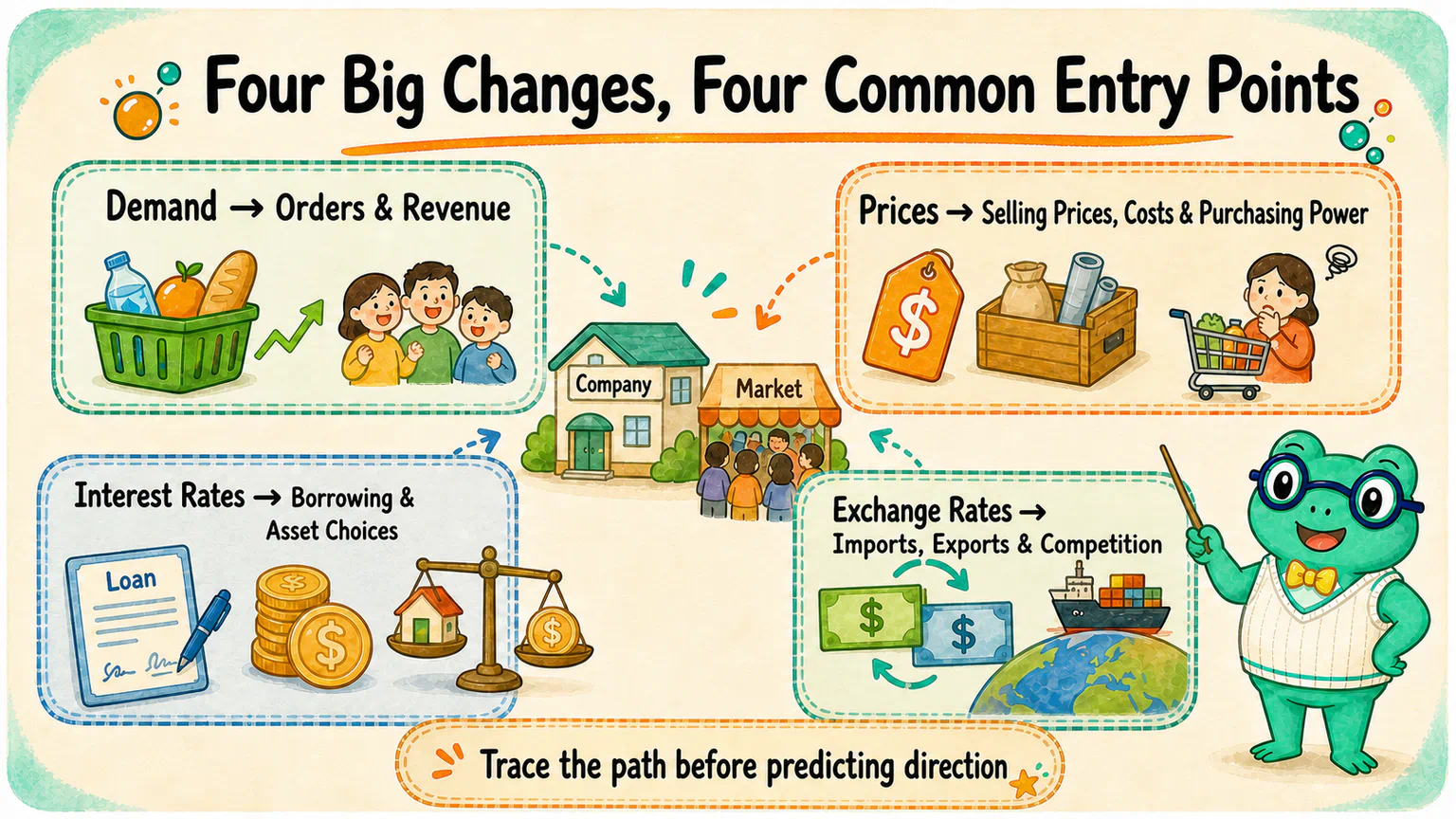
These arrows are investigation paths, not programs that run automatically.
One change can also travel down several paths at once.
An interest-rate change may affect a company’s loan costs, whether customers borrow to spend, and how investors compare stocks with other assets. An exchange-rate change may enter through material costs, overseas revenue, and competitive pressure.
Broad economic changes can eventually reach stock prices in two major ways:
- They change expectations about a company’s future revenue, costs, and risks.
- They change how market participants want to arrange their money and bear uncertainty.
That is why the same economic release can produce different reactions across industries, companies, and even different moments in time.
Economic changes do not send the same instruction to every stock. Demand, prices, interest rates, and exchange rates first affect different people and companies. They then enter the market through orders, costs, borrowing, cross-border business, and funding choices. The direction, size, and timing still need to be investigated.
The Release Date Is Not the Day the Change Began
Financial news often says:
An economic statistic was released today, and the market reacted.
That wording makes it easy to imagine that the economy itself suddenly changed today.
The real sequence is usually closer to this:
Households and businesses make real-world choices
→ A statistical agency collects data over a period of time
→ The data is released later
→ The market compares the result with earlier expectations
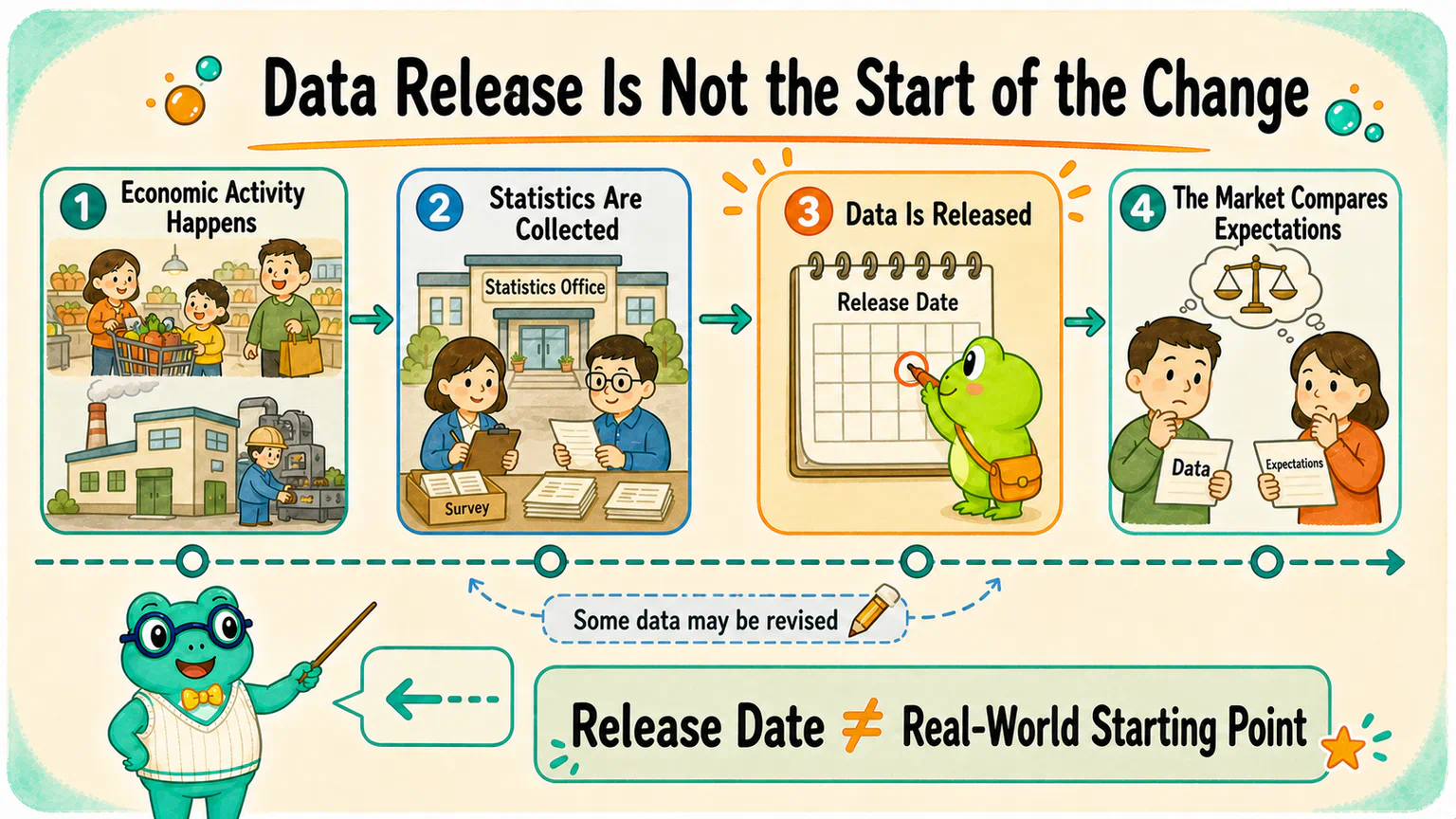
For example, first-quarter data describes activity from January through March. An early estimate is usually published only after the quarter has ended, and some statistics are revised when more complete information arrives.
Meanwhile, companies, consumers, and market participants do not stop living until release day.
Orders, hiring, prices, and other clues may have shaped expectations already. When the data finally appears, the market is not only asking whether the number is “good” or “bad.” It is also asking:
- How different is it from what people expected?
- Which period does the number describe?
- Does it change expectations about the future?
- Was the result already reflected in prices?
An economic statistic is an important window. It is not a time machine, and it is not the economy itself.
A Plain-Language Checklist for Economic News
We do not need to predict the economy today. We do not need to memorize a wall of indicators either.
When you see phrases such as “growth slowed,” “inflation rose,” “interest rates fell,” or “the RMB weakened,” start with six questions:
- What actually changed: demand, prices, borrowing costs, or the relationship between currencies?
- Who feels it first: households, businesses, importers, exporters, or market participants?
- Does it first change revenue, costs, spending decisions, or asset comparisons?
- When might the effect appear, and how long might it last?
- Which period does the data describe, and when was it released?
- How does the result differ from what the market expected?
These questions do not make macroeconomic research easy.
They do stop us from translating one large word into one market-wide answer about prices going up or down.
Hoppy looked again at HopPop Cola, CozyHome Appliances, and Faraway Travel.
He now understood that fewer orders across three industries could come from a broader change in demand. Three updates alone still could not prove the cause.
Then a new document arrived.
It proposed new packaging requirements that would take effect in a few months.
“This does not look like weather changing slowly,” Hoppy said. “It looks like someone changed the rules of doing business.”
Next, we will look at how policy can change market access, costs, demand, and the boundaries of a business—and why the same policy can make one company happy and another company nervous.
References
Sources checked on August 11, 2026
- Federal Reserve: Why do interest rates matter?, used to verify how interest rates affect household and business borrowing costs and spending decisions.
- IMF: Inflation — Prices on the Rise, used to verify the broad meaning of inflation and its relationship with purchasing power and costs.
- Bank of England: Who sets exchange rates?, used to verify how exchange-rate changes may affect imports, exports, and businesses.
- U.S. Bureau of Economic Analysis: Gross Domestic Product, used to verify that quarterly data is released after the measured period and that early estimates may be updated as more information arrives.
- Investor.gov: Introduction to Investing, used to verify that economic conditions, consumer demand, labor and supply-chain costs, and investor preferences can affect stock prices.
The companies, orders, RMB scenario, and policy document in this lesson are fictional. This lesson does not predict the economy, interest rates, exchange rates, or market direction, teach macro market timing, or provide investment advice.
Lesson discussion
Share a question, insight, or different view—and see how other learners are thinking.