Lesson 1
What Do You Actually Buy When You Buy a Share?
Start with two cases of cola Hoppy cannot claim, then separate company equity, stock, and stock price.
Hoppy’s phone buzzed during lunch.
The screen said:
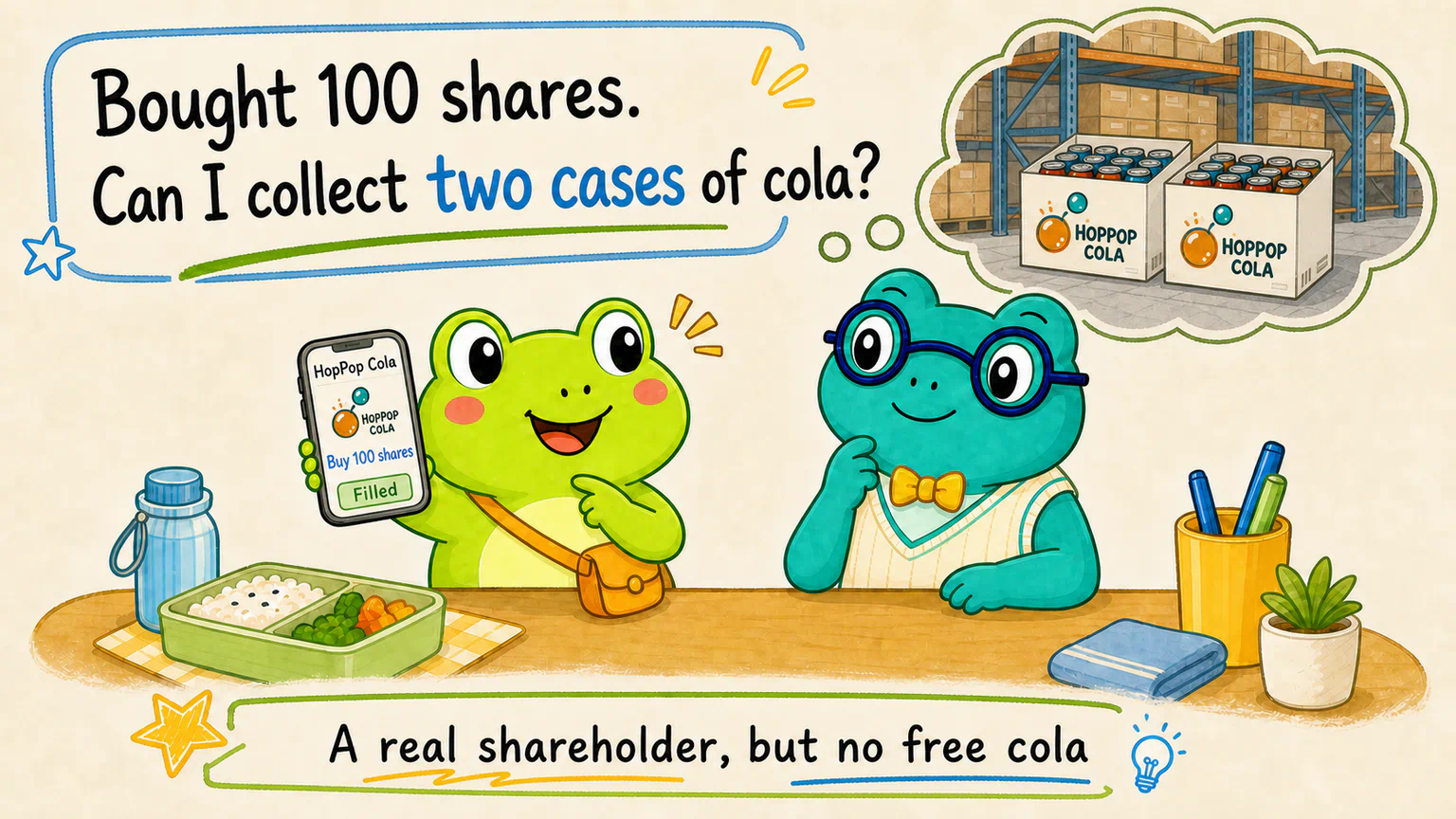
HopPop Cola — Buy 100 shares — Filled
It was his first stock purchase.
Hoppy slid the phone across the table to Dr. Hop. “Look. I own part of this company now.”
Dr. Hop nodded. “What are you planning to do with it?”
“Well, if part of HopPop Cola belongs to me, can I visit the warehouse and collect two cases of cola?”
Dr. Hop slid the phone back.
“The shareholder part is real. The two free cases aren’t.”
Hoppy frowned. “Then what did I pay for?”
It sounds like a basic question. It deserves a full lesson.
You did not buy something off the warehouse shelf
Start by thinking of HopPop Cola as a business that is up and running.
It has money in its accounts, cola in its warehouse, production equipment, a brand, and contracts. It may also owe money to suppliers or banks. People make decisions, sell products, pay bills, and keep the business moving every day.
Together, those pieces form a business that can keep operating.
When Hoppy buys shares, two cases of cola do not suddenly get his name on them. Neither does a chair in the office. Property held by the company remains company property.
Hoppy bought something different: a tiny stake in the company.
The important word here is not “tiny.” It is “stake.”
This is not a physical object he can carry out of a warehouse. It is a legally recognized relationship between Hoppy and the company. How the company performs can affect his stake. If the company decides to distribute some of its profits, eligible shareholders may receive a portion. When certain major decisions go to a shareholder vote, he may also have a say under the applicable rules.
So the familiar sentence “buying stock means buying a company” is not completely wrong. It simply leaves out an important ending:
You buy a small part of the company’s equity. You do not buy one particular piece of the company’s property.
What do “shares” and “stock” mean here?
Let us begin without the legal vocabulary.
A company needs a consistent way to record how much of its equity each shareholder holds. It divides that equity into standardized units.
Those units are shares.
Hoppy owns 100 shares. But that number alone does not tell us how much of the company he owns. We also need to know how many shares the company has in total.
If a company has only 10,000 shares, 100 shares is not trivial. If it has billions of shares, the same 100 shares represents a very small fraction.
The word stock refers more broadly to this kind of ownership security. In ordinary English, people often use “stock” and “shares” almost interchangeably: they buy stock in a company, or they buy 100 shares of it.
In this course, we will usually use share when we mean a countable unit, and stock when we mean the security or the holding more generally.
HoppyQuant uses China’s A-share market as its main source of examples. Stock markets around the world differ in their laws, shareholder rights, trading rules, settlement systems, market structure, and data conventions.
Those differences matter when you work with real data or build a real strategy. They do not change the basic ideas taught here: the core market concepts and research methods are broadly transferable. Before applying them in another market, however, you must check that market’s rules and data conventions.
Chinese legal and market language also draws a useful distinction between gufen (股份), the units of equity, and gupiao (股票), the stock that evidences those units. Under the current PRC Company Law, stock is issued by a company as evidence of the shares a shareholder holds. In an A-share securities account, that holding appears as an electronic record rather than a decorative paper certificate.
You do not need to memorize the wording. Keep the basic order in mind:
The company divides its equity
The equity is divided into standardized shares.
A shareholder holds units
You hold some of those shares.
The stock records the relationship
The stock holding records and evidences that ownership.
Becoming a shareholder does not put you in charge
The word “shareholder” can make it sound as though Hoppy has just moved into the chief executive’s office.
He has not.
Holding 100 shares and running the company’s day-to-day business are different jobs.
Shareholders can have real rights. Depending on the rules and circumstances, those may include receiving a distribution of profits or voting on certain major decisions. But a small shareholder does not normally decide how many cases of cola the factory will produce today or where a sales manager will travel tomorrow.
Shareholder rights are not a membership card that delivers benefits only.
If the company performs poorly, it may have no profits to distribute. If the market becomes less willing to hold the stock, its price may fall. Owning a stake means that the stake is exposed to what happens to the company and to how the market views it.
We do not need a complete catalogue of shareholder rights and risks yet. Two ideas are enough:
- Hoppy really is a shareholder. He is not playing with a number that came from nowhere.
- He owns an equity stake. He does not directly control the company or claim a particular item of company property.
Keep the company, the stock, and the stock price separate
We can now pull apart three things that often get squeezed into the same sentence.
The company
The real business and organization at work.
The stock
The security that represents and records shares held in that company.
The stock price
The current market price shown for one share.
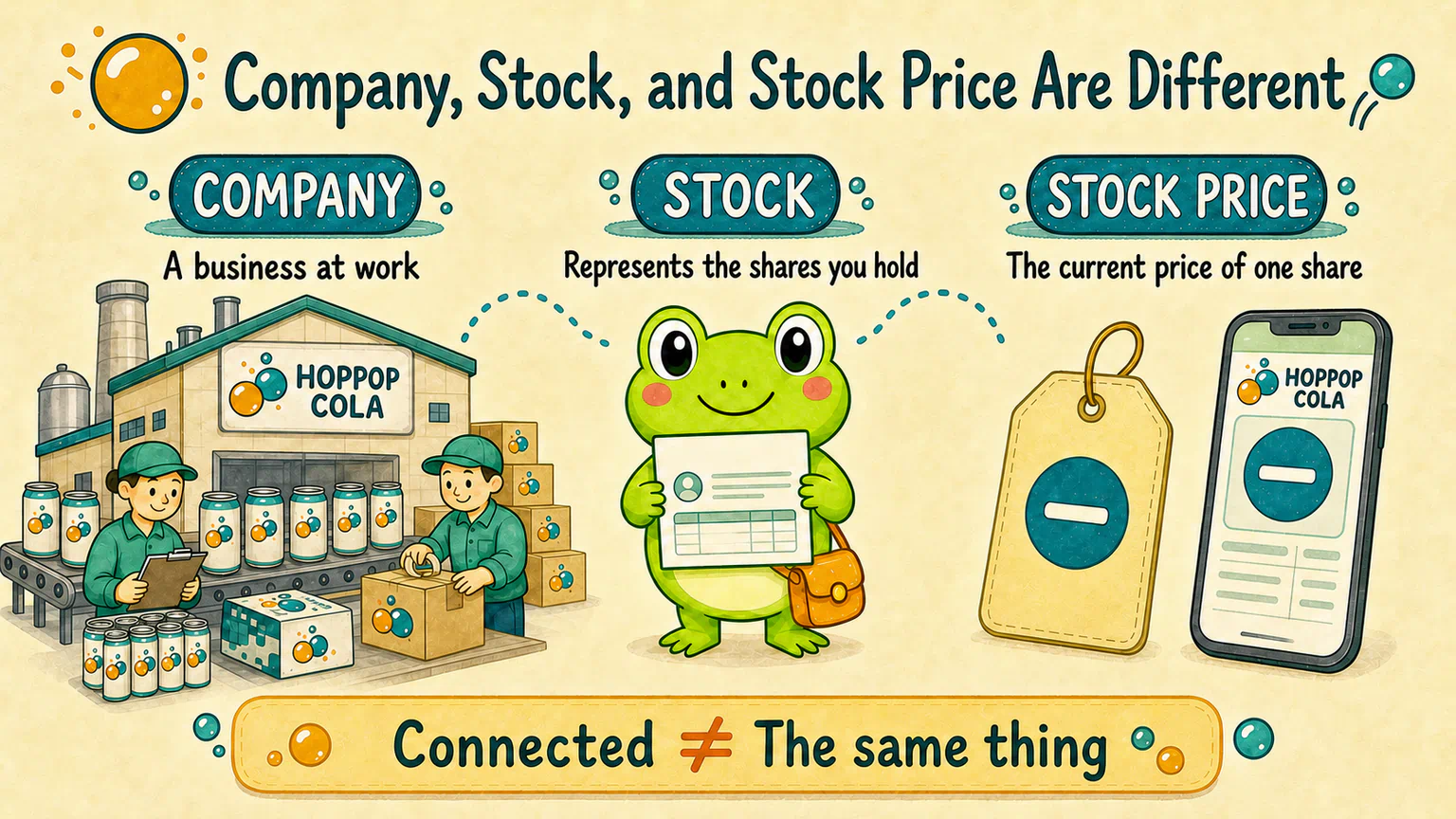
They are connected, but they are not the same thing.
The company may keep producing cola as usual while its stock price changes. A price change does not mean the warehouse, the machines, and the workforce all changed at that same second.
A later lesson will explain why the number on the screen moves. For now, we only need to place a little distance between “the company” and “the price of its stock.”
Buying a share does not let you carry one item out of the company. It gives you a small stake in the company’s equity. The company, the stock, and the stock price are related, but they are not the same thing.
Try saying it in your own words
No definitions to recite. Just answer three questions:
- What did Hoppy actually get when he bought 100 shares of HopPop Cola?
- Why can he not walk into the warehouse and collect two cases of cola?
- Why is “Hoppy owns 100 shares” not enough information to tell us how much of the company he owns?
If you can explain those three points, you have finished this lesson.
Hoppy looked at the trade confirmation again.
“Wait,” he said. “Did the money I paid for these 100 shares go straight into HopPop Cola’s bank account?”
Dr. Hop smiled. “That depends on who sold them to you.”
That is where we are headed next.
Sources
Sources checked on August 10, 2026
- Company Law of the People’s Republic of China (Chinese), especially Articles 3, 4, 110, 116, and 142–149;
- Shenzhen Stock Exchange investor education: “Know Your Shareholder Rights” (Chinese);
- China Securities Depository and Clearing Corporation: Investor Securities Inquiry Guide (Chinese).
This lesson is a beginner-level explanation, not legal or investment advice.
Lesson discussion
Share a question, insight, or different view—and see how other learners are thinking.