Lesson 2
Why Do Shares Keep Trading After the Company Gets the Money?
Separate new share issuance from investor-to-investor transfers, then trace the money and the purpose of ongoing trading.
Hoppy pulled up yesterday’s trade confirmation and read it again.
HopPop Cola — 100 shares bought. Order filled.
“So the money I paid must be sitting in HopPop Cola’s bank account now,” he said. “Maybe I helped pay for today’s batch of syrup.”
Dr. Hop did not answer right away.
“Did you buy those 100 shares from HopPop Cola,” he asked, “or from another investor?”
Hoppy paused.
“Why does it matter who sold them?”
“Because you bought shares in both cases, but the money takes a different route.”
That difference is what this chapter is about.
Two purchases that look similar—but are not
Suppose HopPop Cola wants to build a new factory but does not have enough money.
The company can issue new shares to investors. The investors pay money to the company; in return, they become shareholders and receive those shares.
The route looks roughly like this: HopPop Cola issues new shares, investors pay to subscribe, the company gets the money, and the investors get the shares.
In this case, the company really does receive the money.
Hoppy’s trade yesterday was more likely a different kind of exchange.
Another investor already owned HopPop Cola stock and wanted to sell 100 shares. Hoppy agreed to buy them. Hoppy provided the money, and the other investor transferred the existing shares.
The other route looks like this: an investor offers existing shares, Hoppy pays for them, the seller gets the money, and Hoppy gets the shares.
HopPop Cola did not issue anything new in that trade. Hoppy acquired shares that another investor already owned. The company’s name may be on the stock, but that does not send Hoppy’s payment into the company’s bank account.
The company issues new shares
The company offers new shares and investors subscribe. The company receives the funds, and the investors receive the shares.
An investor transfers existing shares
The current holder gives up existing shares and the buyer pays. The seller receives the funds, and the buyer receives the shares.
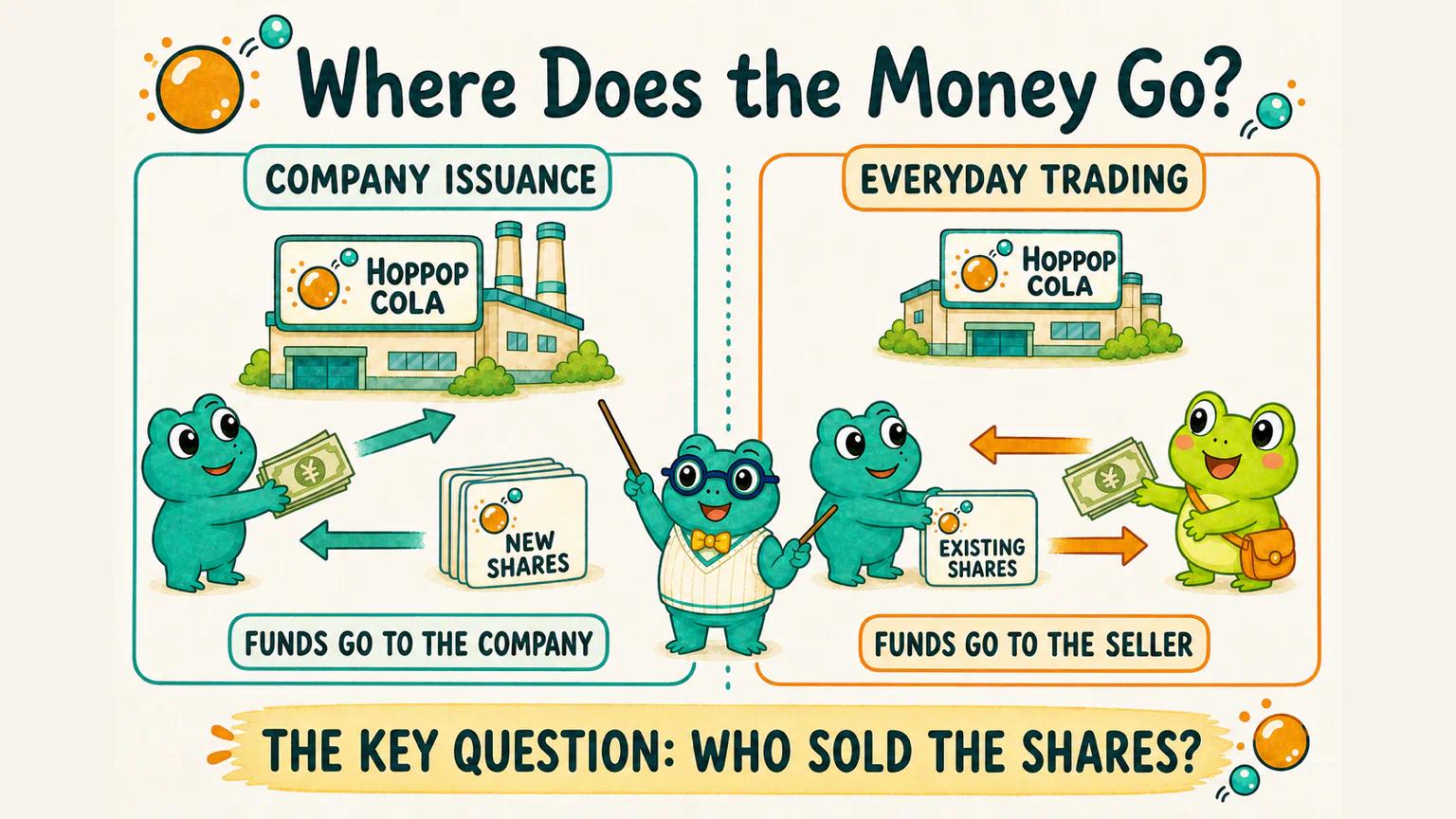
Real trades involve brokers, clearing, settlement, and other machinery. We do not need to climb inside all of that yet. For now, keep your eyes on the exchange at the end of the pipes: the party giving up the shares receives the corresponding funds.
The company does not get paid every time the same shares change hands
Hoppy looked disappointed.
“So HopPop Cola got nothing when I bought it?”
“Your everyday trade did not give the company a new round of funding,” Dr. Hop said. “But that does not mean the company can never issue more shares. And it definitely does not mean your trade was pointless.”
Once shares have been issued, they can move from one investor to another.
Alice might sell to Ben, and Ben might later sell to Hoppy. The company is not selling the same slice of ownership all over again each time.
Think of a concert ticket. The organizer receives money when the ticket is first sold. If the ticket holder later transfers it to someone else, the payment usually moves between the old and new holder; the organizer does not collect the ticket price again at every transfer.
The comparison stops there. A share represents an interest in a company, not admission to a show, and it does not expire when the encore ends. Metaphors are useful—as long as they stay on a short leash.
If the company gets no new money, why keep trading?
Imagine that you could buy HopPop Cola stock but never sell it.
Hoppy thought for a moment. “Then I would be much more careful before buying. What if I needed the money later?”
Exactly.
If an ownership interest is hard to transfer, many people will hesitate before buying it in the first place. Ongoing trading does at least three useful things.
Current shareholders can leave or adjust
They may have changed their view of the company, need money for a home or tuition, or want less of their savings tied to one business. Selling gives them a way to change what they hold; it does not make their decision right.
New investors can enter
Hoppy did not take part when HopPop Cola first issued shares. If an existing holder is willing to sell, he may still be able to buy those shares later.
Completed trades leave a current market price
A seller and buyer agree at a price, and the completed trade leaves a transaction price in the market. Later trades may happen at different prices as people’s views and actions change.
How buyers and sellers actually arrive at those prices is the next chapter’s job.
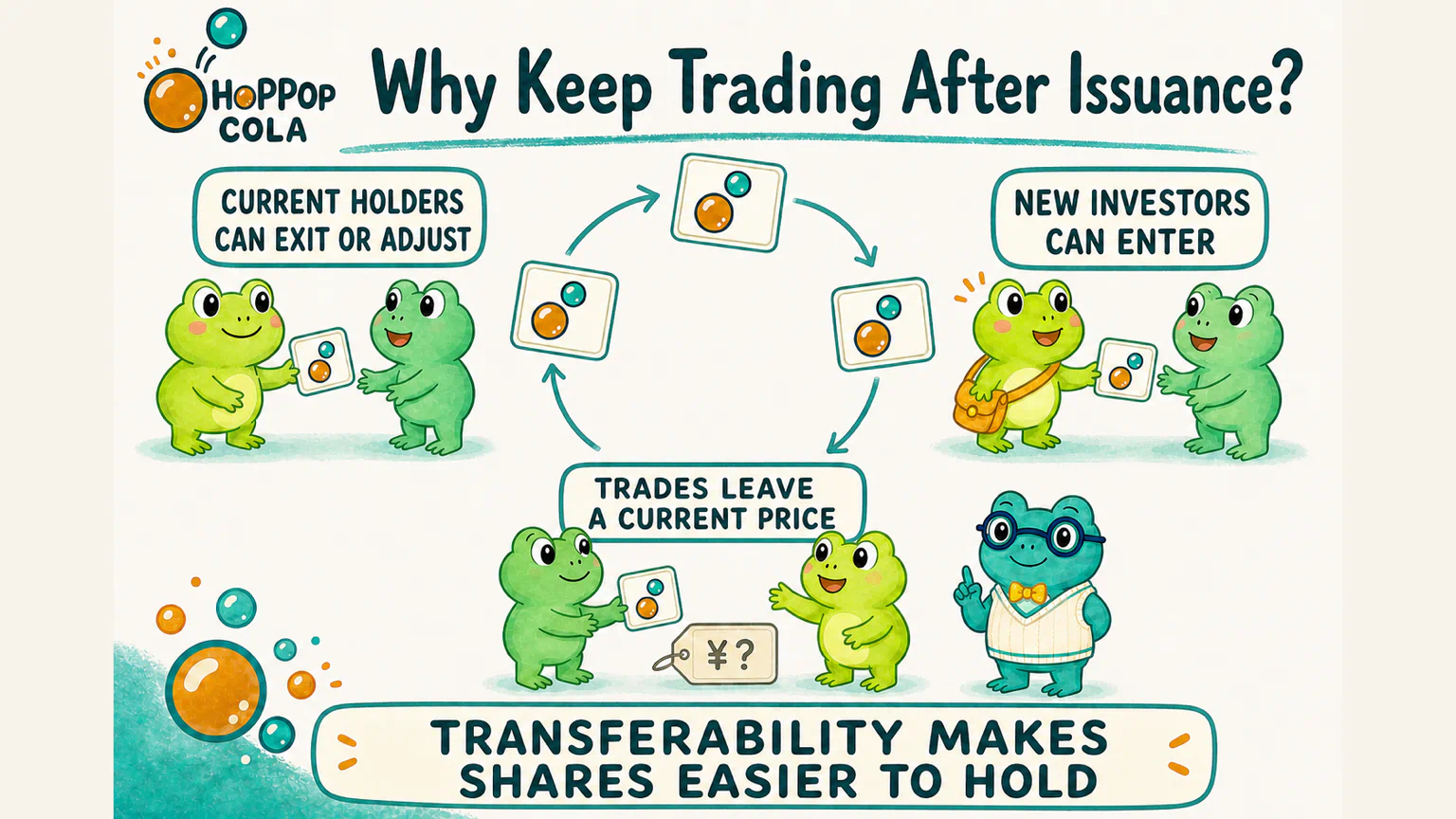
So everyday trading is not just something people do after the company has finished “the important part.” It makes an ownership interest transferable and lets the group of people willing to hold it change over time.
That transferability also matters at the beginning. Investors may be more willing to buy newly issued shares if they know there may be a market for those shares later.
Now we can name the two routes
You will often see these two settings called the primary market and the secondary market.
- In the primary market, newly issued securities are sold to investors, and the issuer receives the proceeds.
- In the secondary market, investors trade securities that have already been issued.
“Secondary” does not mean second-rate. It comes second in the journey: the shares must exist before investors can trade them with one another.
A company may issue additional shares later, so the primary market is not necessarily a one-time event. You only need to recognize the two routes here; we are not opening the box of offering procedures yet.
HoppyQuant uses China’s A-share market as its main source of examples. The distinction between newly issued securities and investor-to-investor trading is used across major stock markets, so the idea in this chapter travels well. The exact laws, offering procedures, trading rules, settlement systems, and data conventions do not. Check the rules of the market you are actually studying.
A stock market does more than one job
We can now place a few of its jobs side by side.
It gives companies a way to raise funds by issuing shares. It gives investors a place to transfer shares that already exist. And its completed trades leave market prices that change over time.
Those jobs are connected, but they cannot be squeezed into the sentence, “Buying stock means giving money to the company.”
Hoppy really did become a HopPop Cola shareholder when he bought 100 shares. His money, however, most likely went to the investor who sold those shares—not directly into the company’s syrup budget.
When a company issues stock, it gives investors new shares and receives funds. In everyday stock trading, investors usually exchange money for shares that already exist. The company does not receive fresh funding every time the same shares change hands, but those trades make the shares transferable and leave current market prices behind.
Say it in your own words
Do not worry about reciting the definitions of “primary market” and “secondary market.” Try answering these instead:
- When HopPop Cola issues new shares, where do the money and shares go?
- When Hoppy buys 100 existing shares from another investor, why does the company not receive that payment again?
- If the company does not get fresh money from each ordinary market trade, why do the shares still need to keep trading?
If you can explain the two routes and the reason trading continues, you are done with this chapter.
Hoppy was about to close the app when the price on the screen changed again.
“Wait,” he said. “If HopPop Cola is not typing in the price, and there is no expert sitting behind the screen choosing it, who put that number there?”
That is our question for the next chapter.
Sources
Sources checked on August 10, 2026
- Investor.gov: Primary Market, for the plain-language definition of newly issued securities and proceeds received by the issuer;
- Investor.gov: Stocks — FAQs, for why companies issue stock and a general introduction to buying and selling shares;
- Investor.gov: Liquidity (or Marketability), for the basic relationship between secondary-market trading and the ability to buy or sell a security;
- China Investor Network: An Introduction to the Securities Market, for the A-share educational distinction between issuance and trading markets;
- Company Law of the People’s Republic of China, especially Articles 151, 157, and 158 on share issuance and transfers.
This chapter uses China’s A-share market as its main case background. It is introductory education, not legal or investment advice.
Lesson discussion
Share a question, insight, or different view—and see how other learners are thinking.