Lesson 4
How Does the Real World Find Its Way Into a Stock Price?
Trace how reality may enter a stock price through information, interpretation, expectations, action, and completed trades.
Hoppy was still wondering why someone would pay only ¥10 for HopPop Cola one moment, then accept ¥10.10 a little later.
His phone lit up with an announcement:
HopPop Cola: Our zero-sugar drink is scheduled to enter 500 stores next month.
Hoppy slapped the table.
“That explains it. More stores mean more sales. This is good news, so the stock price should go up.”
Dr. Hop read the announcement.
“Which words press the up button?”
“What up button?”
“You connected one announcement straight to a higher stock price. What happened to everything in the middle?”
Hoppy read the message again.
There was no button marked, “Tap here to raise the share price.”
A real-world event cannot reach out from beyond the screen and edit a number in a trading app.
It has to travel a longer road.
Something happened—but does the market know?
Let us separate two things that often get squeezed together.
First, something changes in the real world. HopPop Cola makes arrangements to place its zero-sugar drink in more stores.
Second, that change enters the information world. The company publishes an announcement. News outlets may repeat it. Some people see it. Others never notice.
Reality changes
→ the change becomes an announcement or other information
→ market participants see the information
If something has happened but has not become available information, market participants may have no reason to change their trades because of it. Even after an announcement appears, people will not all see it at the same second—or read it with the same care.
So there is already a gap between “what happened” and “what the market knows.”
One message can grow several interpretations
Hoppy sees 500 stores and builds this chain:
More shelf space
→ more people see the product
→ sales might increase
→ the company might earn more in the future
That reasoning is not silly. But every arrow contains the word “might.”
Another investor may think that entering more stores will require inventory, promotion, and distribution. Costs may rise, and nobody knows yet whether customers will like the zero-sugar drink.
A third investor may glance at the announcement and say, “Not enough information. I’ll wait.”
The same message can therefore produce three reactions:
More optimistic
One person thinks the business may improve and chooses to buy.
More cautious
Another worries about costs and uncertain demand and chooses to sell.
Keep watching
A third has not formed a view and chooses to do nothing yet.
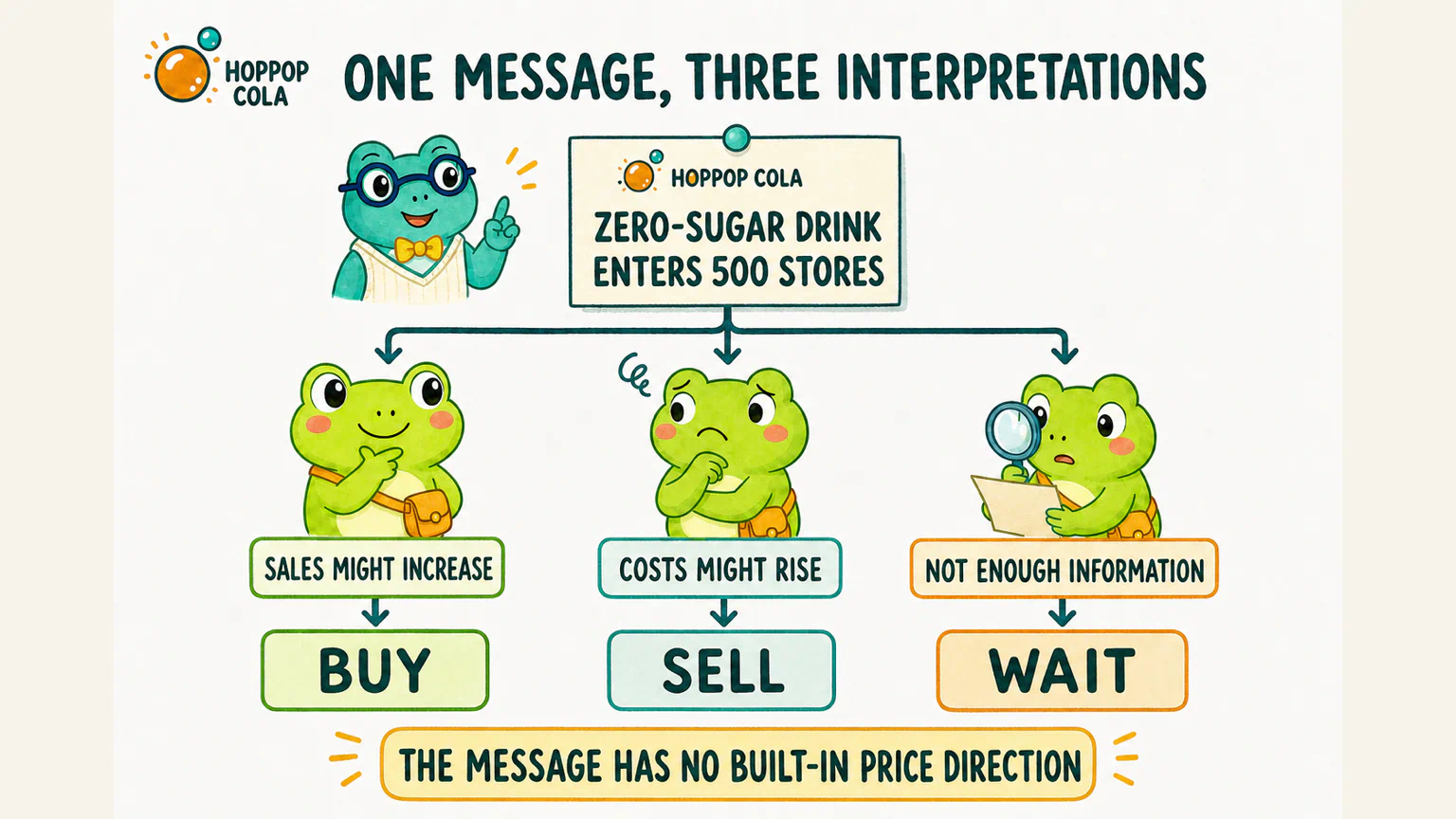
The message did not change. What changed was the second half that each person attached to it.
News can tell you what happened. It usually does not fill in exactly what comes next.
Investors trade more than the past
Why did Hoppy move so quickly from “500 stores” to the company’s future earnings?
A share represents an interest in a company. Anyone holding it faces not only what the company sold yesterday, but also what the business may become tomorrow.
Market participants keep connecting current information to the future:
Could this affect sales?
→ Could it affect costs and profits?
→ Could it change how attractive this ownership interest becomes?
→ What price am I now willing to hold it at?
We can call these views about the future expectations.
Expectations are not fortune-telling, and they do not belong only to professional analysts. The moment Hoppy says, “More stores might mean more sales,” he is forming an expectation. A smooth-sounding story, however, is not guaranteed to come true.
Different people can also hold different expectations. The market does not hand everyone one official answer sheet.
A view must become action—and action must become a trade
Hoppy may feel extremely optimistic. But if he closes the app and does nothing, his optimism cannot update the transaction price by itself.
An expectation may continue into one of three actions:
- buy, because the current price still looks acceptable;
- sell, because the risk looks greater or the price no longer looks attractive;
- do nothing yet, because there is not enough confidence to act.
Doing nothing matters too. It tells us that someone received the information without turning it into new buying or selling.
If people do place orders, the market still has to match compatible buying and selling under its rules. Only a completed trade can leave a new transaction price.
The full journey looks roughly like this:
Reality changes
→ people see information
→ they interpret it differently
→ they form expectations about the future
→ those expectations become buying, selling, or no action
→ real buying and selling results in a trade
→ the result is left in the price
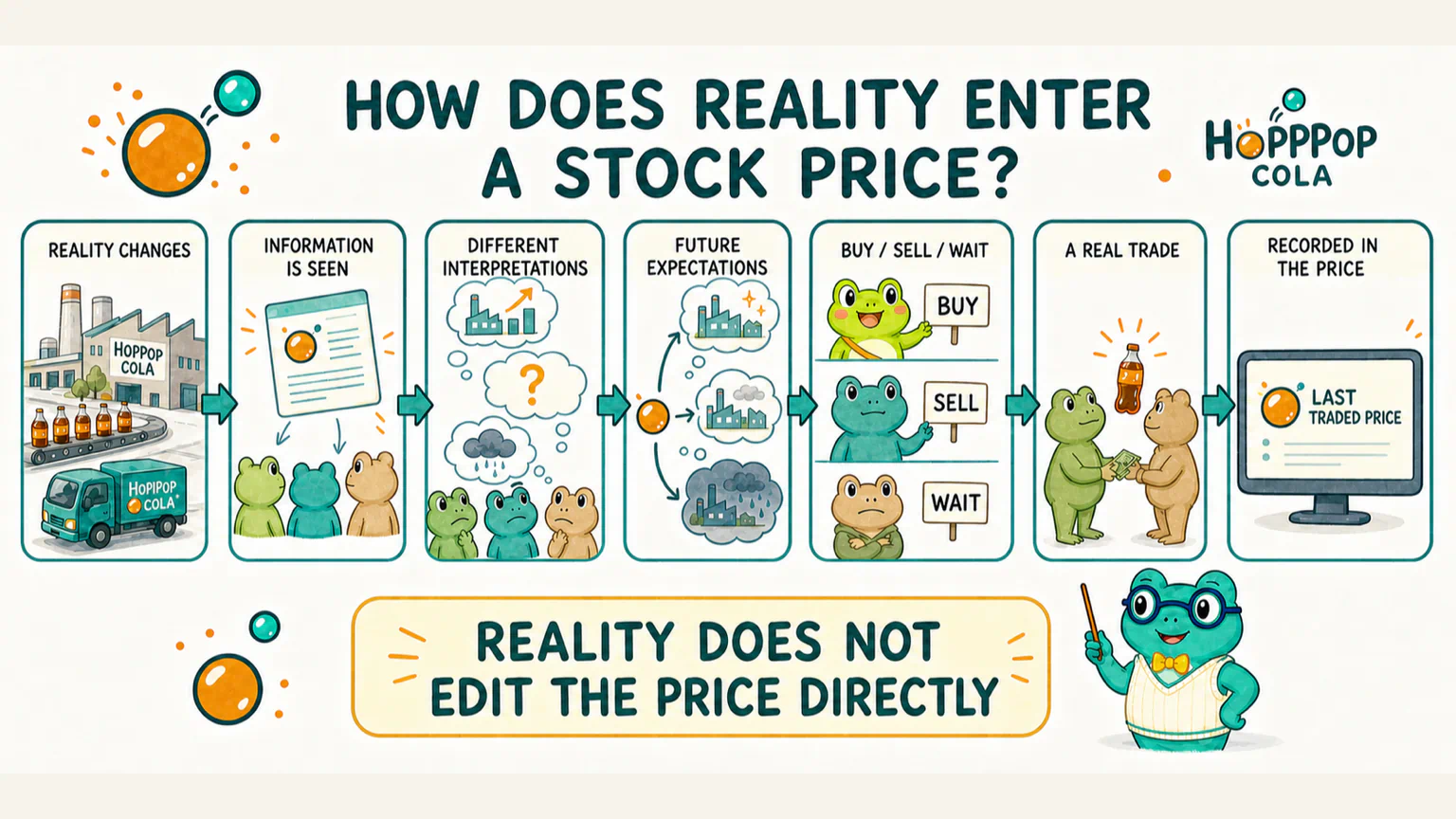
This is not a conveyor belt that always reaches the end.
The information may go unnoticed. Someone may see it and misunderstand it. Someone may form a view but never act. Someone may place an order that does not trade. If any link stops, the real-world change will not enter the latest transaction price in the neat way we imagined.
A message does not arrive with a built-in direction
Now return to Hoppy’s first sentence:
More stores are good news, so the stock should rise.
The problem is not that it must be wrong. The problem is that it skips too many steps.
A fuller set of questions would be:
What might more stores change?
→ How might different people interpret it?
→ How could their expectations about the company change?
→ Will those expectations become real buying or selling?
→ Will any new trades actually happen?
The same information may lead someone to buy, someone else to sell, and another person to wait. The eventual price is a result left when those different views meet through actual trading—not a conclusion prewritten in the headline.
HopPop Cola and its announcement are fictional, and HoppyQuant uses China’s A-share market as its main case background. The path from information to interpretation, expectations, action, and trade is useful across major stock markets. Disclosure rules, trading systems, available data, and the timing of information can differ, so each market still needs its own rule and data checks.
Is the stock market a prediction machine?
HoppyQuant often finds this a useful way to look at the market:
Many people are judging cause and effect in the world, then using real money to express predictions about the future. A stock price is one result left when those judgments meet.
This perspective is useful because it pulls our eyes away from the number alone. It makes us ask: What changed in the real world? Through what causal path might it affect the company? How might market participants understand it?
But it is not the one complete definition of a stock market.
Someone may sell because they need cash, not because they suddenly dislike the company. Someone may reduce a position to control risk. Some trades follow rules decided earlier rather than a brand-new prediction made that morning.
The more careful conclusion is: stock prices contain many views about the future, but they contain more than prediction.
Reality does not edit a stock price directly. It has to become information, be seen and interpreted, shape expectations about the future, turn into buying or selling, and result in completed trades before it can be left in the price. The same information does not carry one guaranteed price direction.
Say it in your own words
Try answering these four questions without relying on formal vocabulary:
- Why can we not jump from “HopPop Cola will enter 500 stores” to “the stock price must rise”?
- Why might the same message make one person buy, another sell, and a third do nothing?
- After someone forms an optimistic expectation, what still has to happen before it can affect the latest transaction price?
- Why is “the stock market reflects predictions about the future” a useful perspective, but not the whole truth?
If you can explain the path from reality to information to interpretation to expectations to action to trade to price, you are done with this chapter.
Hoppy nodded.
“Then if I predict before everyone else that the zero-sugar drink really will be a hit, I can make money, right?”
Dr. Hop smiled. “Predicting what will happen is not the same as predicting what the market was already waiting for.”
We will unpack that sentence in the next chapter.
Sources
Sources checked on August 10, 2026
- Shenzhen Stock Exchange Investor Education: Investor Entry Handbook — Stocks, for its introductory discussion of future expectations and the uncertainty between expected and realized outcomes;
- Investor.gov: Stocks — FAQs, for the basic background that stock represents company ownership and that investors research public-company information;
- Investor.gov: Executing an Order, for the distinction between deciding to buy or sell and having an order actually executed in a changing market.
HopPop Cola, its zero-sugar drink, and the 500-store announcement are entirely fictional. They do not represent a real company, disclosure, or investment opportunity. This chapter explains only the basic relationship between reality, expectations, trades, and prices; it is not investment advice.
Lesson discussion
Share a question, insight, or different view—and see how other learners are thinking.