Lesson 5
Getting the Direction Right: Why Could You Still Lose Money?
Put reality, expectations, entry price, and timing together to see why being right about direction does not guarantee a positive return.
One month later, HopPop Cola released the first-month sales figure for its zero-sugar drink:
800,000 bottles.
Hoppy sat up straight.
“I knew it would sell well!”
He was not pretending. Comparable HopPop product launches had sold about 600,000 bottles in their first month. Reaching 800,000 was a real improvement.
Then Hoppy opened his trading app. The latest transaction price was below the price he had paid.
“Wait. The product sold more. The company improved. I was right. So why am I the one showing a loss right now?”
Dr. Hop wrote three numbers on a sheet of paper:
Comparable past launch: 600,000 bottles
What the market had expected: 1,000,000 bottles
Actual first-month sales: 800,000 bottles
“You predicted that it would sell better than before.”
“The market may have been waiting for something even better.”
Is 800,000 good or bad?
Compare 800,000 with the previous 600,000, and the answer is easy: good.
Sales increased by 200,000 bottles.
But suppose many market participants had already been imagining sales close to one million. Against that expectation, 800,000 looks less impressive.
The phrase “the market expected one million” is a teaching shortcut.
Real markets do not publish a daily answer sheet that says, “Every investor agrees on exactly one million bottles.” One person might expect 900,000, another 1.1 million, and many may have no sales forecast at all. Here, one million simply stands for a fairly optimistic set of views already circulating before the result.
The same 800,000 bottles can therefore answer two different questions:
Compared with the past: better
Compared with prior expectations: not as good
There is no contradiction.
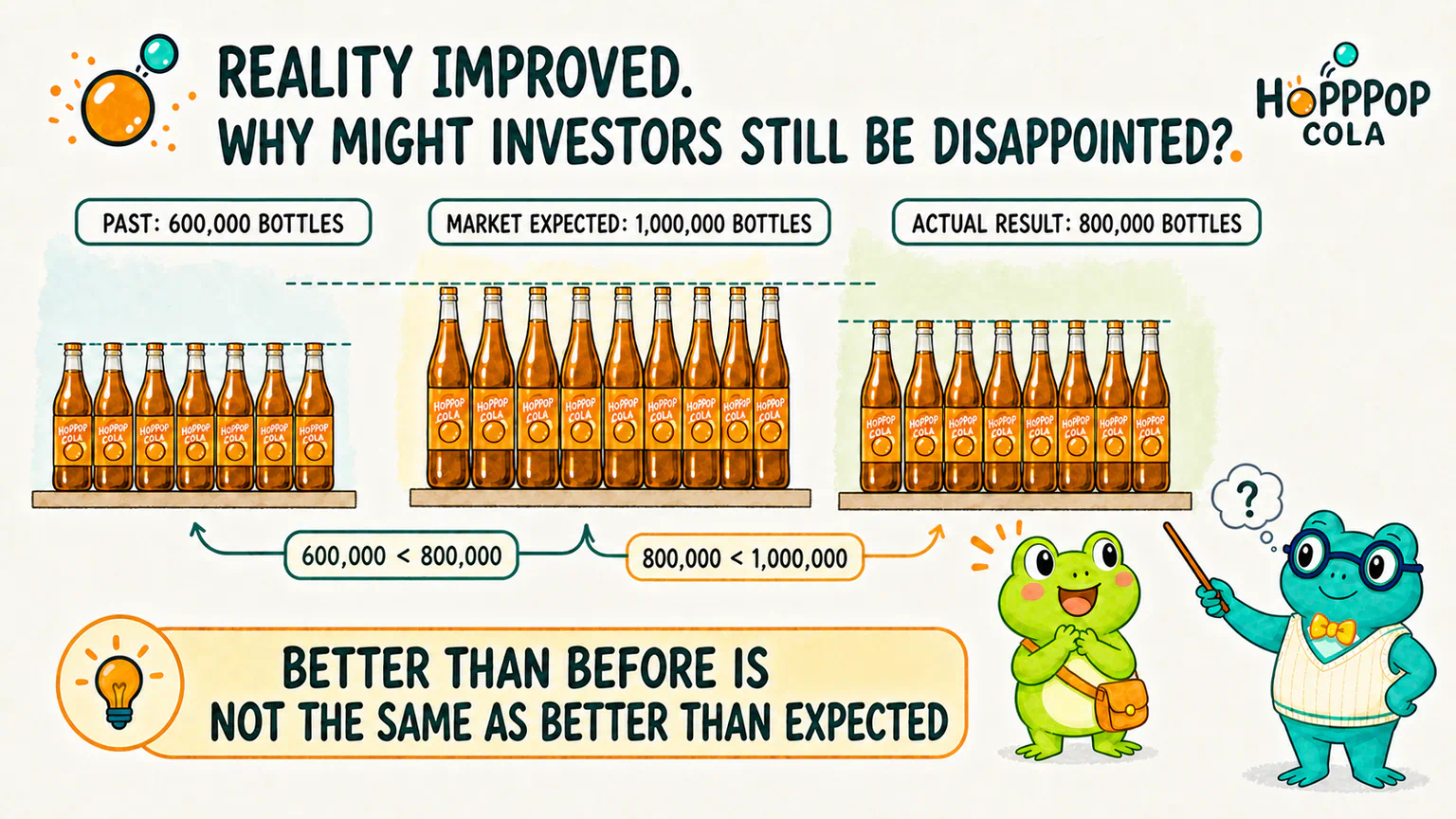
This is one reason stock markets can feel awkward. They do not look only at whether a company improved. They also compare reality with the future people had already imagined.
A good result may no longer be a surprise
Return to the day HopPop announced that the drink would enter 500 stores.
If many people believed the product would be a hit, they might have accepted higher prices to buy the shares. As trades took place, some of that optimism could have made its way into the market price.
By the time Hoppy bought, he was not paying only for an ownership interest in a cola company. He was accepting a transaction price that may already have contained a generous amount of optimism.
When the 800,000-bottle result arrived, market participants might not have heard:
The new drink sold 200,000 more bottles than the earlier launch!
They might have heard:
We were waiting for one million, and the result was only 800,000.
The result was still decent. It simply did not deliver the surprise people had been waiting for. Some participants might revise their views downward and accept lower prices. If new trades then occur at those prices, the stock price can fall.
The word might matters.
Falling short of one version of market expectations does not guarantee that a stock will drop. Participants may be considering other information or changing their views about the future in different ways. This fictional example makes only one point: an improving company and a rising stock price are not connected by an automatic equals sign.
HoppyQuant uses China’s A-share market as its main case background, while HopPop Cola and all numbers in this chapter are fictional. The distinction between actual results, prior expectations, entry price, and timing is useful across major stock markets. Disclosure rules, trading systems, data, and information timing can differ, so research in another market still needs its own rule and data checks.
The price you start from matters too
Hoppy was not fully convinced.
“But my view that the company would improve was still correct.”
“It was,” said Dr. Hop. “But you are studying a stock return, not collecting points on a true-or-false quiz.”
To know whether a stock investment gained or lost money, we at least need two prices: the price you paid and the price at which you later sold—or the price at which the market is currently willing to trade.
Imagine that two people both correctly predict sales of 800,000 bottles:
- one buys before the market becomes so optimistic;
- the other buys after excitement has already pushed the transaction price higher.
Their view of the company is identical, yet their stock returns may differ. The difference is not who understands cola better. It is how much each person paid for the same kind of ownership interest.
That is why “a good company” and “worth buying at any price” are not the same sentence.
This chapter will not calculate what a particular stock is worth or tell you which price is cheap. Keep only the simplest reminder: your return starts from the price you actually paid, not from how admirable the company is.
“Someday” is missing a date
Getting the direction right can create another problem.
“Maybe sales will reach one million in the second or third month,” Hoppy said. “My prediction might just be late.”
That is possible.
But the “someday” in “this product will succeed someday” could mean a week, six months, or five years. If a claim does not say roughly when the result should become visible, it is hard to tell whether it is temporarily unfulfilled or simply impossible to check.
The stock price will not stand still while we wait. New company information, industry changes, and fresh trades will keep arriving. Even if the original direction eventually becomes reality, the price can take a very different path along the way.
This does not mean that faster is always better, and it is not advice about how long to hold a stock. It means only this: a claim about the future needs a time window before it becomes a question we can seriously investigate.
Getting a stock return right still leaves four questions
We can now turn Hoppy’s experience into four questions:
Reality
Expectations
What had market participants roughly been waiting for?
Entry price
What did you actually pay for the shares?
Timing
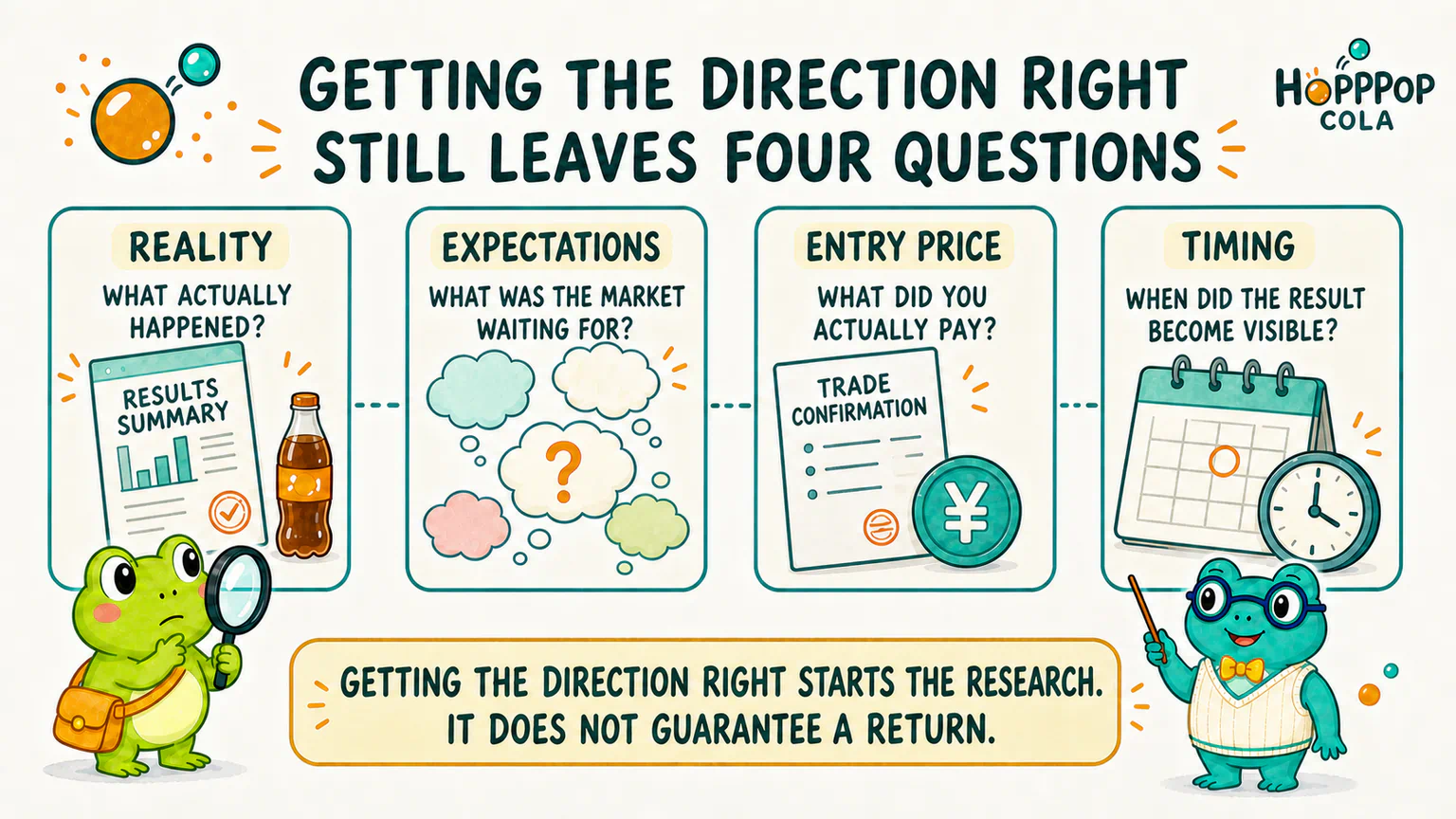
These questions are not a profit formula or a complete investing system.
They exist to stop one premature conclusion:
I correctly predicted that the company would improve
≠ I am guaranteed to make money from the stock
A stock trade asks more than “Will this happen?” Reality can improve without improving as much as the market had expected. The same outcome can also produce different stock returns when the entry price or timing differs. Getting the direction right starts the research; it does not guarantee a return.
Is information still worth researching?
At this point, it is easy to run toward the opposite extreme:
“If other people may have thought of it already, why research anything?”
There is no need to give up so quickly.
“An expectation may already be priced in” does not mean “the price knows every answer.” Nor does it mean that everyone has interpreted the information equally well. The previous chapter showed that the same message can produce different interpretations, and a view may never turn into a trade.
Research still matters. It simply cannot stop at “I found good news.” We also need to ask:
- Through what path might this information affect the company?
- What may market participants have noticed already?
- Where do disagreement and uncertainty remain?
- Over what time window are we willing to let reality test our view?
These questions do not hand us a profitable answer. They help turn a market hunch into a research hypothesis that can be checked.
Say it in your own words
Try answering these questions without relying on terms such as “valuation” or “excess return,” which we have not learned yet:
- How can HopPop’s sales be better than the past and still below expectations?
- Why might two people predict the same sales result but earn different stock returns?
- Why is “this company will improve in the future” missing a time window?
- Why does “expectations may already be priced in” not make information research useless?
If you can explain what reality, expectations, entry price, and timing each add to the question, you have completed this chapter.
Looking back: What is the stock market?
We began with “What do I actually buy when I buy a share?” and followed the trail all the way here.
We can now give a beginner’s answer to the question at the heart of this part of the course:
A stock market allows shares representing ownership interests in companies to be issued and transferred. Participants trade those shares with different views of the future, and their completed trades keep leaving market prices behind.
That is not a complete definition of a stock market. It does, however, bring together the most important relationships from these foundational lessons: companies, shares, participants, expectations, trades, and prices.
Now connect all five chapters by answering five questions:
- What do you broadly receive when you buy a share?
- How is a company issuing shares different from investors trading existing shares?
- If no one person sets the price, how does a transaction price appear on the screen?
- How can a real-world change travel through interpretation, expectations, and trading into the price?
- Why does getting the real-world direction right still not guarantee a positive stock return?
There is no model answer to memorize. If you can explain that path in your own words, you have genuinely completed this set of stock-market foundations.
Hoppy looked at the questions on the page and slowly nodded.
“So studying the stock market is not just predicting what will happen in the world. We also have to study what other people are watching—and how they might act.”
“Exactly,” said Dr. Hop. “Next, let’s see what kinds of things can change those views.”
Next, we will look at companies, industries, the economy, policy, capital flows, sentiment, and news—and trace how each can influence market expectations and behavior.
Sources
Sources checked on August 10, 2026
- FINRA: What Is Earnings Season?, for its introductory explanation that market participants compare actual results with several layers of expectations, and that good results do not guarantee a rising stock price;
- Investor.gov: Stocks — FAQs, for the basic relationship between changing stock prices, losses, and the prices at which an investor buys and sells;
- Shenzhen Stock Exchange Investor Education: Investor Entry Handbook — Stocks, for introductory background on stock returns, expectations about the future, and uncertainty between expected and realized outcomes.
HopPop Cola, its zero-sugar drink, the figures of 600,000, 800,000, and one million bottles, and every price reaction in this chapter are fictional teaching examples. This chapter provides no valuation, trading-timing, or holding-period advice and is not investment advice.
Lesson discussion
Share a question, insight, or different view—and see how other learners are thinking.