Lesson 3
Who Actually Sets the Stock Price on Your Screen?
Follow quotes, matching, and completed trades to see how the last traded price appears—and why it is not the company’s official value.
Hoppy was about to close his trading app when HopPop Cola’s price changed.
¥10.00 → ¥10.10
He stared at the extra ten cents.
“Who changed it?”
“Changed what?” Dr. Hop asked.
“The stock price. HopPop Cola was ¥10 a moment ago. Now it is ¥10.10. Someone must be replacing the price tag, like they do in a grocery store.”
Dr. Hop shook his head.
“HopPop Cola did not put a new sticker on its own shares. And the exchange did not ask an expert to calculate the company and announce, ‘The correct answer is now ¥10.10 per share.’”
“Then how did the screen add ten cents?”
It did not change by itself.
Before the number moved, a trade happened.
The market does not begin with one correct answer
Suppose Hoppy wants to buy HopPop Cola.
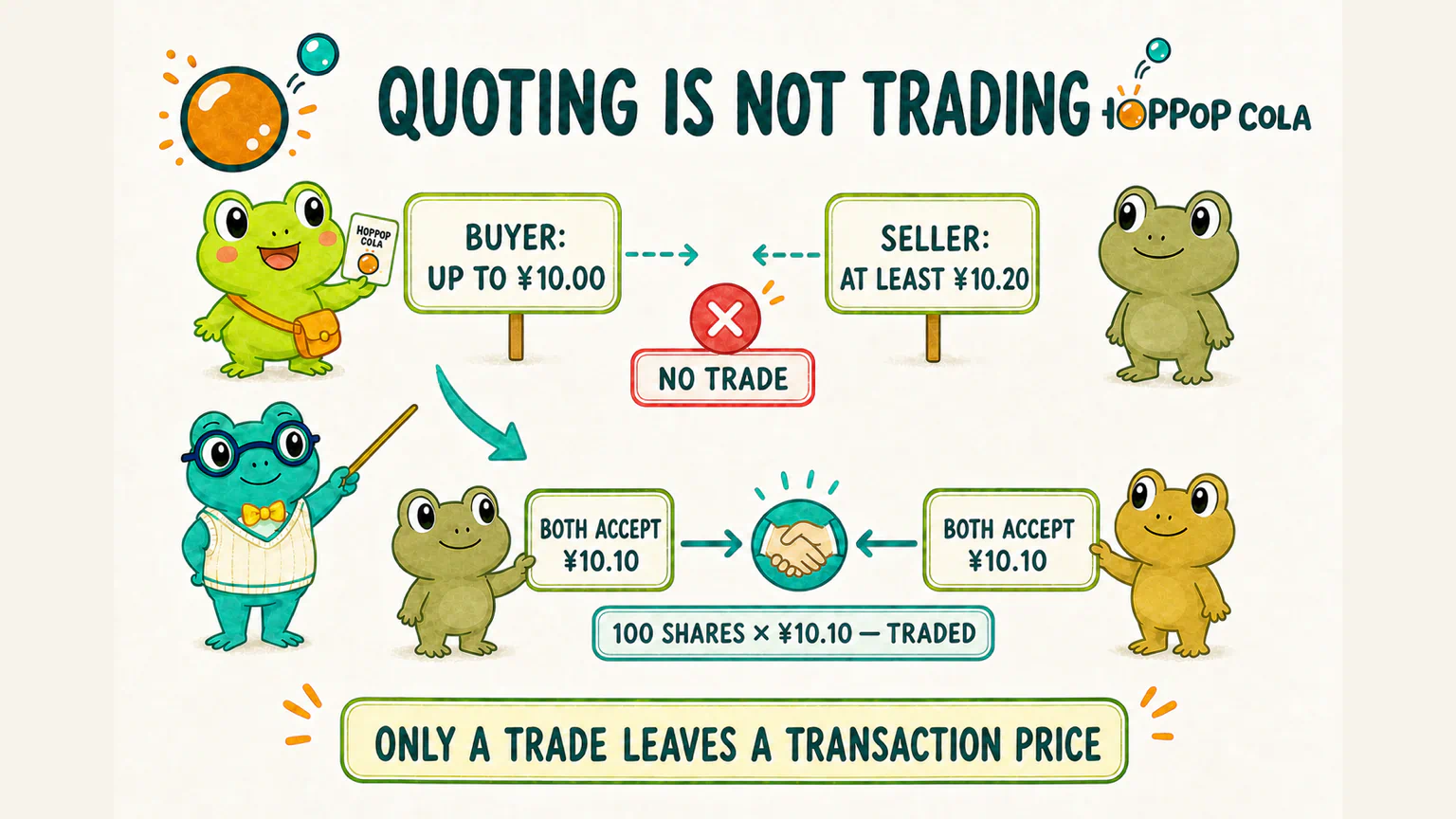
He is comfortable paying ¥10 for a share, but no more. His buying interest says: I am willing to pay ¥10.00.
Another investor wants to sell. That investor thinks ¥10 is too low and will accept no less than ¥10.20.
The two sides now look like this:
Bid
Ask
The seller is willing to accept no less than ¥10.20.
Both have an opinion. Their opinions simply do not meet.
The buyer will not pay more, and the seller will not accept less. No trade occurs. With no new trade, the market cannot quietly invent a ¥10.10 transaction and pretend the two sides shook hands.
That is why quoting a price is not the same as trading at that price.
When the conditions meet, a trade can appear
A little later, new buying and selling interest reaches the market.
One buyer is willing to pay ¥10.10 for 100 shares. One seller is willing to accept ¥10.10 for 100 shares. The trading system matches compatible buying and selling interest under the market’s rules, and a trade is completed:
100 shares × ¥10.10 — traded
The market now has two facts to record. Someone bought 100 shares, someone sold 100 shares, and their transaction took place at ¥10.10 per share.
We gave both sides the same ¥10.10 price to keep the first example simple. In a real market, their original quoted prices do not always have to be identical. If the buying and selling conditions are compatible, the trading system applies that market’s rules to determine whether a trade occurs and at what price.
We are making one small simplification here.
A trading screen can show bids, asks, the previous close, the open, the day’s high and low, and several other numbers. In this chapter, when we talk about the large, changing “stock price” on Hoppy’s screen, treat it as the last traded price: the price of the most recent completed trade.
Exactly how orders line up, which one trades first, and which rules apply depends on the market. We do not need that machinery yet. Keep the smallest useful chain:
Someone is willing to buy
+ someone is willing to sell
+ their conditions can be matched
→ a trade happens
→ the trade leaves a price
So ¥10.10 is not a correct answer that somebody calculated for HopPop Cola.
It tells us something narrower: a buyer and seller actually completed a trade at ¥10.10.
Why does the price keep moving?
Suppose the latest trade took place at ¥10.10.
The next buyer willing to pay ¥10.10 might disappear. Or a new buyer might be willing to accept ¥10.20. The prices sellers are willing to accept can change too.
When another trade is completed, its transaction price becomes the new last traded price on the screen.
Previous trade at ¥10.10
→ next trade at ¥10.20
→ last traded price becomes ¥10.20
HopPop Cola’s factory might have kept running normally throughout that minute. It did not need to sell one extra bottle between the two trades. What changed was the price market participants were actually willing to trade its shares at.
Why they changed their minds is a question for the next chapter.
If more people are bullish, must the price rise?
Not necessarily.
The market is not a show of hands. Nobody counts the bullish and bearish people before the close and awards the price to the larger team.
Imagine 100 people posting in a group chat:
I love HopPop Cola. It is definitely going up tomorrow.
Then none of them places an order.
The chat can be loud without producing a single trade. The screen does not hand out an upward arrow as a reward for 100 bullish messages.
Meanwhile, one quiet investor may actually commit funds and buy at a price a seller is willing to accept. That completed trade can leave a new transaction price.
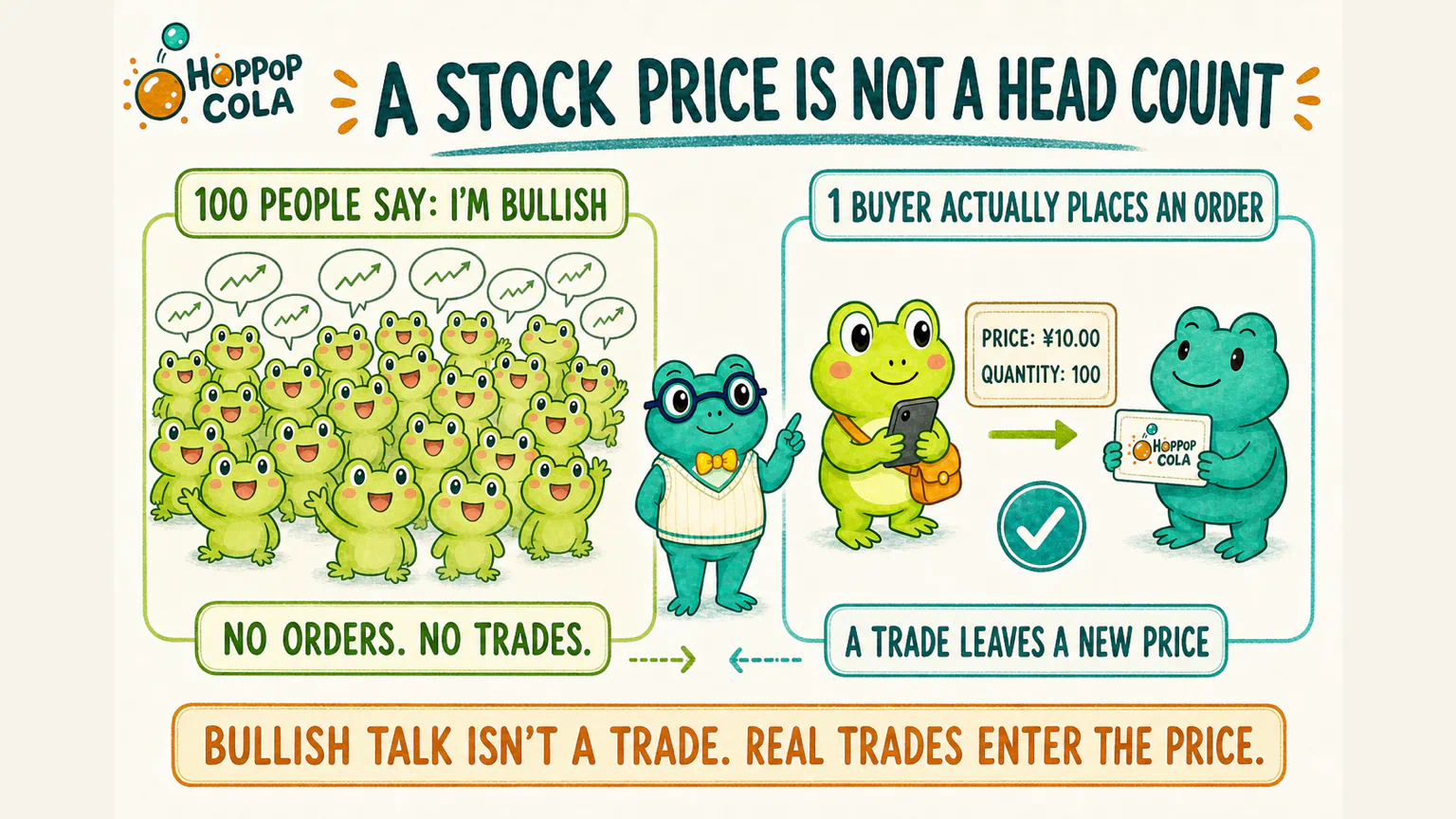
This does not mean the number of participants is always irrelevant. It means head count alone is not enough.
What reaches the market is action: who is willing to commit how much money, at what price, to buy; who is willing to offer how many shares, at what price, to sell; and whether those orders actually trade.
“Lots of people are bullish” is an unfinished sentence. Are they willing to buy? How much? At what price?
A transaction price is not the company’s medical report
Now we can separate one more pair of ideas.
A trade at ¥10.10 tells us that the two sides of that transaction accepted ¥10.10. It does not prove that HopPop Cola’s “true value” has been officially measured at ¥10.10. It does not guarantee that the next investor will agree either.
The transaction price is more like a freshly printed receipt. It faithfully records the price at which this trade happened.
It is not an appraisal certificate stamped with the company’s one true value.
HoppyQuant uses China’s A-share market as its main source of examples, which is why the lesson uses yuan. Major stock markets share the basic distinction between bids, asks, and completed trades. Their order types, matching rules, trading sessions, price limits, and displayed quote fields can differ. Always check the rules and data definitions of the market you are actually studying.
Companies, shares, and transaction prices are connected. We simply cannot jump from “the last trade happened at ¥10.10” to “the company is objectively worth exactly ¥10.10 per share.”
A stock price is not a correct answer written by the company, the exchange, or an expert. It is a record left by real buying and selling. An opinion enters a transaction price only after it becomes action with a price and quantity and results in a completed trade.
Say it in your own words
You do not need to memorize trading rules. Try answering these four questions instead:
- If a buyer will pay no more than ¥10.00 and a seller will accept no less than ¥10.20, why can we not simply call ¥10.10 the stock price?
- After a trade is completed at ¥10.10, what does that number tell us—and what does it not tell us?
- Why do 100 bullish messages in a group chat not guarantee that the price will rise?
- What is the difference between a bid, an ask, and a transaction price?
If you can explain the short chain from quote to match to trade to price, you are done with this chapter.
Hoppy looked at ¥10.10 on the screen and found one more question.
“It is still the same HopPop Cola,” he said. “Why would someone pay only ¥10 a moment ago, then become willing to pay ¥10.10?”
“Because before the price changed,” Dr. Hop said, “someone’s view of the future changed first.”
In the next chapter, we will follow the path from the real world into the stock price.
Sources
Sources checked on August 10, 2026
- Investor.gov: Stock Quotes, for its beginner explanation of bids, offers, and common quote fields;
- Investor.gov: Bid Price / Ask Price, for the basic distinction between prices buyers will pay and sellers will accept;
- Shanghai Stock Exchange Investor Education: An Introduction to STAR Market Order Rules, for A-share examples involving submitted prices, displayed prices, and executions.
This chapter intentionally omits order types, matching priority, and detailed trading rules to build only the smallest useful trading intuition. Real trades are governed by the current rules of the relevant market. This chapter is not investment advice.
Lesson discussion
Share a question, insight, or different view—and see how other learners are thinking.