Lesson 4
Choose Your Starting Point
Choose an entry point based on your market and quant foundations, and know when local practical work begins.
“All right.” Hoppy looked at the course map. “I’m in. Where do I start?”
Two entrances stood out. One began with market and quantitative foundations. The other went straight to building an AI quant lab.
Hoppy knew some Python. He had built a calculator, a few small tools, and some simple scripts. So his finger naturally moved toward the AI quant lab.
“Can I jump straight into the practical course and come back to the theory later?”
Dr. Hop did not stop him. He simply asked three questions.
“How would you turn ‘I think this stock will go up’ into a question you can check?”
“If a backtest curve goes up, what does that tell you—and what can’t it promise?”
Hoppy stared at the hands-on entrance for a few seconds, then slowly moved his finger back.
Knowing how to write a few lines of code and knowing what the code should investigate were not the same thing after all.
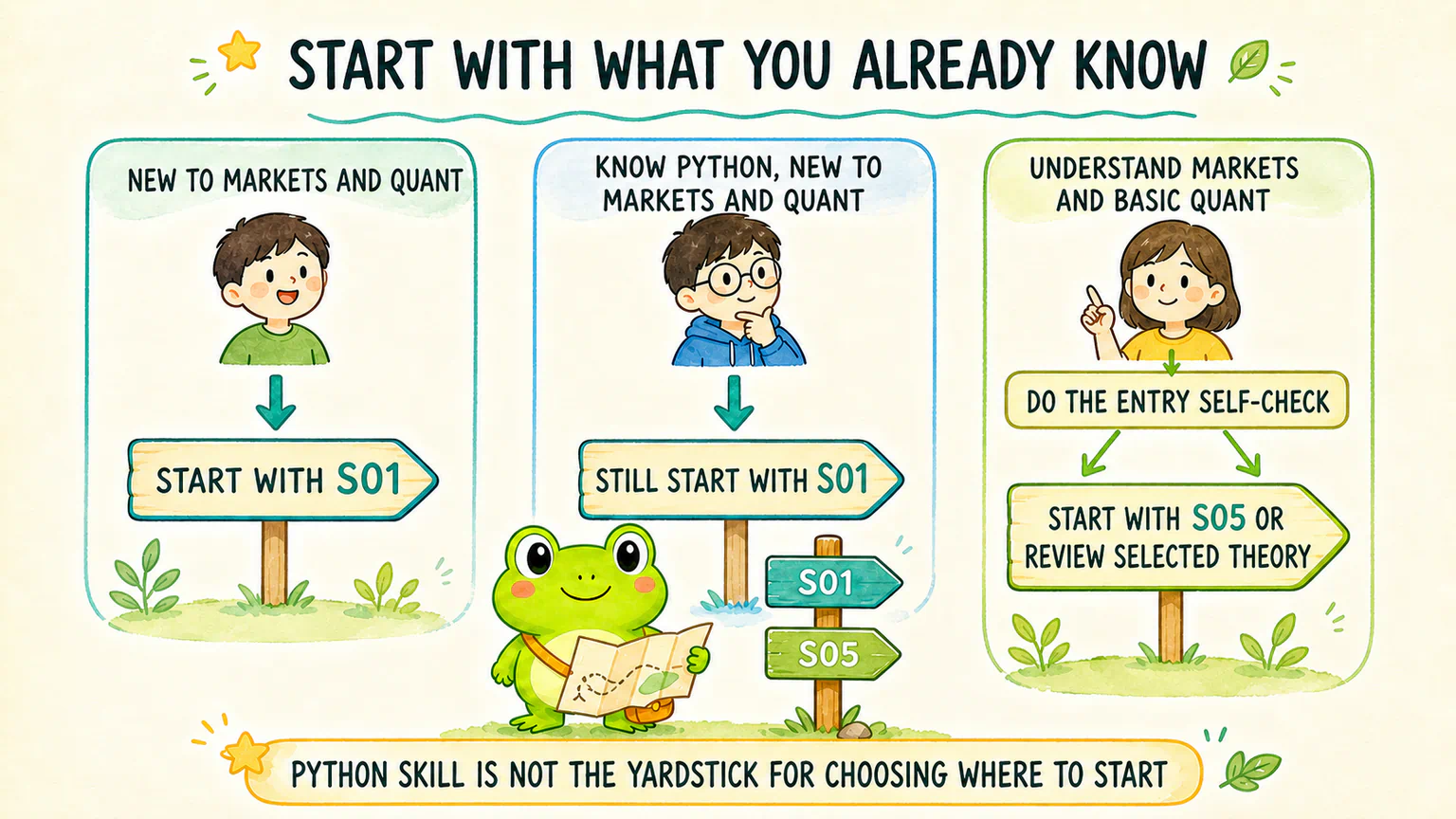
The simplest answer: most people should begin with the foundations
Choose your starting point by what you already understand about markets and quantitative research—not by how many lines of Python you have written.
Markets and quant are both new to you
Begin with the market and quantitative foundations.
You know Python, but not markets or quant
Begin with the foundations too. Your coding experience will become useful soon; it just does not need to go first.
You came from HoppyPy for a real project
Welcome. But Python exercises cannot answer what a stock is, why prices change, or how data can check a market idea.
You understand markets and basic quant concepts
Use the entry self-check, then consider entering the practical course directly or reviewing only the theory you do not know.
This does not mean everyone must sit through material they already know. It means one simple thing: Python skill is not the yardstick for choosing between the theory and practical parts of the course.
Already know some quant? Ask yourself four questions
If you already understand the stock market and some basic quantitative concepts, there is no need to repeat familiar material just to keep pace with everyone else.
Without searching, try answering these four questions in your own words:
Why do stock prices change as expectations and trading change?
How does a market intuition become a hypothesis that data can check?
Why are a signal, a trading rule, and a backtest not the same thing?
What can a historical backtest tell us, and what can’t it promise about the future?
This is not a test, and there is no score to add up.
If the questions feel familiar and you can explain them reasonably well, you can consider entering the practical course directly.
If only one or two areas feel unclear, find the relevant theory on the course map and come back. The course does not force you to choose between “repeat everything” and “skip everything.”
If all four questions feel new, begin with the foundations without worrying about being behind. Starting earlier simply reduces the chance that you will later think, “The code ran, but I have no idea what it proved.”
A starting point is not a prize or an exam result. Choose the place that lets you genuinely follow the course.
You can ask an AI assistant to help with the self-check
If you already use Codex or WorkBuddy, you can ask either one to talk through the four questions with you.
Here is an optional way to begin:
Optional conversation
I want to find out whether I am ready to begin a hands-on quantitative research project. Ask me a few short questions about my understanding of stock markets, testable hypotheses, and historical backtests. Do not give me a score, and do not judge my readiness only by whether I know Python. If my answer is vague, ask a follow-up question instead of completing the answer for me. At the end, explain in plain language whether I should first learn the foundations of markets and quantitative research, review only a few unfamiliar concepts, or begin working with data and programs on my own computer, and explain why.
The AI does not need to know anything about HoppyQuant or its course map. Its job is only to help you see what kind of preparation you still need.
Then return to our course map. If you need the foundations, begin with the theory course. If only a few concepts are missing, review the relevant material. If you are ready for hands-on research, consider going directly to the AI quant lab.
The AI’s suggestion can help you organize what you already know. It is guidance, not permission. You still choose where to begin.
If you do not use either tool yet, that is fine. You can complete the same self-check on your own. There is no reason to install anything just for this step.
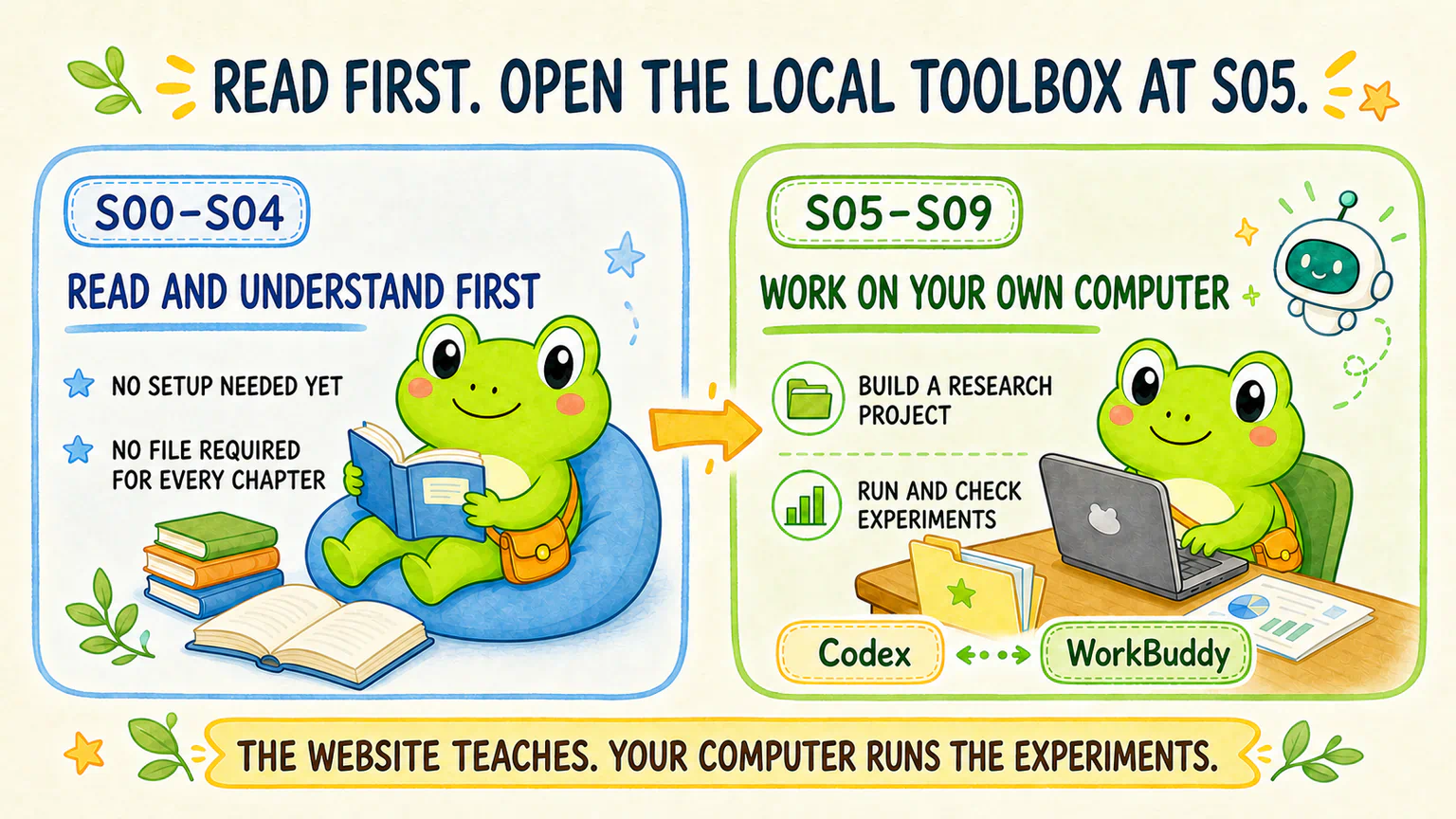
Read first; open the local toolbox when the practical work begins
The introduction and theory course are mainly about reading and understanding. You do not need to pause now and install Python, uv, and a pile of tools you do not need yet.
These parts also will not ask you to create a file after every chapter. If a question is worth thinking about, jot down a note. If there is no local task, simply keep reading.
The practical work begins when we build the AI quant lab. That is when you will create a research project on your own computer, prepare the environment and data, and start running programs.
The website does not include an online code editor, and it will not run the experiments for you. That is not meant to create extra work. Your research project needs to remain available so that you can run it again, inspect it, and keep changing it.
If you cannot use Codex, do not stop at the door
Codex is the course’s preferred tool and the one used in the default demonstrations.
If Codex is not available to you, use WorkBuddy instead. Their interfaces and exact steps may differ, and the course will not pretend otherwise.
But they have the same role here: helping us work with programs, data, and research checks. Neither tool can decide what the market evidence means on your behalf.
If you can use Codex, follow the default path. If you cannot, use WorkBuddy. Do not spend all your time comparing tools before the research has even begun.
We will deal with environment setup, the division of work between you and the AI, and checking what it actually did when we reach the AI quant lab. There is no need to sprint ahead now.
Hoppy finally placed his starting marker on “What Is the Stock Market, Really?”
Not because he could not write code, but because he had never seriously asked what the code was supposed to investigate.
His friend looked at the title. “What does this part begin with?”
Dr. Hop replied, “We’ll begin with a question that sounds almost too simple: what is a stock, really?”
His friend blinked. “We need a whole lesson for that?”
We do. Many of the questions that come later begin right there.
Lesson discussion
Share a question, insight, or different view—and see how other learners are thinking.