Lesson 2
What Will You Take Away?
Zoom out to the full course map and see the three abilities you can keep using afterward.
A friend heard that Hoppy was about to work through an entire course on quantitative research and asked a very practical question:
“So after all that, what will you actually know how to do?”
Hoppy opened his mouth, then paused.
Write Python? That made the course sound much smaller than it was.
Know which stock would go up next? That answer was much bigger than any course could honestly promise.
As for reciting every course-unit title, his friend would probably be checking his phone by the third one.
To give a useful answer, Hoppy needed to unfold the whole course map and see where the journey was actually going.
First, zoom out
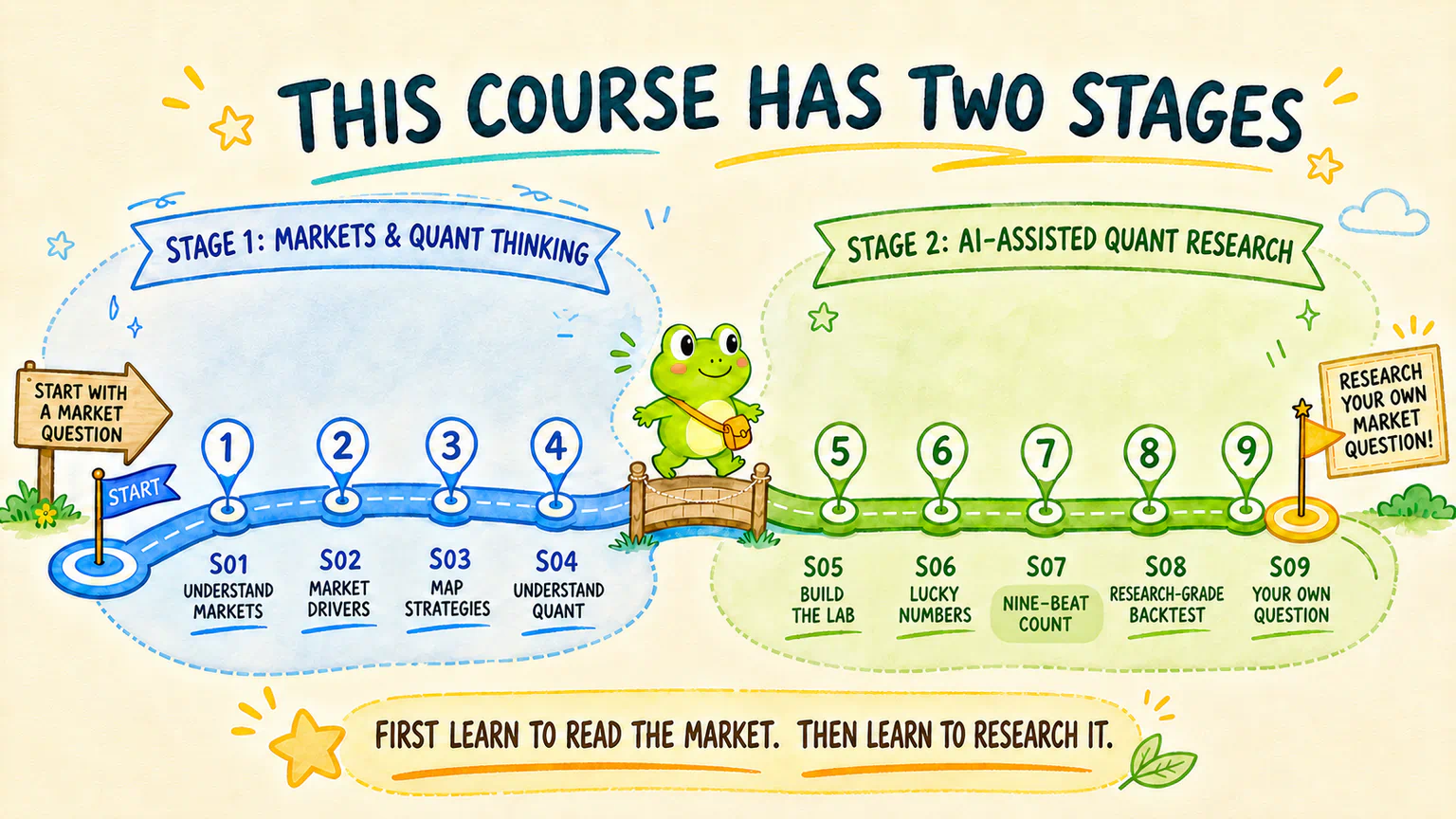
HoppyQuant has two parts.
Part One is the theory course: Understanding Markets and Quantitative Thinking.
Part Two is the practical course: Researching Markets with an AI Assistant.
This is not a case of “sit through some theory, then go play with code.” The first part helps us understand what we are studying. The second part lets us take a real question and investigate it for ourselves.
We could jump straight into a program, download some data, calculate returns, and draw a chart. But the moment the chart appeared, we would run into harder questions. Why did we calculate it this way? What does the result actually tell us? Did we discover a pattern—or accidentally manufacture one?
So the direction of the course is simple: first learn how to look at the market, then learn how to research it.
Part One: Understand what you are studying
The theory course will not ask you to memorize a financial encyclopedia. Instead, it works through four basic questions.
What Is the Stock Market, Really?
Why do people trade stocks, and why do prices keep changing? We begin with expectations and trading so that we know what kind of market we are looking at.
What Moves the Stock Market?
Companies, industries, news, the economy, and market sentiment can all affect prices. We learn where each kind of influence fits.
A Three-Dimensional Map of Investment Strategies
Where does a strategy expect its advantage to come from? How long should that advantage take to appear? How does the strategy try to find it? These three questions give us a map for comparing very different approaches.
What Does ‘Quant’ Actually Mean?
How does a market intuition become a hypothesis? How does a fuzzy claim become something we can calculate? What can data answer—and what can’t it answer? This is where quantitative thinking properly enters the story.
By the end of this part, you will not suddenly understand everything happening in the market.
But when you come across an industry story, a technical indicator, or another confident “I think this will go up,” you will have a better sense of what kind of claim you are hearing—and what is still missing from it.
That is the first thing you take away: a market map. It will not show every street, but it will be good enough to help you find your bearings.
Part Two: Research a question for real
With that map in hand, we move into the hands-on research part of the course.
This part does not stop at copying a few lines of code from a webpage and admiring the output. The research happens on your own computer, with an AI research assistant, Python, and market data all working together.
Build Your Own AI Quant Lab
We prepare the local environment, project, and basic data that the rest of our research will need.
Do Stocks Care About Lucky Numbers?
Our first experiment begins with a playful question from the Chinese market: do stocks with auspicious numbers in their names tend to perform better? We turn an odd hunch into something we can actually test.
Does Price Really Rebound After a Nine-Beat Count?
Our second case is closer to a familiar technical signal. We keep practicing how to define a question, find suitable data, and make sense of the result.
From a Weak Pattern to a Research-Grade Backtest
A small difference in the data is not enough. We go on to examine entry and exit rules, timing, costs, and the many ways a promising result can be misleading.
Research Your Own Market Intuition
At the end, the course’s practice questions step aside. You bring in a market idea that genuinely interests you and take it through the full research process.
The point is not to see how much code an AI can produce. The point is to learn how to work with it: let it help with programs and data, then ask it to inspect the files, results, and research definitions with you.
By this stage, you should have more than a folder full of screenshots. You should have a research project that can be run again, changed, and checked when you come back to it later.
What you really take away
Put the two parts together, and HoppyQuant aims to leave you with three things.
A better understanding of what you are studying
When you face prices, news, industry trends, and investment opinions, you do not need to pretend you understand everything. But you should be better able to tell where a question belongs.
The ability to turn an intuition into a question that can be checked
You will start asking: How long is “more likely to rise”? What should we compare it with? What data would we need? What kind of result would actually support the original idea?
The ability to complete a real research cycle with AI and programs
You do not need to memorize every line of Python. You do need to know what you asked the AI to do, where the result came from, and which parts you still should not trust too quickly.
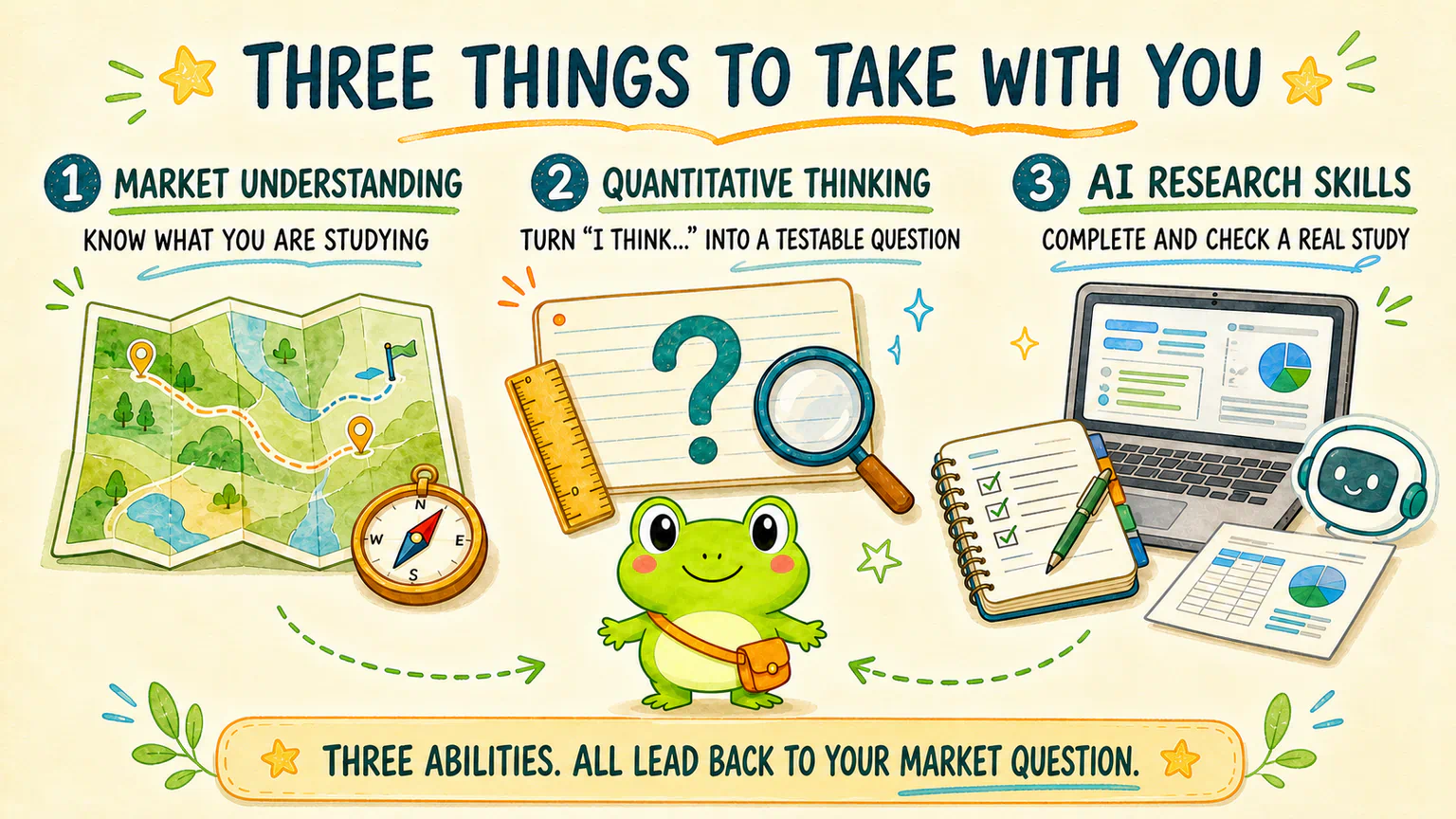
First, you will learn how to look at markets. Then, you will learn how to research them. What you take away is an AI-assisted quantitative research process you can keep using.
Hoppy’s friend nodded, then asked one more question:
“So after all that, will this course help you make money?”
Hoppy looked over the course map again. It mentioned markets, questions, data, testing, and backtests. Nowhere did it say “guaranteed profits.”
That was not a printing error.
In the next chapter, we will talk honestly about why a quantitative course can teach you how to research the market without promising that the market will pay you for it.
Lesson discussion
Share a question, insight, or different view—and see how other learners are thinking.