Lesson 3
This Is Not a Get-Rich-Quick Course
Separate research skill and historical results from future profits, and accept the three answers evidence may provide.
Hoppy’s friend was not ready to let the last question go.
“So after finishing the course, can you actually make money?”
He pointed to the words “research-grade backtest” on the course map.
“If you run a backtest and the line keeps going up, doesn’t that prove the method can make money?”
Hoppy thought for a moment, then drew a line climbing from the bottom left of a sheet of paper to the top right.
His friend’s eyes lit up. “Yes. Exactly like that!”
Dr. Hop picked up a marker and drew a vertical line at the right edge of the chart. He wrote “Past” on the left. The space on the right stayed blank.
“That blank space is the problem,” he said. “Every beautiful result you can see is on the left. Any money you invest will have to face the part we haven’t drawn yet.”
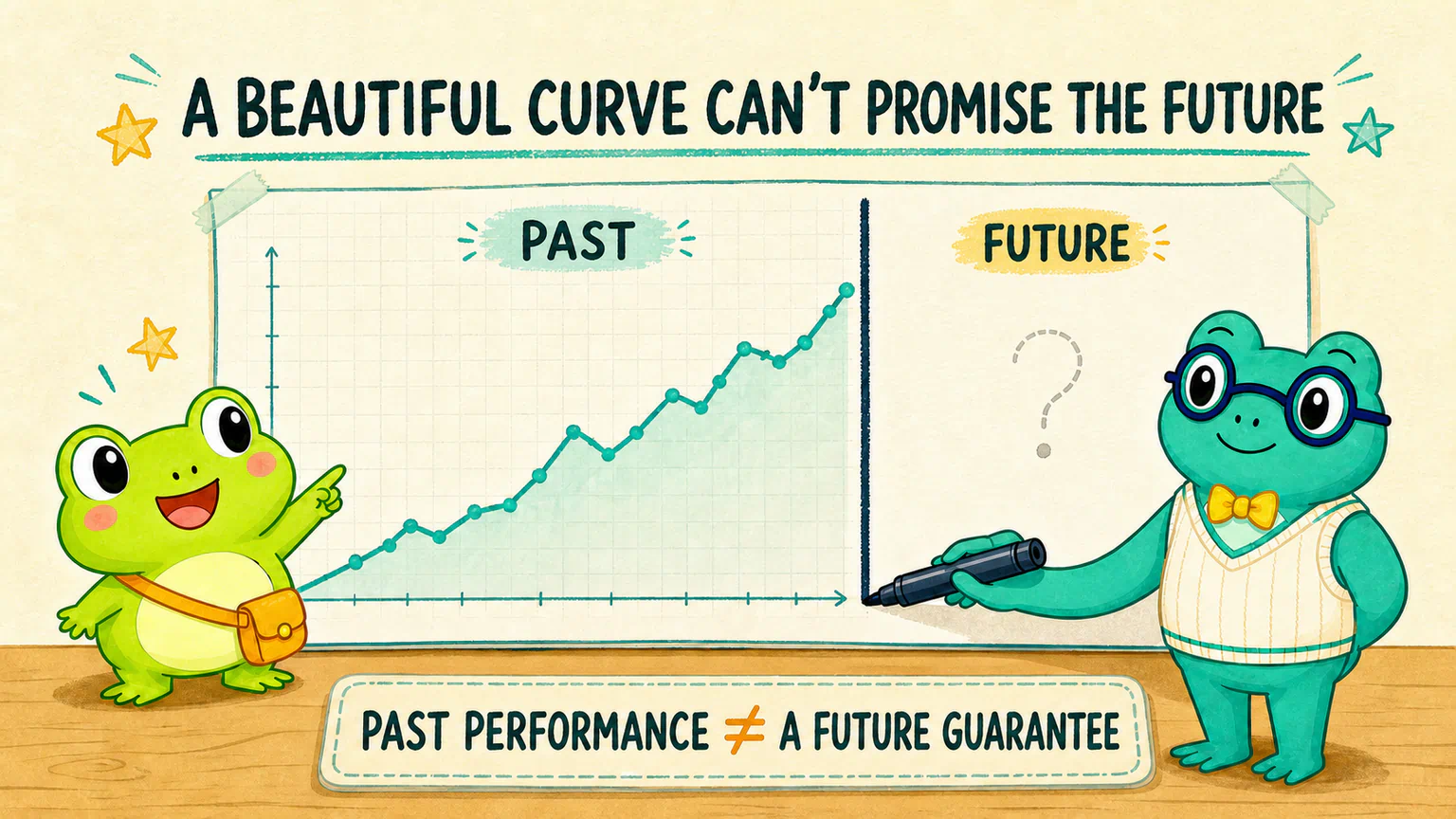
A beautiful curve cannot promise the future
You do not need to learn how to build a backtest yet. For now, one plain-language definition is enough: a backtest uses historical data to check how a set of rules would have performed in the past.
That is useful.
If historical data does not support an idea at all, we have a good reason to stop and investigate. If the idea looks promising, we can keep testing whether the result was a fluke and whether it still holds under slightly different conditions or time periods.
But there is no automatic bridge from “it worked in the past” to “it will make money in the future.”
Markets change. The people trading in them change. Our data and rules may also contain problems. Even after we check these things carefully, the future does not owe us a repeat of the past.
That is the first reason HoppyQuant cannot promise that you will make money: a course can control what it teaches, but it cannot control what the market does tomorrow.
There is no guaranteed-profit formula hidden at the end
Sometimes “we cannot promise profits” sounds like a line people are required to say before giving you a knowing wink.
There is no wink here.
The course’s final research project will not hand you a magical rule to copy. The course cannot guarantee that everyone will discover a method that keeps making money over time. An AI research assistant can help us write programs, organize data, and inspect experiments, but it cannot manufacture correct market answers in bulk.
What we can practice is different: how to state an idea clearly, find suitable data, check the result, and resist the urge to force a conclusion when the evidence is not there.
That may sound less exciting than “discover the secret to wealth,” but it is much closer to what research can honestly do.
Research does not have to end with “I was right”
Remember our question from the Chinese market about whether stocks with auspicious numbers in their names tend to perform better?
When we eventually study it, the research may end in one of three ways.
Current evidence supports the idea
Under the definitions and data range we chose in advance, the lucky-number stocks show a meaningful difference.
Current evidence does not support the idea
We do not see the advantage we expected, or the result points in the opposite direction.
There is not enough evidence
Too few stocks qualify, some data is missing, or the result falls apart when we make a small, reasonable change. We cannot reach a reliable conclusion yet.
These are not “pass,” “fail,” and “unfinished homework.” They are all possible research outcomes.
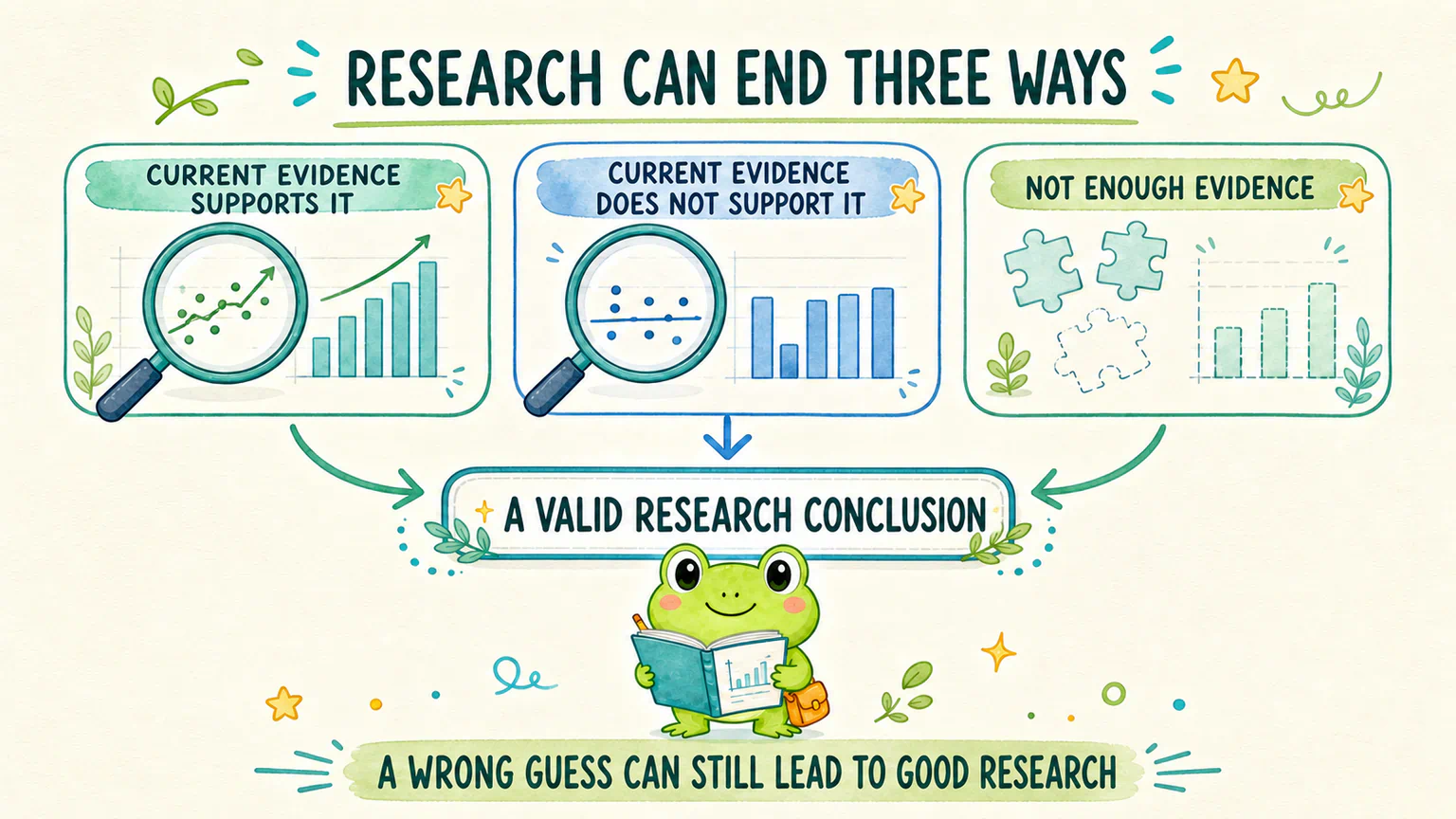
The word “current” matters too. A research conclusion comes from a particular set of data, definitions, and dates. Saying where the conclusion holds is more honest than pretending we have found an answer that will remain true forever.
A wrong guess can still lead to good research
Suppose the data does not support the lucky-number idea.
Hoppy has not found a profitable pattern. But he has learned that the original hunch does not currently have enough evidence behind it. It does not deserve real money just because it sounds plausible.
That is not wasted effort.
Ruling out a weak idea, finding a question the available data cannot answer, or discovering that the original question was too vague can all protect us from believing a bad answer too confidently.
The job of research is not to prove that your first guess was right. It is to find out whether you actually have evidence.
The guess may have failed. The research did not.
A research result is not a trading instruction
There is one final boundary that is not a joke.
The stock examples and backtest results in this course are here to teach research methods. Even when historical data supports a result, that does not mean you should buy or sell any particular stock. Real investing can lose money and involves conditions and risks that this course does not attempt to cover.
HoppyQuant teaches you how to investigate and judge a market question. It does not make real investment decisions for you.
Hoppy’s friend thought for a moment.
“So the course doesn’t give me an answer?”
Hoppy shook his head.
“It does—just not a preprinted one. We will learn how to work toward an answer we can defend. And when the evidence is not there, we will learn not to invent one.”
His friend looked back at the course map. “All right. Where should I start?”
That is exactly what the next chapter will help us decide.
Lesson discussion
Share a question, insight, or different view—and see how other learners are thinking.