Lesson 4
The Program Says You Can Buy. Can You Really?
Use position size, diversification, liquidity, and execution limits to see why a backtest trade may not be practical in the real world.
Hoppy reopened the account that had started with 100 units.
“If I used one million yuan instead, would the gains or losses just scale up?”
Dr. Hop pointed to the trade records.
“The program can make the numbers bigger. But when you want to buy, will anyone be selling that many shares at that price?”
Hoppy looked at the entry price in the table.
“There's a price right here. Doesn't that mean I can buy?”
Not necessarily. In the previous lesson, we asked how much we could trust the historical results. Now there's another question: could the trades that work in the program actually happen that way?
Those 100 units were a convenient scale for comparing results—not 100 yuan. They didn't establish how much real money these rules could accommodate, either.
To answer Hoppy's question, let's start with how the money is allocated.
Not just what to buy, but how much
Our earlier account held shares in only one company at a time. A trade had to end and release the money before the account could look for the next one.
That made it easy to see how money gets tied up, and kept the experiment understandable. But it was only one possible arrangement.
When the same entry signal appears, we could also ask: how much should this trade use? Should some money stay in cash? What if we already hold another stock?
These questions bring us to position sizing and management. In plain language: how much of the account is exposed to an investment's ups and downs, and how do we manage that amount?
Without borrowing, putting only part of the money into a stock will generally give its price changes a smaller effect on the whole account than putting all available money into it. The trade-off is straightforward, too: if the stock rises, the money left out won't benefit from that gain.
So position size isn't a “smaller is always better” or “bigger is always better” setting. It changes the account's experience.
“What if I spread the money across several companies? Would that make it safe?” asks Hoppy.
Don't start by counting names.
Suppose you pick several companies that depend on the same kind of product. If demand for that product falls, they could all be affected. Different names don't necessarily mean different sources of risk.
Spreading money across investments to reduce dependence on one holding or source of risk is the idea behind diversification. The question is why those investments might rise or fall together—not just how long the list is. Diversification doesn't guarantee against losses. Investor.gov: Asset allocation and diversification
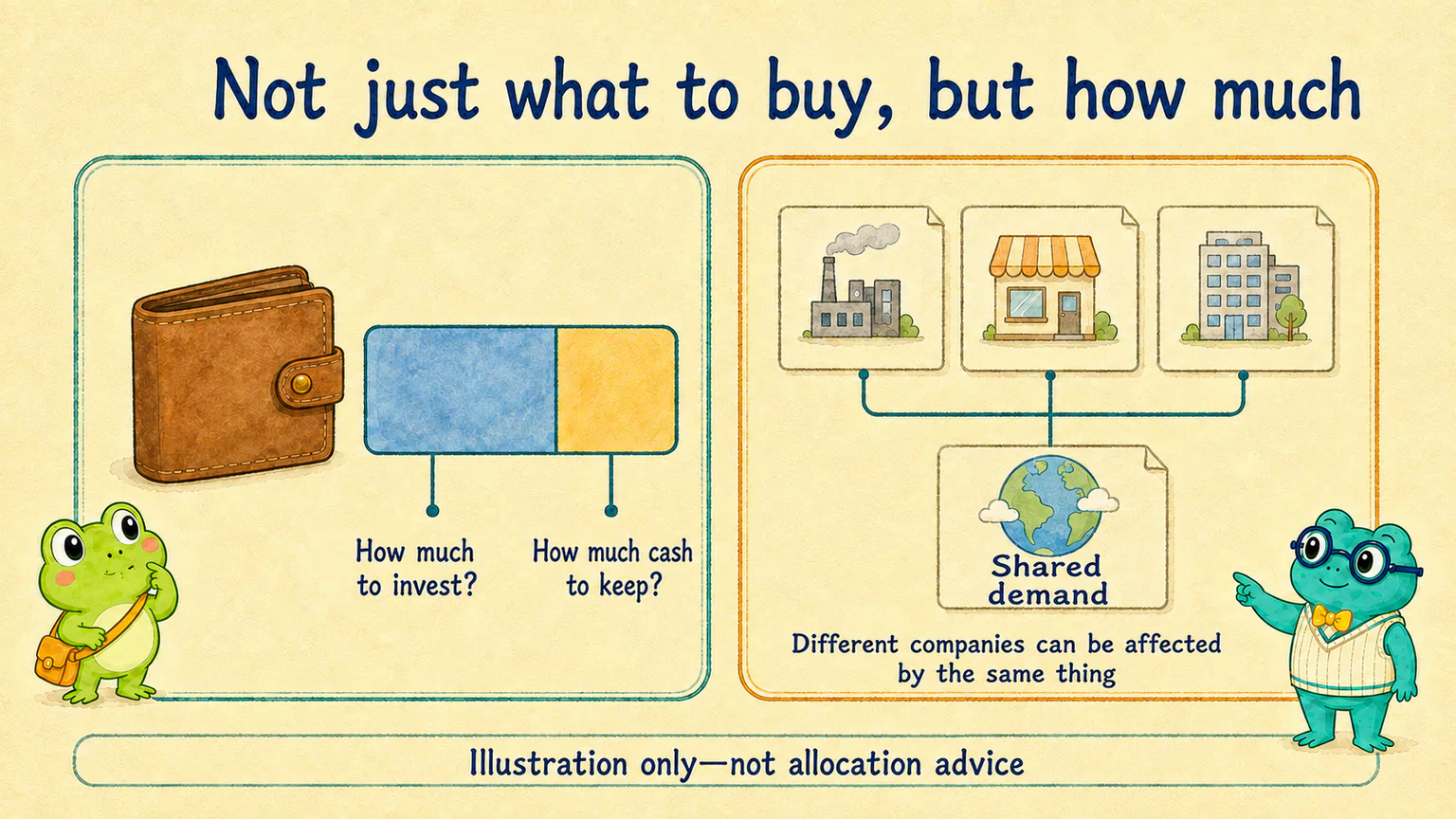
This lesson won't decide how much cash you should keep or turn our earlier experiment into a complicated allocation system. For now, recognize the distinction: the same trading rules can produce different account results when the money is allocated differently.
A price doesn't mean unlimited shares
Now let's return to the entry price Hoppy was staring at.
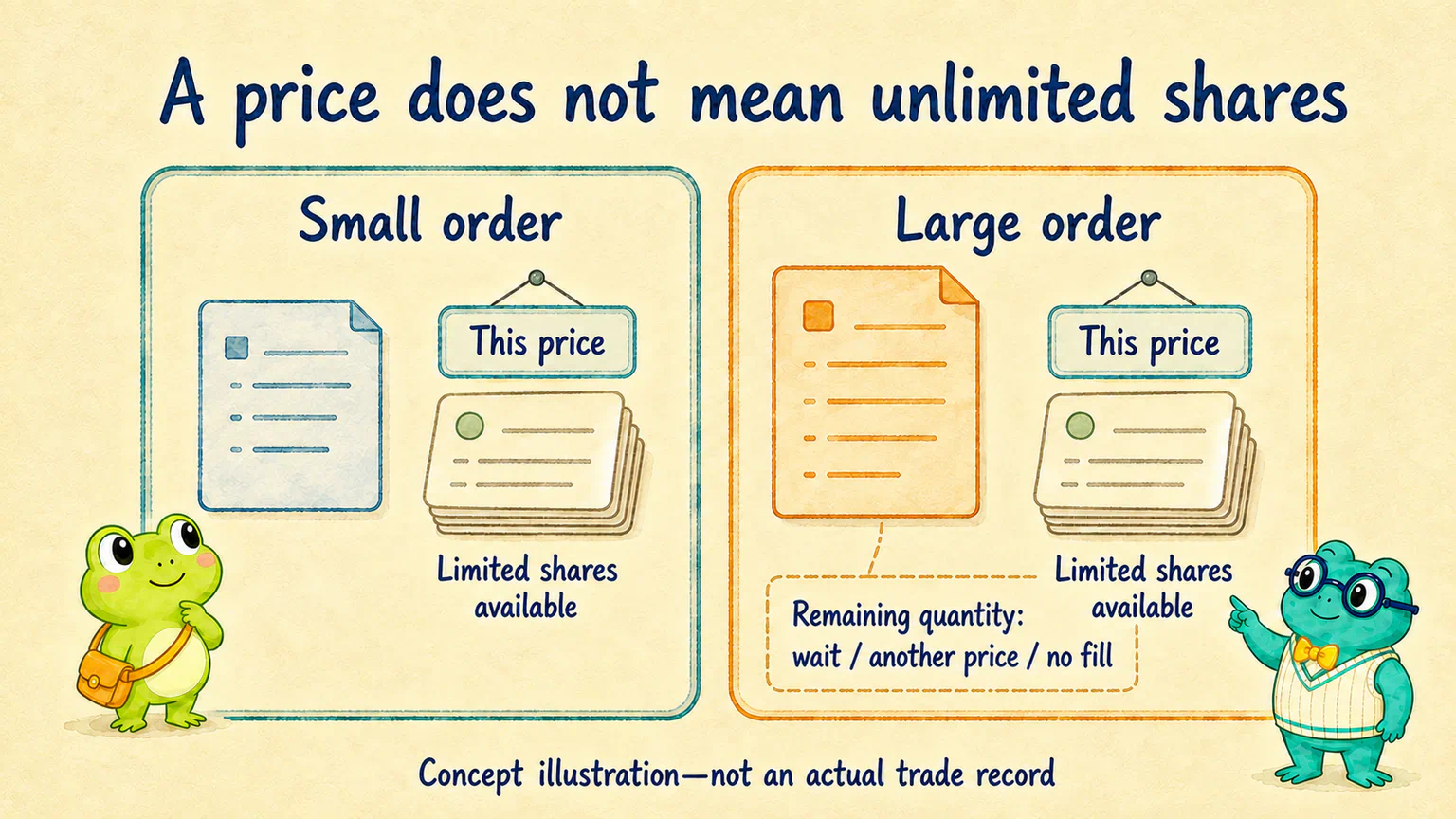
Imagine a simple situation: at a particular moment, only a small batch of shares is available for sale at that price.
A small buy order might fit. A large one wouldn't. The remainder might have to wait, might be bought at a higher price, or might not trade at all.
The same applies when selling. Wanting to sell at a certain price doesn't mean someone is willing to buy your entire quantity at that price. A displayed quote covers a limited quantity, and it can change before an order is executed. Investor.gov: Displayed prices and trade execution
That brings us to liquidity: how readily we can buy or sell without substantially affecting the price. Investor.gov: Liquidity
You don't need to memorize the term right away. Just remember that a price table isn't a promise of “as many shares as you want at this price.”
Keep increasing the amount of money, and you run into the question of strategy capacity: given the quantities the market can accommodate and the costs of trading, how much capital could this approach handle without materially changing its performance?
You can't read that limit off a return figure. What you trade, how long you hold it, and how much you try to trade at once all matter.
We've already included fees and slippage, and that helps. But one fixed slippage assumption doesn't automatically establish that orders of every size can trade that way.
“So I can't just change the starting balance.”
Exactly. More money can also mean more shares waiting to trade—and a different cost of getting the trade done.
The program says “filled.” What made it assume that?
Order size isn't the only constraint. When researching a market, we also need to check the trading rules that applied at the time, whether the stock was available to trade, and whether the information behind the signal was already available.
We don't need to cover all of that today. The important habit is to look at a simulated trade and ask what conditions the program used to decide that it could happen.
Our daily data alone cannot reconstruct the complete quotes, order queues, and actual execution of our own order at a particular moment. We can't ask AI to fill those gaps with guesses and then present them as verified facts.
Was the earlier backtest still useful?
Hoppy scrolls back through his research notes.
“The more I learn, the more unanswered questions I find. Was all that earlier work for nothing?”
No.
We observed how an approach behaved under stated rules and conditions. Discovering more real-world conditions to examine helps us understand where that answer stops. It doesn't erase the work.
For example, holding one company at a time helped us see money being tied up in a position. Adding fees showed us how costs affect the result. Those insights don't disappear just because we haven't studied every detail of actual execution.
A backtest gives a result under a set of conditions. Understanding those conditions tells us which questions the result can answer—and which it cannot.
The companies and data in this course are fictional teaching material, not a basis for real investment decisions. Reaching this point doesn't mean we're one account connection away from live trading.
But you can now ask more specific questions than “Will this strategy make money?”
If one of these topics interests you, you could ask Codex or WorkBuddy:
Check execution assumptions with AI
Start by reading my existing research records. What conditions does the program assume when it treats a trade as executable? Which are simplifications, and which still lack supporting data? Explain first; don't modify the original experiment.
You don't need to address everything immediately. Understand one question that matters to you, then decide whether to research it further.
Until next time
Hoppy saves his research notes and opens a new document.
This time, he doesn't write, “Find me a way to make money.”
He writes, “I have a hunch. Can we talk about how to test it?”
Dr. Hop leans over to look.
“What hunch?”
“That one's for next time.”
And that's where we'll leave this course for now.
You don't have to begin another experiment today, or master every new term from these last few lessons. It's fine to close the laptop and take a break.
The next time something in the market catches your curiosity, we hope you'll go beyond “I think…” and ask, “How could we check?”
You don't have to figure out every line of code or every error on your own. AI can help you try things out. What to investigate, whether the evidence is enough, and when to stop are still questions worth thinking through yourself.
Thank you for coming this far with Hoppy and Dr. Hop.
Stay curious. Until next time.
Lesson discussion
Share a question, insight, or different view—and see how other learners are thinking.